Information in Matter
Resonant Nanophotonics

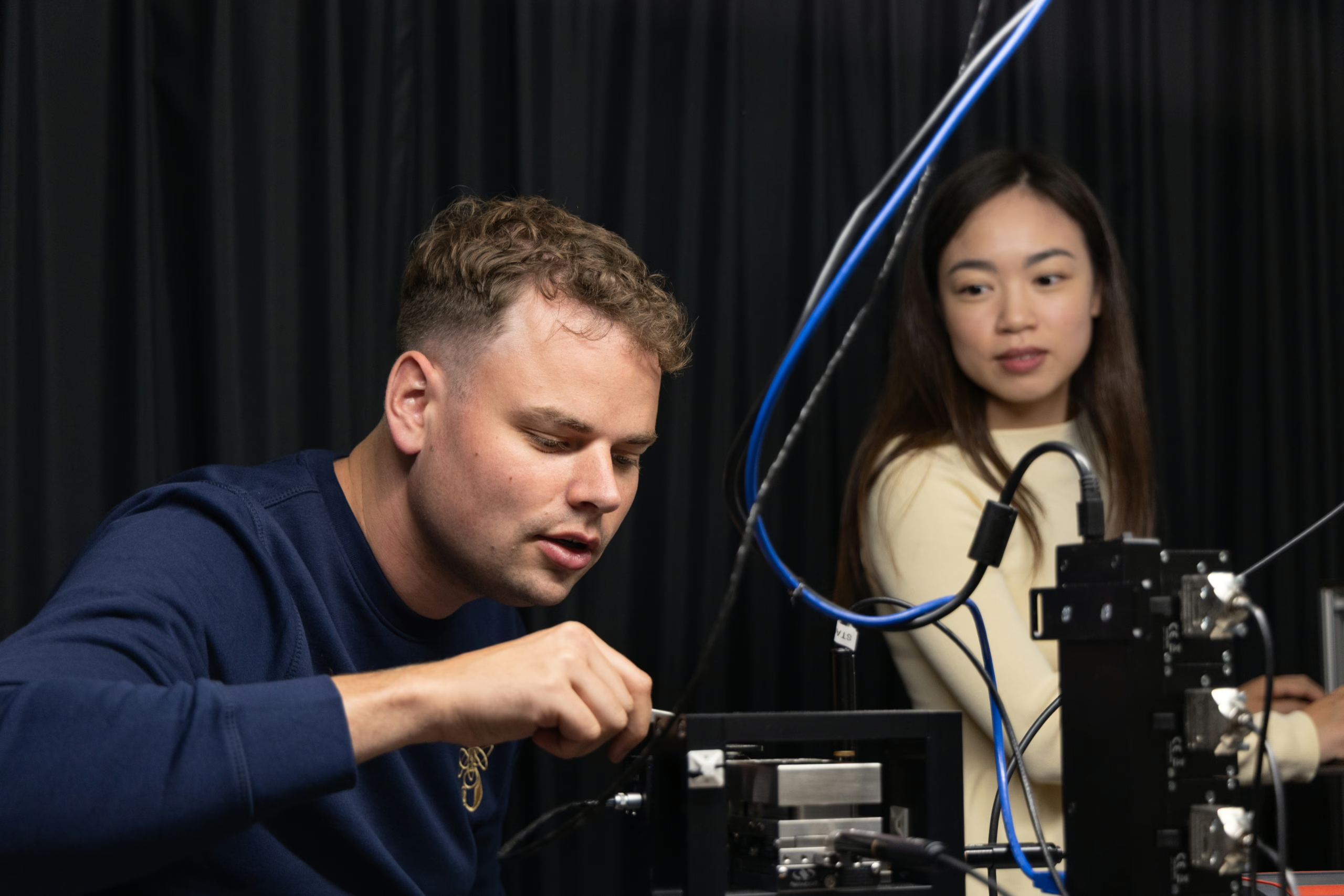
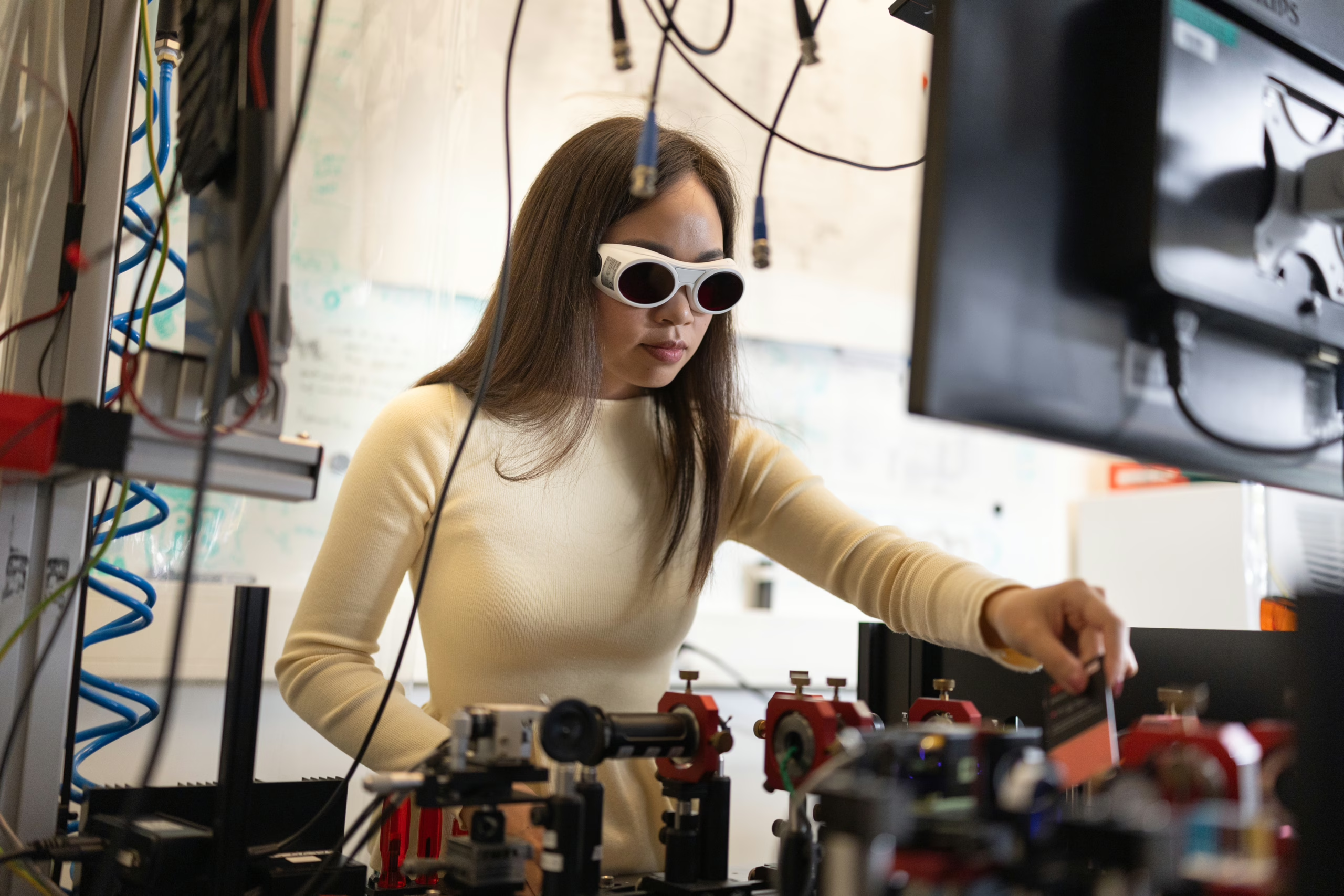
The Resonant Nanophotonics team at AMOLF studies tiny structures that control how light interacts with matter on the smallest scales. Researchers design nanostructures to improve quantum light sources and to enable more precise measurements and microscopy. Also, they develop energy-efficient technologies for wave-based processing of information.
Research focus
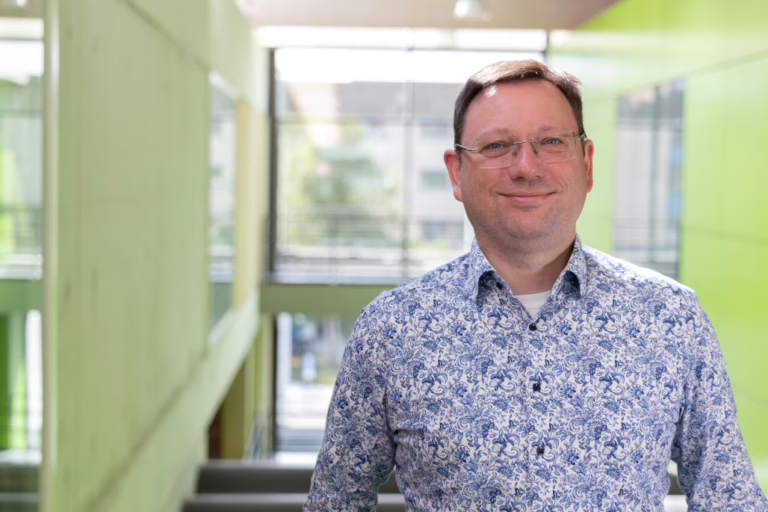
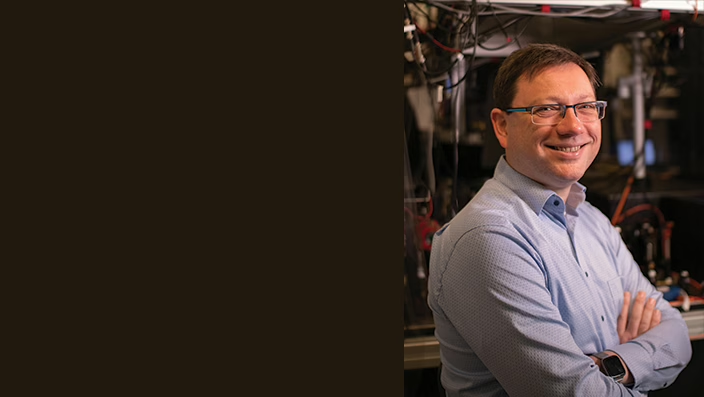
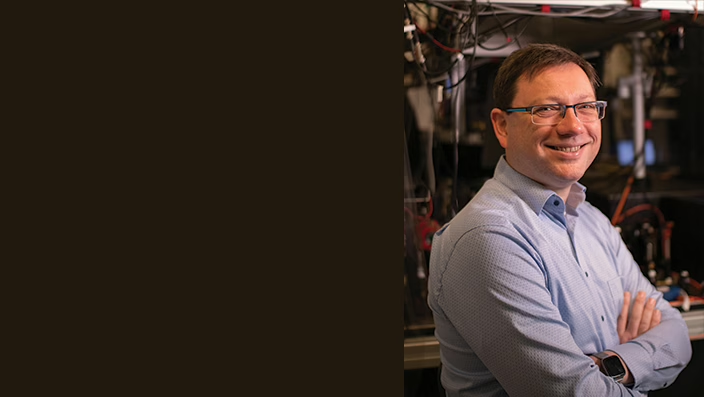
The Resonant Nanophotonics group creates ultrasmall, engineered structures that can control light in powerful ways. Inspired by advanced materials and the way light interacts with metals and dielectrics at the nanoscale (plasmonics and metasurfaces), these structures can boost, absorb, and redirect light for applications like better sensors, lighting, and imaging. Group leader Femius Koenderink about the three research domains in his group.
We design ultrasmall light-emitting surfaces and hybrid systems that control brightness, direction, and polarization, enabling brighter LEDs, quantum light sources, and ultrasmall, efficient nanolasers.
In partnership with ARCNL, we do research that is relevant to semiconductor metrology.
We study engineered surfaces, called metasurfaces, that can process information with waves, performing calculations and inference, while exploring ways to reconfigure and control them quickly.
Our research has potential impact on solid-state lighting, quantum technologies, microscopy and precision measurements, and energy-efficient information processing. We build advanced optical setups and work closely with theorists, material scientists, and industry partners.
Elementary emitters of photons, like molecules, quantum dots and color centers, are by themselves deeply subwavelength in size. As consequence individual quantum emitter are not very bright, and their emission is not very directional. In applications like LEDs where many emitters are distributed in an extended device, a main challenge is to make emission brighter, more efficient and directional. A rich playground to enhance emission and impart spatial coherence is through diffractive metasurfaces
The invention of the blue light-emitting diodes (LEDs) enabled the solid-state lighting (SSL) revolution. SSL typically achieves white light via phosphor-based down-conversion, where blue or UV LEDs excite phosphors that re-emit at longer wavelengths. In remote phosphor systems, nanophotonic metasurfaces leverage waveguide local density of optical states (LDOS) to induce spatial coherence and direct spontaneous emission into specific modes, which are then outcoupled via engineered periodic arrays.
In projects with Philips, Signify and Lumileds we have worked on these strategies, and on translating them to devices like compact phosphor-converted (pc) micro-LEDs for high brightness displays. Another exciting new direction is on the interface of chirality and light-matter interaction. How do you control the local density of states for chiral fluorescent transitions, and how do you transfer polarization (and phase) properties at will to ensembles of emitters? Circularly polarized emission is important, for instance, for 3D display technology.
How much information about the nanoscale geometry of an object can you retrieve from its diffraction pattern? This question is relevant in metrology – for instance, the semiconductor lithography industry uses diffraction measurements on bespoke scattering targets that are placed on the wafer in between actual devices to measure the accuracy of lithography in terms of feature size, alignment, andsoforth. This raises the question how you can optimally use a finite footprint for a maximally informative scattering target, what the best illumination wavefront is, and what features in a diffraction pattern are optimal for reading out geometrical perturbations.
We tackle these questions in the AMOLF-ARCNL collaborative research program with Lyuba Amitonova, Peter Kraus, and Arie den Boef, and in industry co-funded projects. We take inspiration from the fields of resonant metasurfaces for design, wavefront shaping for illumination, and from the concept of Fisher information to measure information content. We explore metasurface motifs for metrology. For instance, in one recent experiment we show that Pancharatnam-Berry phase metasurfaces can transduce nanoscale alignment information in background free polarimetric signatures.
In other experiments we focus on the use of Fano resonances and Bound States in the Continuum. We combine Fourier microscopy to measure diffraction patterns of sub-wavelength sized scattering targets, wavefront shaping with spatial light modulators to program the incident wave, and information theory to design maximum information illuminations, read outs and targets. Beyond linear scattering we also study metasurfaces as nonlinear light generation devices for metrology, and do theory hand in hand with experiments.
The field of metasurfaces seeks to implement analog mathematical operations, as well as tasks like inference directly by light diffraction. We perform research on the information processing capacity of metasurfaces, as well as seeking strategies to reconfigure and rapidly modulate metasurface based processing.
Light-based interpretation of the environment is ubiquitous in many applications, from imaging, augmented and virtual reality, to automotive (e.g., LIDAR), and diagnostics (e.g., handheld spectroscopy, sensing and microscopy). Light encodes information in many degrees of freedom – aside from the ~ 106 DOFs in a typical 2D image, this also includes spectral, polarization, phase, and 3D depth-degrees of freedom.
A main bottleneck in “edge” applications is that conversion of light to electronics for processing, classification is energy-inefficient: the optical data sets are large, and computing tasks such as classification and inference are highly CPU intensive. Electronics-based solutions hence either require to deal with large energy consumption locally, or when outsourcing the computing to datacenters, cause large data traffic.
In this spirit we imagine that future energy-efficient computing strategies should be hybrid (e.g., hybrid photonic-electronic), and should avoid unnecessary DOF-conversion. Thus, we envision that large optical datasets should be (pre)processed and compressed as much as possible with light-based technologies, leaving the conversion to integrated circuits and electronics to the last.
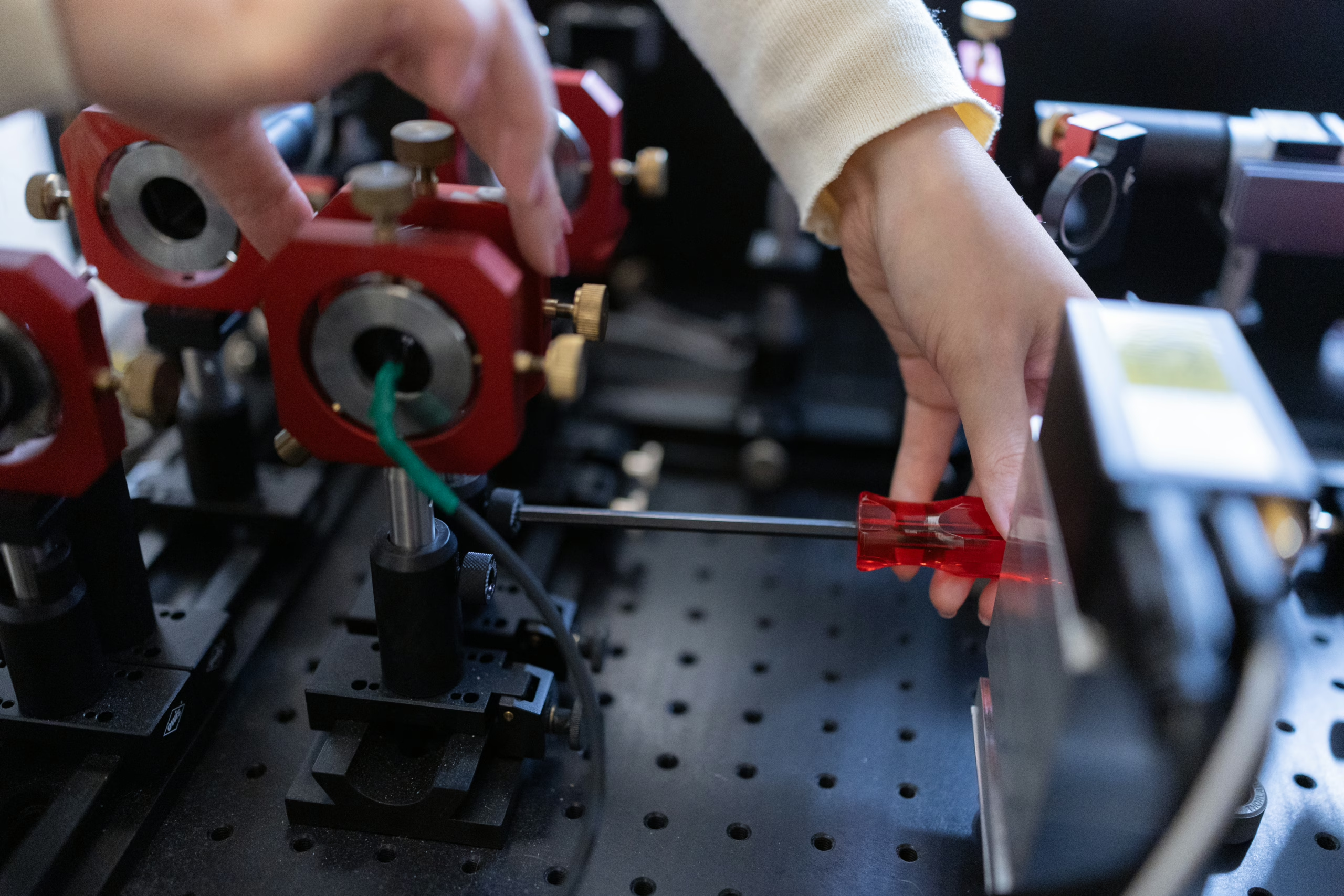
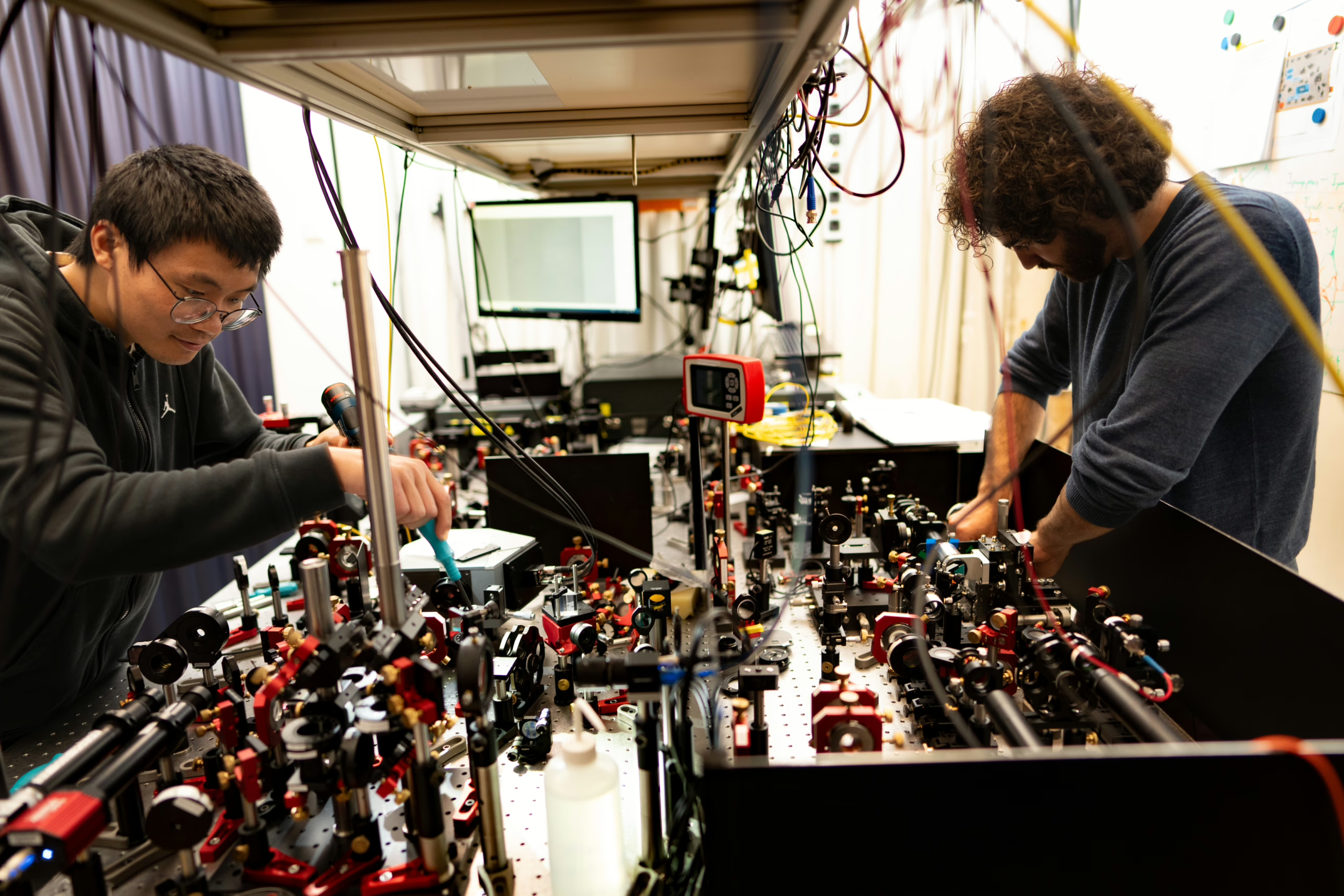
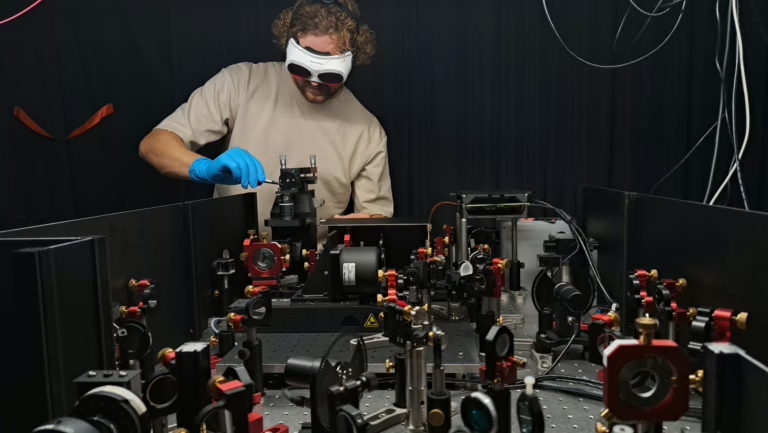
The Resonant Nanophotonics group develops state of the art methods in nanoscopy, single molecule microscopy, k-space scatterometry, ultrafast laser spectroscopy, near-field manipulation and nanofabrication. Feel free to reach out if you are interested to collaborate on basis of our infrastructure.
- Supercontinuum scatterometry (NKT SuperK Extreme, any wavelength from 450 to 2000 nm), transmission, reflection and dark field
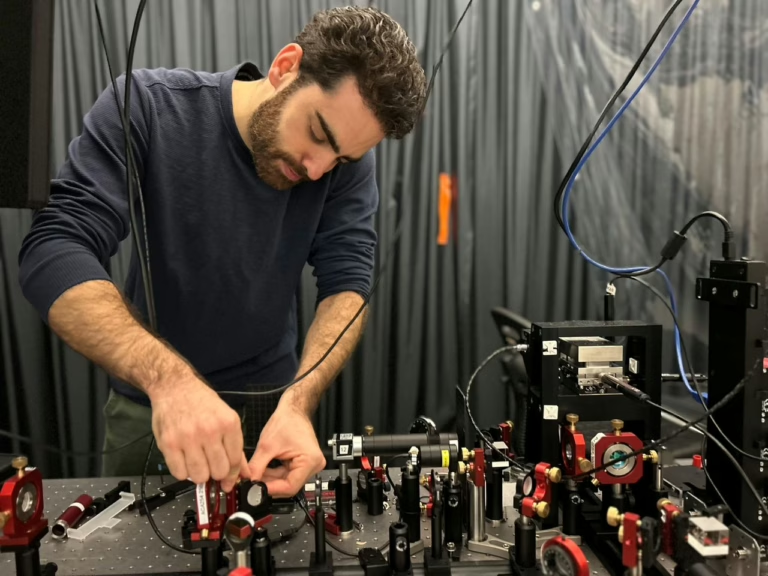
- Back-focal plane or `Fourier’ microscopy: mapping of single nano-antenna radiation patterns and differential scattering cross sections with sub-degree resolution, over large angular ranges (NA=1.4) from visible to NIR . Integrated with an SLM for wavefront shaped addessing, and with digital off axis holography for phase resolution.
- Single-molecule microscopy, including spectroscopy, time-correlated single photon counting for fluorescence lifetime and g(2)-antibunching, and fluorescence correlation spectroscopy, applicable to room-temperature emitters in the visible
- Montana cryostat for low-temperature (down to 3K) single emitter microscopy
- Twin-OPA system (LightConversion Orpheus F) delivering down to 30 fs pulses from 650 to 900 nm, and from 1100 to 2000 nm, feeding into ultrafast pulse interferometry, and designed for pump-probe microscopy experiments
- Narrowband cw spectroscopy near 780 nm for interrogating high Q cavity systems, integrated with a set up to measure through integrated waveguides, approached tapered fibers, or through near- and far-field addressing in a microscope






Resonant Nanophotonics Latest news

Most recent publications
Research group alumni
Below you will find an overview of alumni of AMOLF’s Resonant Nanophotonics group, in chronological order.
PhD students
- Ivana Sersic (2012, Brabantse Ontwikkelings Maatschappij)
- Martin Frimmer (2012, ETH Zürich)
- Andrej Kwadin (2014, Heinekamp)
- Felipe Bernal Arango (2014, QED Technologies)
- Abbas Mohtashami (2015, TNO Optics)
- Lutz Langguth (2015, Quantum Technologies GmbH)
- Hinke Schokker (2016, UMCG)
- Michel Cotrufo (2017, Rochester University)
- Freek Ruesink (2017, Boston Consulting Group)
- Ke (Cocoa) Guo (2018, NCT Dresden)
- Hugo Doeleman (2019, ETH, TNO)
- Kevin Cognée (2019, TNO)
- Annemarie Berkhout (2020, Dutch National Bank)
- Ruslan Röhrich (2020, Zeiss)
- Chia-Ching Huang (2021, Onto Innovation)
- Robin Buijs (2021, ASML)
- Isabelle Palstra (2021, head AMOLF cleanroom)
- Nelson de Gaay Fortman (2025, TNO Optics)
- Debapriya Pal (2025, CUNY, US)
- Nick Feldman (2025, Sparrow Quantum, Danmark)
- Falco Bijloo (2025, Cosine BV)
Postdoctoral fellows
- Clara Osorio (2016, TNO-Optics)
- Per Lunnemann Hansen (2012, DFDS Data Science)
- Sachin Kasture (2018, IMEC)
- Radoslaw Kolkowski (2021, Aalto Univ)
- Tom Wolterink (2021, Rostock Univ)
- Ilan Shlesinger (2022,Univ Paris Cité, CNRS)
- Zihao Lu (2025, Great Bay University, China)
Interns
- Jeroen Jacobs (2009)
- Christelle Tuambilangana (2010)
- Anouk de Hoogh (2010)
- Bob Hommersom (2010)
- Marie-Anne van der Haar (2011)
- Freddy Rabouw (2011)
- Janika van Moergestel (2013)
- Hugo Doeleman (2013)
- Bart Vos (2013)
- Floor van Riggelen (2015)
- Mengqi Du (2015)
- Alessandro Antoncecchi (2015)
- Remmert Muller (2015)
- Wouter den Hollander (2016)
- Chris Hoekmeijer (2017)
- Noor Veenhoven (2017)
- Sylvianne Roscam Abbing (2018)
- Ilse Wenniger (2018)
- Thomas Esselink (2019)
- Tomas Kaandorp (2019)
- Beniamino Ferrando (2020)
- Stefanos Kovaios (2020)
- Kian Goeloe (2023)
- Boris van der Ham (2024)
- Masha Ogienko (2024)
- Georg Krause (2024)
- Joris Pals (2024)
- Louis Veerkamp (2025)
Guests
- Yuntian Chen (2013, Huazhong Univ, China)
- Andrea Alù (2015, CUNY, US)
- Francesco Monticone (2015, Cornell, US)
- Dimitrious Sounas (2015 & 2026, Wayne State Univ, US)
- Yakir Hadad (2015, Tel Aviv univ & UT Austin, US)
- Randall Goldsmith (2020, Wisconsin-Madison, US)
- Imran Avci (2023-2025, Vrije Universiteit Amsterdam)
- Radoslaw Kolkowski (2024, Aalto Univ,. Finland)
- Pasquale Falcone (2025, Univ. of Campania, Italy)