Research highlights

New measurement technology to further sensing capabilities

The research teams of Femius Koenderink and Lyuba Amitonova (ARCNL) investigated new optical detection strategies to efficiently measure perturbations at the nanometer scale. For their experiments they used metasurfaces, which are artificial surfaces configured with carefully shaped nanoparticles that interact with light. Inspiration for the project came from a collaboration of AMOLF, ARCNL and industry partner ASML, focused on finding new ways to monitor potential errors that might arise during computer chip fabrication. The researchers published their findings in the journal Nature Communications on December 10.

Direction of light

Metasurface sensors are often used to sense disturbances in an environment, such as dangerous gases or specific molecules. Commonly they are read out by measuring how a disturbance affects the way in which different colors of light scatter off the metasurface. Instead, the new aspect of this work is that the researchers investigated how a disturbance influences the direction of the light scattering off the resonant sensor.

The researchers show that this new approach is more informative than the widespread spectroscopic (or ‘color-only’) approach of shining light onto the sensor and capturing the scattered light with a spectrometer.  First author Nick Feldman: “We encoded intentional nanoscale errors into a resonant metasurface by slightly displacing nanoparticles in a controlled way, which mimics the errors typically encountered in chip fabrication. Our goal was then to develop a measurement which could precisely detect these displacements, and to quantify how much displacement information this measurement provides.”

Two techniques
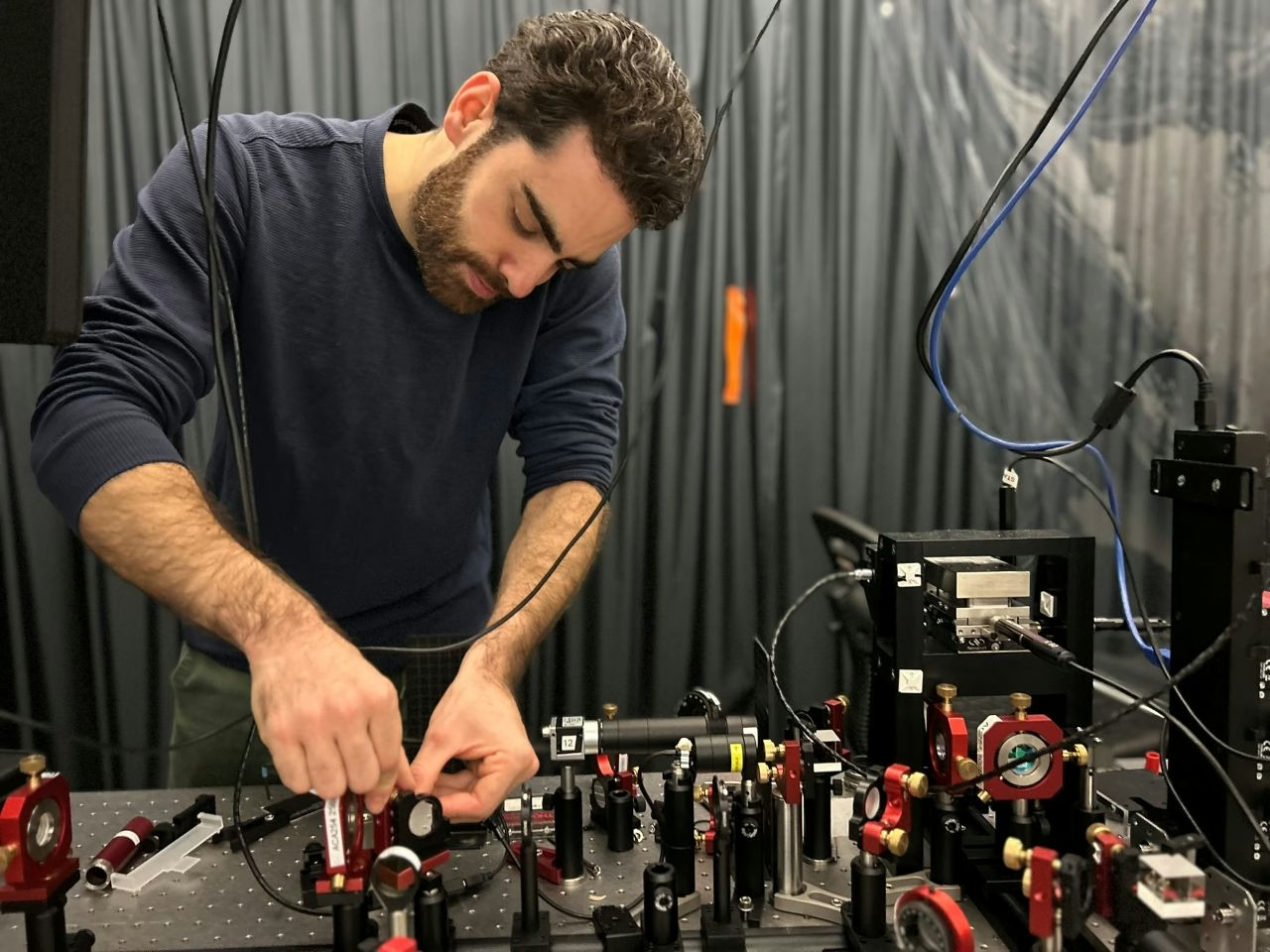
Nick Feldman in the lab

Nick and his colleagues investigated two different detection strategies to most efficiently measure a specific perturbation imprinted onto the metasurface. The first technique is called ‘scattering spectroscopy’: it tells the researchers what the dominant colors are in a scattered signal. A resonant metasurface sensor typically shows only one specific dominant color in the scattered signal (imagine a rainbow with a very bright red ring only), which is very sensitive to disturbances.

The second technique is called ‘Fourier scatterometry’, which shows how light scatters into different directions. By using Fourier scatterometry in combination with a resonant metasurface, new pathways in which a perturbation can be translated into a detected signal can be unlocked. The main finding is that almost an order of magnitude in precision can be gained with Fourier scatterometry compared to spectroscopy, while using the same number of photons to do the measurement.

AMOLF group leader Femius Koenderink is enthusiastic about the findings. He says: “The work is relevant because it shows that perturbations in combination with carefully engineered metasurface resonances can drastically change the direction in which light is scattered off a sensor. This feature provides more information than previously available about relevant disturbances. This may inspire the sensing community to optimize their detection strategies and use this insight in their own sensing experiments.”

Learn more

If you have questions about this research, please contact Femius Koenderink (f.koenderink@amolf.nl).

This paper was published in Nature Communications: Information advantage in sensing revealed by Fano-resonant Fourier scatterometry

Read full paper on Nature Communications.

 

Share article
What's happening

Most recent news items

All news items
Collaboration

Successful outcomes of international EBEAM program led by AMOLF

The EU Pathfinder project Electron Beams Enhancing Analytical Microscopy (EBEAM) that was recently completed has received a highly positive review of the European Innovation Council (EIC). EBEAM brought together eight European research institutions and companies, including AMOLF, that develop new concepts and instruments combining spectroscopic analysis with electron microscopy.

Read news item
Research highlights

Everything you need to know about organoids

Organoids are instrumental in improving our understanding of processes that are otherwise hidden inside the body. For instance, these small 3D organs can be used to test medicines on tissue grown from a patient’s own cells. AMOLF researchers carry out unique and complex experiments to follow organoids in time. In order to enable other researchers to benefit from their experiences, they now publish their methods in the prestigious journal Nature Protocols.

Read news item
Events and outreach

Minister Rianne Letschert wears hat and shoulder ornament inspired by Wim Noorduin’s research

This year at the opening of the parliamentary year (Prinsjesdag) Minister of Education, Culture and Science Rianne Letschert wears a spectacular hat and shoulder ornament. Both of them are inspired by the microscopic structures studied by group leader Wim Noorduin (AMOLF/UvA), which look remarkably like tiny flowers under a microscope. Artist and designer Malou Beemer translated these shapes, normally invisible to the naked eye, into wearable art.

Read news item
Nachi Stern, Group Leader Learning Machines at AMOLF
People and recognition

Nachi Stern awarded ERC Starting Grant to explore how matter learns

Why do brains learn, but rocks do not? Could a material one day adapt to its environment the way a living organism does? AMOLF group leader Dr. Nachi Stern has been awarded an ERC Starting Grant to investigate the physical laws of learning, in a project called, “Physical Learning in Dynamical Systems.”

Read news item
Stay informed

Get the latest research highlights, events, and news from our institute delivered to your inbox