People and recognition

Four PhD candidates close their AMOLF chapter

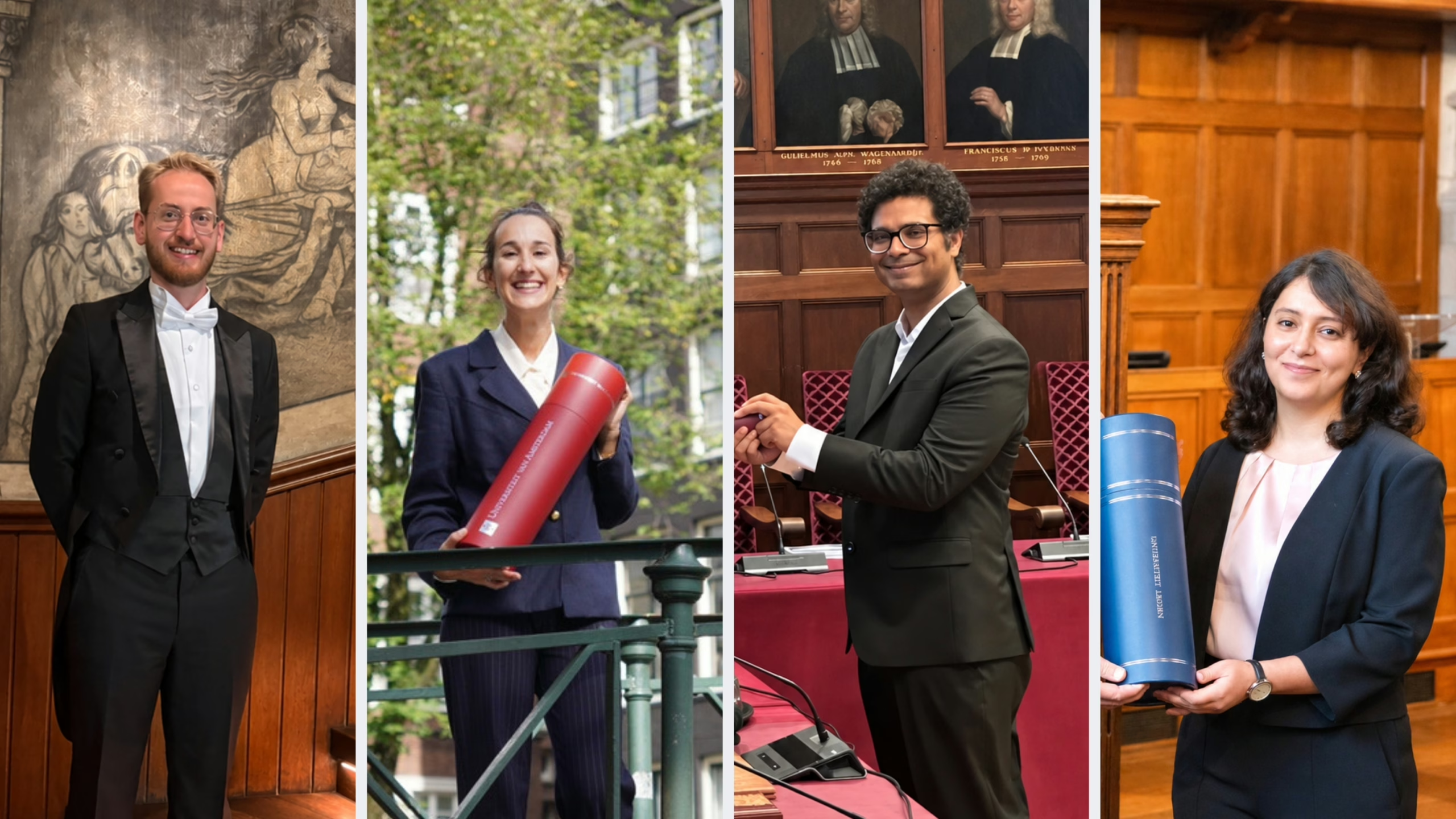
Congratulations to the new doctors: Colin Meulblok (Mechanical Metamaterials), Francesca Scalerandi (Hybrid Nanosystems), Vashist Gangigude Ramesh (Interacting Photons), and Parisa Omidvar (Hypersmart Matter).

Collage of four AMOLF researchers celebrating their PhD graduations: Colin Meulblok, Francesca Scalerandi, Vashist Gangigude Ramesh, and Parisa Omidvar.
Left to right: Colin Meulblok, Francesca Scalerandi, Vashist Gangigude Ramesh and Parisa Omidvar

Colin Meulblok

Colin studied materials with unusual properties, including the ability to perform computations in the material without using an external energy source. These materials are able to do so because of the way they are designed, rather than because of their molecular composition.

One example of the materials Colin worked with is a collection of rubber beams that can snap either left or right. Colin: “We call these ‘material bits’ because they can exist in two stable states, similar to the 0s and 1s used in digital computers.”

Colin did his doctoral research in the Mechanical Metamaterials group led by Martin van Hecke. He divided his work between AMOLF and Leiden University. “Having the flexibility to take full advantage of the different research sites was really nice. Enjoying the best of two worlds.”

Read the thesis


Francesca Scalerandi

Francesca studied hybrid plasmonic nanosystems in the Hybrid Nanosystems group led by Wiebke Albrecht. Her research focused on understanding how the shape and structure of extremely small gold-based particles influence the way they interact with light. Using advanced electron microscopy and light, she studied individual nanoparticles and developed methods to examine, change, and control their structure.

Francesca’s findings help us understand how light interacts with materials at the nanoscale. This knowledge is relevant to technologies that use light to drive chemical reactions or convert solar energy.

Read the thesis


Vashist Gangigude Ramesh

Vashist’s thesis is called “Random walks of light in optical resonators” and covers the randomness of light. Vashist: “When you make things smaller, you will see that the smaller constituents constantly vibrate and move quite a bit. This also happens with light.”

Vashist points out that randomness is always present in nature. “The smaller you make the light trap, the more significant this randomness becomes. We call it noise.”

This randomness is not just a result of imperfections or external influences. It is a fundamental property of light. Interestingly, similar patterns of randomness can be found in very different systems, such as the stock market.

Vashist did his doctoral research in the Interacting Photons group led by Said Rodriguez.

Read the thesis

Parisa Omidvar

In her thesis, Parisa explores whether materials can store and process information through deformation.

She explains: “Imagine holding a piece of paper vertically between your hands and slowly bringing the two ends closer together. At a certain point, the paper buckles either to the left or to the right. We can use these two shapes to represent the binary states 0 and 1, just like the bits in a computer.

“Now imagine connecting many of these elements so that they can interact. By carefully designing and controlling their interactions, we can move information through the material and perform logical operations. In a way, the material itself becomes a computer!”

Parisa did her doctoral research in the Hypersmart Matter group led by Marc Serra Garcia.
Read the thesis

    Share article
    What's happening

    Most recent news items

    All news items
    Joining forces to study perovskite interfaces
    People and recognition

    Joining forces to study perovskite interfaces

    AMOLF group leaders Professor Wiebke Albrecht and Professor Bruno Ehrler have received an NWO ENW-M2 grant for their joint research project, The Dynamic Atomic Interface between Halide Perovskites and Metals. The insights gained will pave the way for sustainable, high-performance solar energy and information technology. Wiebke and Bruno will each hire a PhD student for this project. The grant amounts to €800.000.

    Read news item
    Wim Noorduin and Arian van Asten presenting their scientific journey
    People and recognition

    Wim Noorduin and Arian van Asten presenting their scientific journey

    On October 8, Professor Wim Noorduin and his collaborator Professor Arian van Asten (University of Amsterdam) presented their scientific journey in a video to the audience at the ‘Avond van Wetenschap en Maatschappij’. They did so alongside the other nominees for the Huibregtsen Prize.

    Read news item
    Natural phenomena ‘hyperuniform disorder’ enables highly efficient, thin silicon solar cells
    Research highlights

    Natural phenomena ‘hyperuniform disorder’ enables highly efficient, thin silicon solar cells

    Silicon solar panels are rigid and heavy, and many rooftops cannot support them. This creates a need for thin, flexible solar cells that can be integrated into building materials. However, making silicon solar cells thinner makes it harder to trap light inside the material. Researchers in the 3D Photovoltaics group found a fascinating way to overcome this challenge using a phenomenon called hyperuniform disorder. They publish their findings in the journal ACS Photonics.

    The researchers were able to make highly efficient silicon solar cell materials that are 30 times thinner than conventional ones. They managed to do this by integrating a layer of nanometer sized structures on top of the material. Up close, this pattern looks random, but it is remarkably when you step back: no clumps, no gaps, and no repeating pattern. This is called hyperuniform disorder (or HUD).

    Read news item
    Off Road grant for a better understanding of intestinal cells that communicate with the immune system
    People and recognition

    Off Road grant for a better understanding of intestinal cells that communicate with the immune system

    AMOLF postdoc Dr. Susanna Eli received an Off Road grant from ZonMw to investigate cells known as M cells in the gut lining that connect the intestine to the immune system. Understanding how M cells develop could ultimately contribute to better treatments for intestinal and immune-related diseases. The grant amounts to 100,000 euros.

    Read news item
    Stay informed

    Get the latest research highlights, events, and news from our institute delivered to your inbox