People and recognition

Joining forces to study perovskite interfaces

AMOLF group leaders Professor Wiebke Albrecht and Professor Bruno Ehrler have received an NWO ENW-M2 grant for their joint research project, The Dynamic Atomic Interface between Halide Perovskites and Metals. The insights gained will pave the way for sustainable, high-performance solar energy and information technology. Wiebke and Bruno will each hire a PhD student for this project. The grant amounts to €800.000.

Halide perovskites are promising materials for solar cells, LEDs, and brain-inspired computers. Their performance is determined by the ‘living’ interfaces they form with metals, which can change under the influence of light and voltage.


Complementary expertise

The M2 grant provides funding for two PhD student projects that bring together complementary expertise. The Hybrid Nanosystems group, led by Wiebke, operates the light-coupled TEM, a microscope that can image materials atom by atom while shining light on them and applying a voltage. The PhD student in this group will use this microscope to study gold–perovskite nanostructures under illumination.

In the Hybrid Solar Cells group, led by Bruno, a second PhD student will build small device-like structures, including electronic components that can remember information by changing their electrical resistance. These are called memristors, a name combining the words ‘memory’ and ‘resistor’. Memristors are promising building blocks for brain-inspired computers because they can mimic certain properties of synapses, the connections between neurons.

Since the nanostructures studied in Wiebke’s group are the key to the function of the memristors, both groups combine their expertise to understand these dynamic materials.

Both observation and understanding

When asked about their complementary expertise, Wiebke says: “Using our unique microscope, I will make visible what otherwise stays hidden. Bruno will bring expertise in how these materials behave in real devices.”

The contacts between perovskites and metals are crucial for the performance of electronic devices. These are known to change during operation, but it is unclear where or how these changes begin. Together, Wiebke and Bruno will be able to follow the entire process: from moving atoms to working devices.
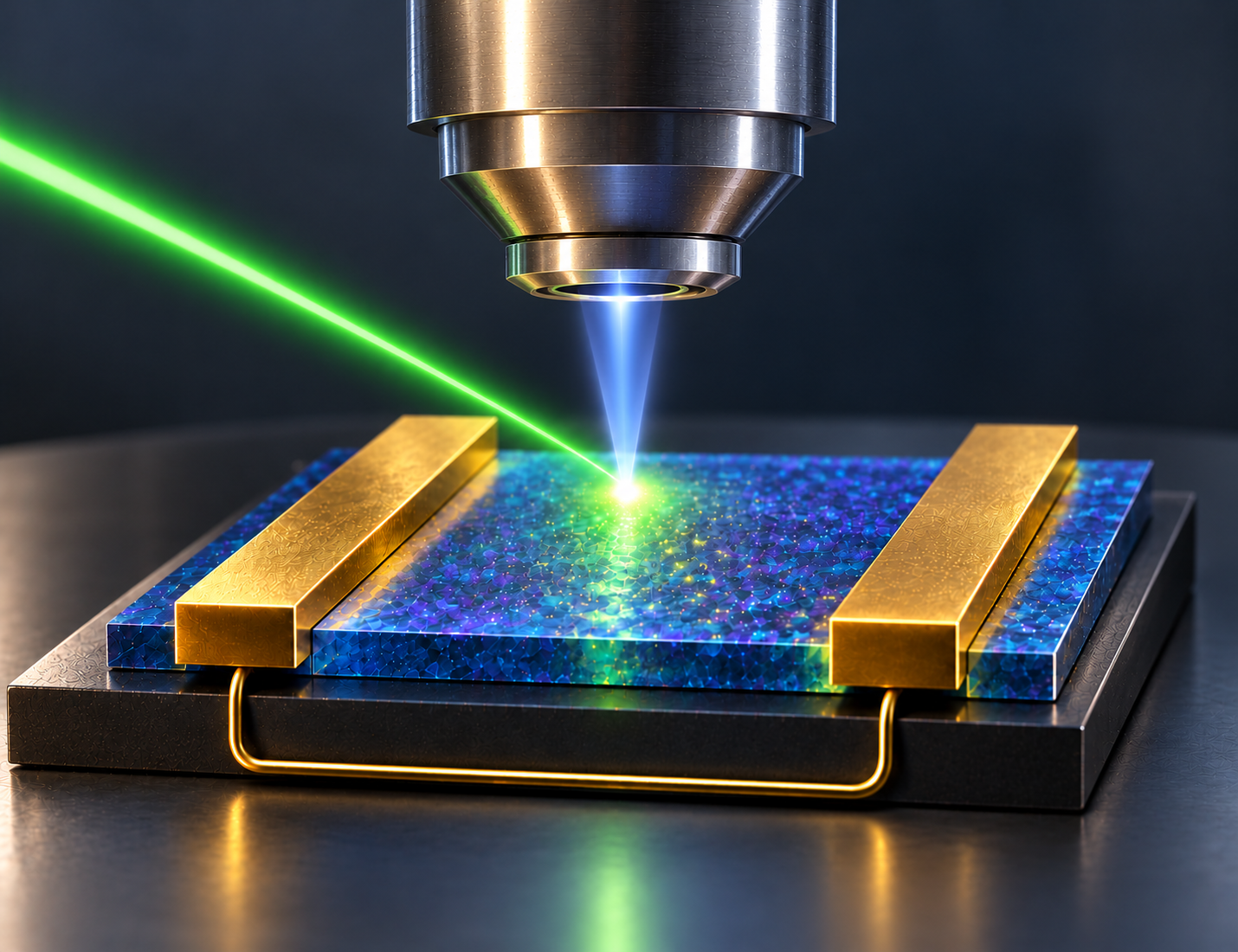

Illustration of the project The Dynamic Atomic Interface between Halide Perovskites and Metals. Researchers study the atomic motions at the interface between a metal and a perovskite semiconductor using light (green beam coming from the left) and the transmission electron microscope (tip descending from top to bottom). A voltage can be applied between the metal contacts (gold colored). AI-generated image.
The atomic motions at the interface between a metal and a perovskite semiconductor using light (green beam coming from the left) and the transmission electron microscope (tip descending from top to bottom). A voltage can be applied between the metal contacts (gold colored).

“Perovskites are almost alive: their atoms move as soon as you shine light on them or apply a voltage. With our microscope, we will watch this happen at the contact with a metal, atom by atom.”

Wiebke Albrecht

Learn more

Share article
What's happening

Most recent news items

All news items
Wim Noorduin and Arian van Asten presenting their scientific journey
People and recognition

Wim Noorduin and Arian van Asten presenting their scientific journey

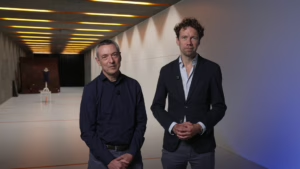
On October 8, Professor Wim Noorduin and his collaborator Professor Arian van Asten (University of Amsterdam) presented their scientific journey in a video to the audience at the ‘Avond van Wetenschap en Maatschappij’. They did so alongside the other nominees for the Huibregtsen Prize.

Read news item
Natural phenomena ‘hyperuniform disorder’ enables highly efficient, thin silicon solar cells
Research highlights

Natural phenomena ‘hyperuniform disorder’ enables highly efficient, thin silicon solar cells

Silicon solar panels are rigid and heavy, and many rooftops cannot support them. This creates a need for thin, flexible solar cells that can be integrated into building materials. However, making silicon solar cells thinner makes it harder to trap light inside the material. Researchers in the 3D Photovoltaics group found a fascinating way to overcome this challenge using a phenomenon called hyperuniform disorder. They publish their findings in the journal ACS Photonics.

The researchers were able to make highly efficient silicon solar cell materials that are 30 times thinner than conventional ones. They managed to do this by integrating a layer of nanometer sized structures on top of the material. Up close, this pattern looks random, but it is remarkably when you step back: no clumps, no gaps, and no repeating pattern. This is called hyperuniform disorder (or HUD).

Read news item
Off Road grant for a better understanding of intestinal cells that communicate with the immune system
People and recognition

Off Road grant for a better understanding of intestinal cells that communicate with the immune system

AMOLF postdoc Dr. Susanna Eli received an Off Road grant from ZonMw to investigate cells known as M cells in the gut lining that connect the intestine to the immune system. Understanding how M cells develop could ultimately contribute to better treatments for intestinal and immune-related diseases. The grant amounts to 100,000 euros.

Read news item
Science for all ages at Wetenschapsdag 2026
Events and outreach

Science for all ages at Wetenschapsdag 2026

Each year during the national Weekend of Science, AMOLF opens its doors to visitors of all ages to share our enthusiasm for science. AMOLF organizes Wetenschapsdag together with four other research organizations at Amsterdam Science Park: ARCNL, Nikhef, CWI, and University of Amsterdam.

Read news item
Stay informed

Get the latest research highlights, events, and news from our institute delivered to your inbox