Research highlights

Natural phenomena ‘hyperuniform disorder’ enables highly efficient, thin silicon solar cells

Silicon solar panels are rigid and heavy, and many rooftops cannot support them. This creates a need for thin, flexible solar cells that can be integrated into building materials. However, making silicon solar cells thinner makes it harder to trap light inside the material. Researchers in the 3D Photovoltaics group found a fascinating way to overcome this challenge using a phenomenon called hyperuniform disorder. They publish their findings in the journal ACS Photonics.

The researchers were able to make highly efficient silicon solar cell materials that are 30 times thinner than conventional ones. They managed to do this by integrating a layer of nanometer sized structures on top of the material. Up close, this pattern looks random, but it is remarkably when you step back: no clumps, no gaps, and no repeating pattern. This is called hyperuniform disorder (or HUD).

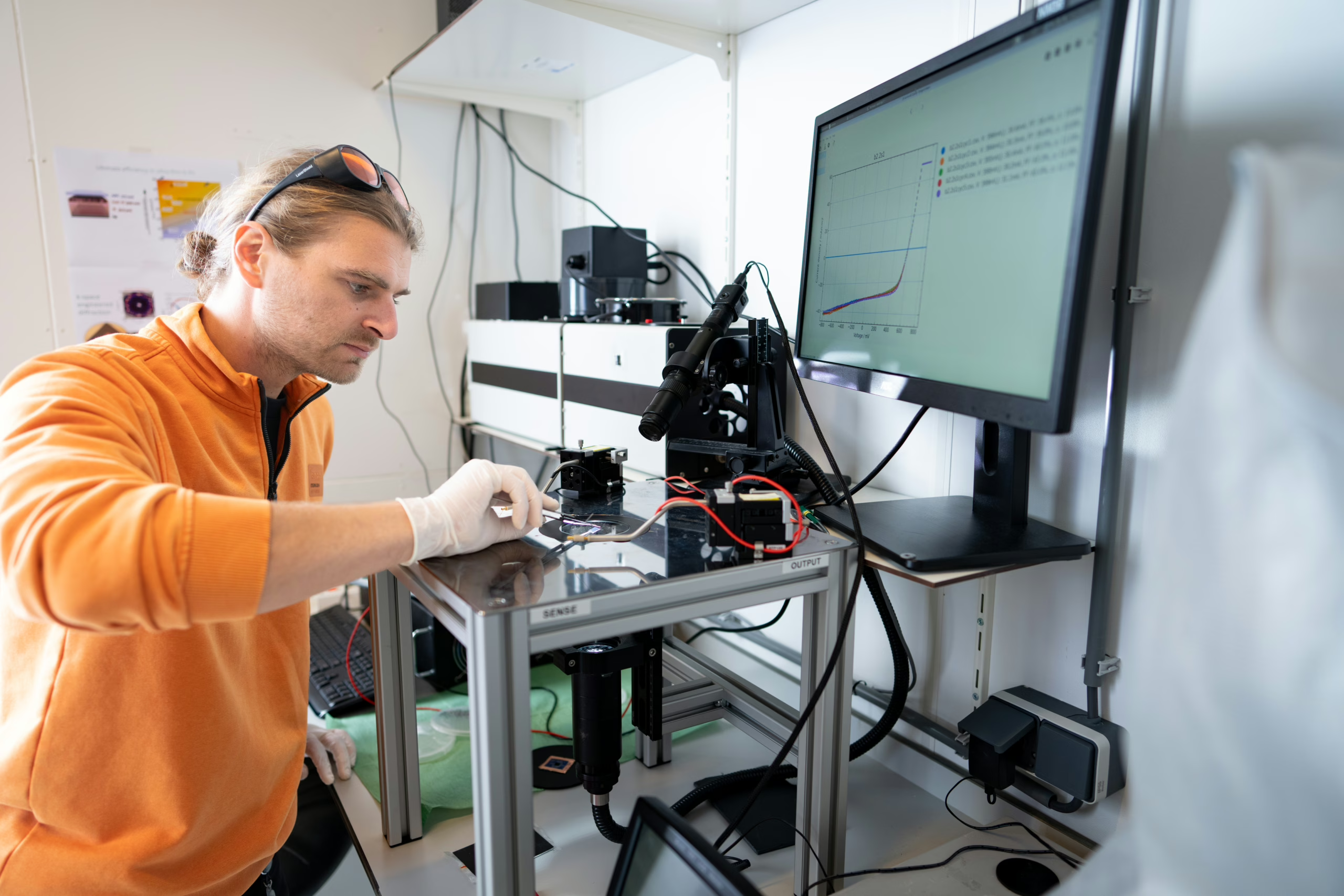
Alex Lambertz in his lab
First author, Alex Lambertz in his lab

Hyperuniform Disorder

HUD patterns are like people milling around a busy square: nobody stands in a grid, but everyone keeps a comfortable distance from each other. As a result, the crowd spreads out evenly, without clusters or empty spaces. There are many examples in nature that follow HUD order, all the way from the light-sensing cones in a bird’s eye to the structure of the universe.

“We managed to harness nature’s hidden order to make ultra-thin solar cells more efficient.”

Esther Alarcón Lladó

Trapping all colors

The researchers used inverse design to create patterns that direct light where they want it to go, regardless of its color. Inverse design is a method that starts with the desired result and works backwards. Thus, it became possible to implement the patterns in the ultra-thin solar cells and effectively trap light across the entire spectrum, which is crucial for making the most of the available sunlight.
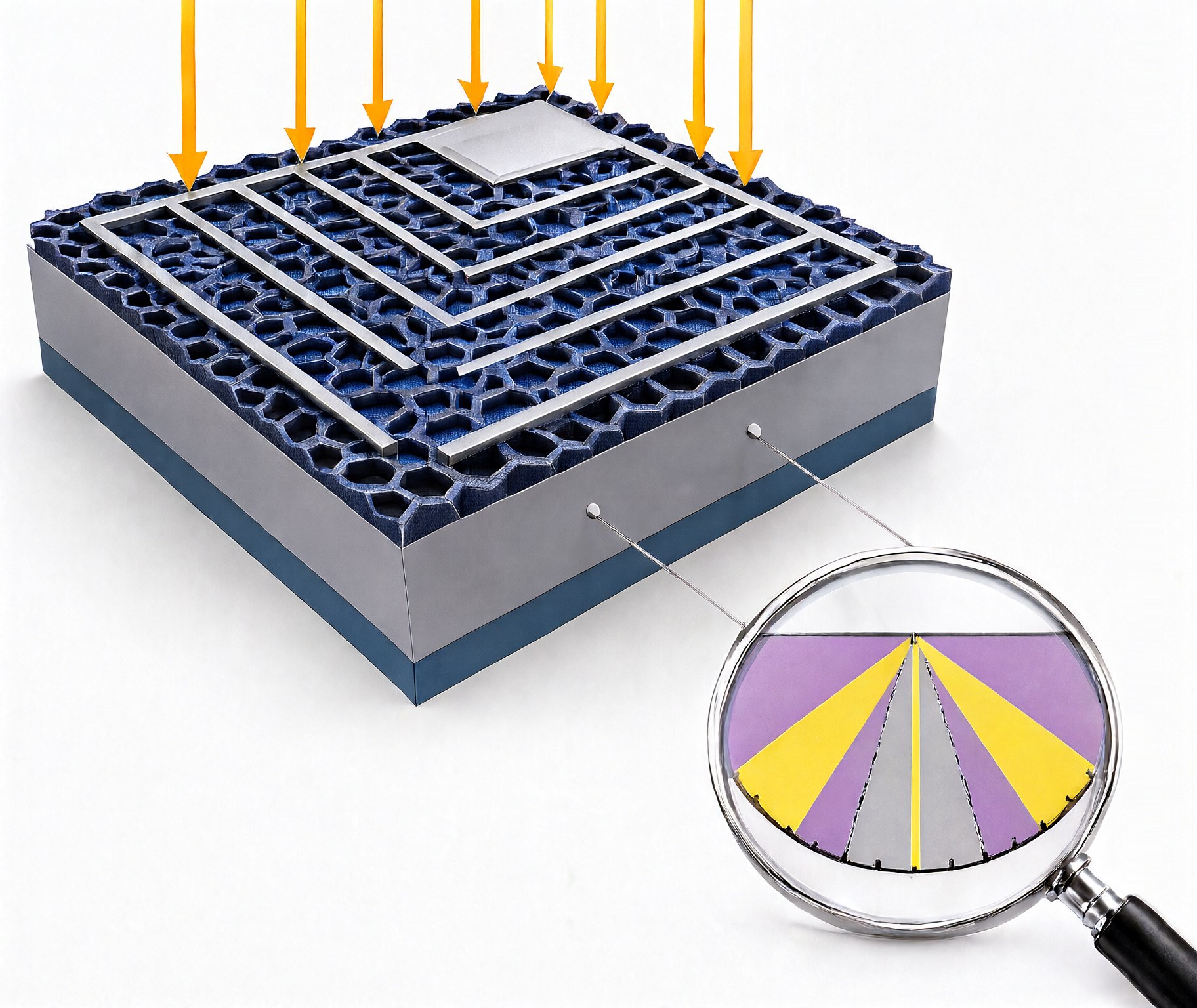
Illustration showing how an ultrathin silicon solar cell traps light of all colors.

Collaboration

The work was a collaboration between AMOLF, University of Amsterdam, Stanford University and University of Southampton. Esther looks back on a great project: “This was a wonderful collaboration, in which the cells were fabricated in Stanford, the designs were made in Southampton, and the patterning with all of the optical/solar cell analysis was done in Amsterdam.”

Learn more:

– If you have any questions about this research, please contact Esther Alarcón Lladó at e-mail e.alarconllado@amolf.nl
– The paper Integrating hyperuniform disordered light trapping layers in ultrathin c-Si solar cells was published in ACS Photonics on October 12.
– To read full paper go to ACS Photonics
Share article
What's happening

Most recent news items

All news items
Off Road grant for a better understanding of intestinal cells that communicate with the immune system
People and recognition

Off Road grant for a better understanding of intestinal cells that communicate with the immune system

AMOLF postdoc Dr. Susanna Eli received an Off Road grant from ZonMw to investigate cells known as M cells in the gut lining that connect the intestine to the immune system. Understanding how M cells develop could ultimately contribute to better treatments for intestinal and immune-related diseases. The grant amounts to 100,000 euros.

Read news item
Science for all ages at Wetenschapsdag 2026
Events and outreach

Science for all ages at Wetenschapsdag 2026

Each year during the national Weekend of Science, AMOLF opens its doors to visitors of all ages to share our enthusiasm for science. AMOLF organizes Wetenschapsdag together with four other research organizations at Amsterdam Science Park: ARCNL, Nikhef, CWI, and University of Amsterdam.

Read news item
About AMOLF

Annual AMOLF Diversity Day focuses on Impostor Phenomenon

Once a year, the AMOLF Inclusion and Diversity team organizes Diversity Day for all AMOLF employees. On October 1, this year’s event took place with the theme Beyond Impostor Phenomenon – More Than Just Luck.

Read news item
Wiebke Albrecht, Group Leader Hybrid Nanosystems at AMOLF
People and recognition

Wiebke Albrecht appointed professor at Vrije Universiteit Amsterdam

Dr. Wiebke Albrecht has been appointed professor by special appointment in Electron and Optical Imaging of Nanomaterials at the Faculty of Science of Vrije Universiteit Amsterdam (VU). The chair was established on behalf of the Foundation for the Advancement of Atomic and Molecular Physics (‘Stichting tot bevordering van de Atoom- en Molecuulfysica’) with the Department of Physics and Astronomy of the VU.

Read news item
Stay informed

Get the latest research highlights, events, and news from our institute delivered to your inbox