Research highlights

Highlights of nanophotonics published in Science

The research field of nanophotonics, the science and application of light at the nanoscale, has seen a rapid growth in the last years, with AMOLF researchers among the pioneers. In a recent article in Science, AMOLF group leaders Femius Koenderink and Albert Polman together with Andrea Alù, visiting professor from the University of Texas, review scientific highlights, applications and a future perspective of light at the nanoscale.

In recent years nanophotonics has become a vibrant field of research, as scientists and engineers master the flow of light at length scales far below the optical wavelength, largely surpassing the classical limits imposed by diffraction. Using metallic and dielectric nanostructures precisely sculpted into 2D and 3D nano-architectures, light can be scattered, refracted, confined, filtered, and processed in fascinating new ways. This is impossible to achieve with natural materials and in conventional geometries. Control over light at the nanoscale has not only unveiled a plethora of new phenomena, but has also led to a variety of important applications.

AMOLF has been active in this new research field from its very beginning, and has helped shape it over the years. Currently, over 50 PhD students, postdocs and master students are active in AMOLF’s Center for Nanophotonics, working on a broad range of nanophotonics topics. The review article, published in Science on May 1st, describes scientific highlights of research groups all over the world in plasmonics, two-dimensional materials, optical antennas, quantum plasmonics, light vector fields, metamaterials and metasurfaces. It also draws attention to nanophotonics applications that have been developed in the past years, such as photonic crystal lasers, LEDs, solar cells, medical applications. The article concludes with a perspective of the direction in which the nanophotonics research field is evolving, describing challenges in hybrid nanophotonics, energy harvesting, nanophotonic control over chemical reactions, optical computing and opto-electronic integration. In the authors’ vision, there is no doubt that the intense ongoing research activity in nanophotonics will lead to novel fundamental insights in the science of light and its applications in the years to come. The timing of the paper is ideal, since this year we celebrate worldwide the International Year of Light.

Reference
A.F. Koenderink, A. Alù, and A. Polman, Nanophotonics: shrinking light-based technology Science 348, 516-521 (2015) | DOI: 10.1126/science.1261243
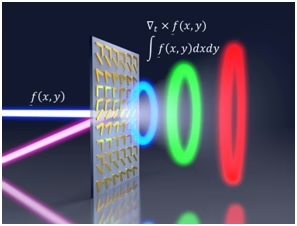


Steering light with optical metasurfaces.

 

Share article
What's happening

Most recent news items

All news items
Collaboration

Successful outcomes of international EBEAM program led by AMOLF

The EU Pathfinder project Electron Beams Enhancing Analytical Microscopy (EBEAM) that was recently completed has received a highly positive review of the European Innovation Council (EIC). EBEAM brought together eight European research institutions and companies, including AMOLF, that develop new concepts and instruments combining spectroscopic analysis with electron microscopy.

Read news item
Research highlights

Everything you need to know about organoids

Organoids are instrumental in improving our understanding of processes that are otherwise hidden inside the body. For instance, these small 3D organs can be used to test medicines on tissue grown from a patient’s own cells. AMOLF researchers carry out unique and complex experiments to follow organoids in time. In order to enable other researchers to benefit from their experiences, they now publish their methods in the prestigious journal Nature Protocols.

Read news item
Events and outreach

Minister Rianne Letschert wears hat and shoulder ornament inspired by Wim Noorduin’s research

This year at the opening of the parliamentary year (Prinsjesdag) Minister of Education, Culture and Science Rianne Letschert wears a spectacular hat and shoulder ornament. Both of them are inspired by the microscopic structures studied by group leader Wim Noorduin (AMOLF/UvA), which look remarkably like tiny flowers under a microscope. Artist and designer Malou Beemer translated these shapes, normally invisible to the naked eye, into wearable art.

Read news item
Nachi Stern, Group Leader Learning Machines at AMOLF
People and recognition

Nachi Stern awarded ERC Starting Grant to explore how matter learns

Why do brains learn, but rocks do not? Could a material one day adapt to its environment the way a living organism does? AMOLF group leader Dr. Nachi Stern has been awarded an ERC Starting Grant to investigate the physical laws of learning, in a project called, “Physical Learning in Dynamical Systems.”

Read news item
Stay informed

Get the latest research highlights, events, and news from our institute delivered to your inbox