Collaboration

Sharp view of the smallest structures

NWO announced that twelve consortia can start research projects through the Perspectief program. A crucial factor in these projects is their societal and economic impact. One of these projects is the CHAIN consortium, with AMOLF group leader Femius Koenderink as co-applicant. In this consortium, researchers join forces to advance the semiconductor industry. The budget will support six junior researchers in total, including one at AMOLF in the Resonant Nanophotonics group.

Project goal

Semiconductor chips are an important pillar of Dutch industry. New imaging and inspection techniques are needed to make these chips smaller, more powerful, more energy efficient, and less harmful to the environment. These techniques must be capable of producing high precision, high resolution and highly efficient three-dimensional images of the smallest possible structures.

The CHAIN consortium will develop new techniques based on light, extreme ultraviolet radiation and electron beams. By combining new measurement techniques with advanced data processing, the researchers aim to make imaging faster and more accurate. This will enable more precise control of production processes.

CHAIN participants

The CHAIN consortium is led by Stefan Witte from TU Delft and brings together expertise in optical microscopy, electron microscopy and algorithms from TU Delft, AMOLF, ARCNL, Utrecht University and Leiden University.
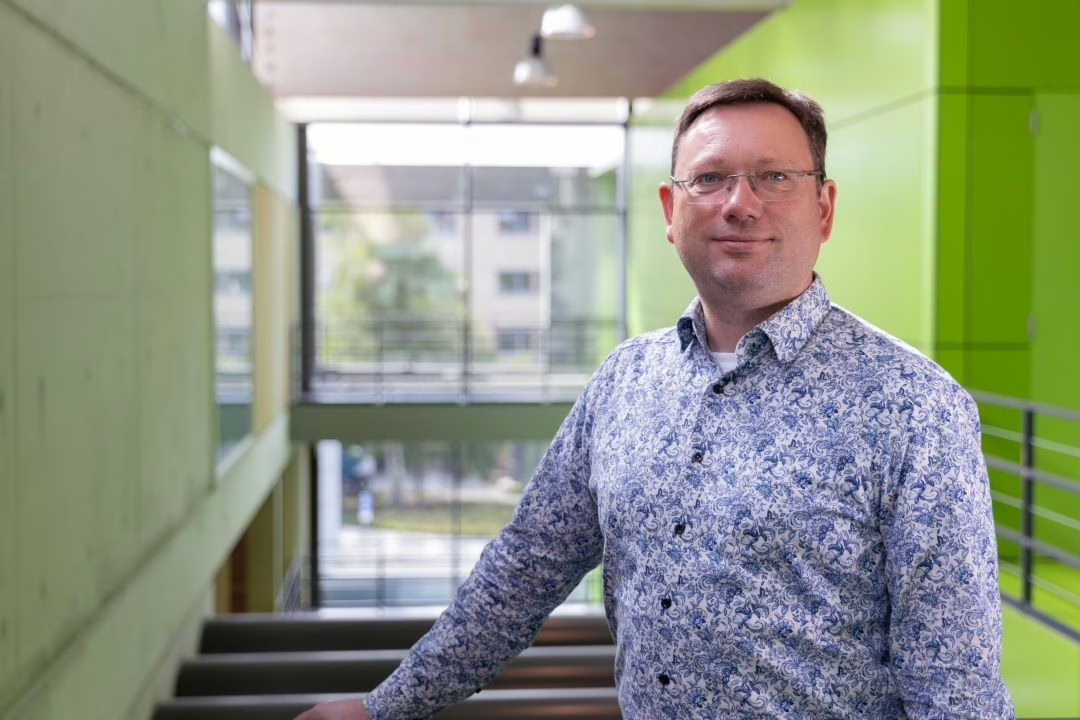
Femius Koenderink at AMOLF. Photo credits: Floris Krelage

AMOLF contribution

The AMOLF researcher will develop theoretical and experimental techniques to reconstruct object images that are buried in complex environments that scatter light. The goal is to extract super high-resolution information from these buried features. Femius Koenderink says: “I am really excited about this project. We are going to bring together very complementary expertise, both from the point of view of physical imaging modalities and from the algorithmic point of view.”

Femius already works closely with ARCNL in a joint research program, and he expects that the researchers in this program will indirectly benefit from CHAIN, for instance through the incorporation of state-of-the-art mathematical methods.

Finally, Femius is looking forward to collaborating with the associated companies. “It will be a unique opportunity to learn from domain experts in the associated companies, both regarding the problems that they struggle with and the wonderful methods that they develop to tackle them.”

Learn more

To read the latest news of the AMOLF-ARCNL joint research program, go to this news item on our website. If you have questions about this research, then please contact Femius Koenderink

To read more about the Perspectief program go to the NWO website.

Share article
What's happening

Most recent news items

All news items
Collaboration

Successful outcomes of international EBEAM program led by AMOLF

The EU Pathfinder project Electron Beams Enhancing Analytical Microscopy (EBEAM) that was recently completed has received a highly positive review of the European Innovation Council (EIC). EBEAM brought together eight European research institutions and companies, including AMOLF, that develop new concepts and instruments combining spectroscopic analysis with electron microscopy.

Read news item
Research highlights

Everything you need to know about organoids

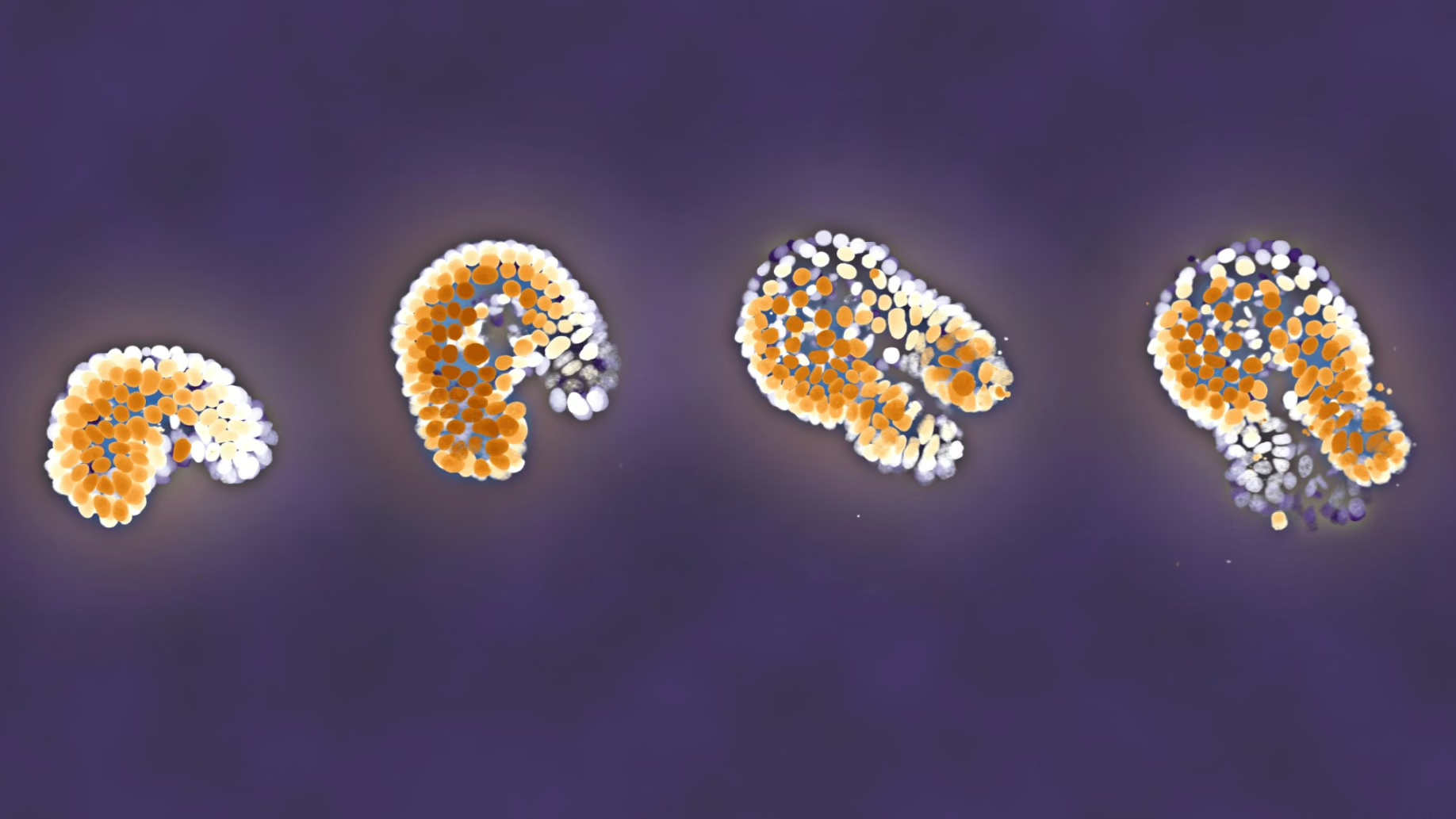
Organoids are instrumental in improving our understanding of processes that are otherwise hidden inside the body. For instance, these small 3D organs can be used to test medicines on tissue grown from a patient’s own cells. AMOLF researchers carry out unique and complex experiments to follow organoids in time. In order to enable other researchers to benefit from their experiences, they now publish their methods in the prestigious journal Nature Protocols.

Read news item
Events and outreach

Minister Rianne Letschert wears hat and shoulder ornament inspired by Wim Noorduin’s research

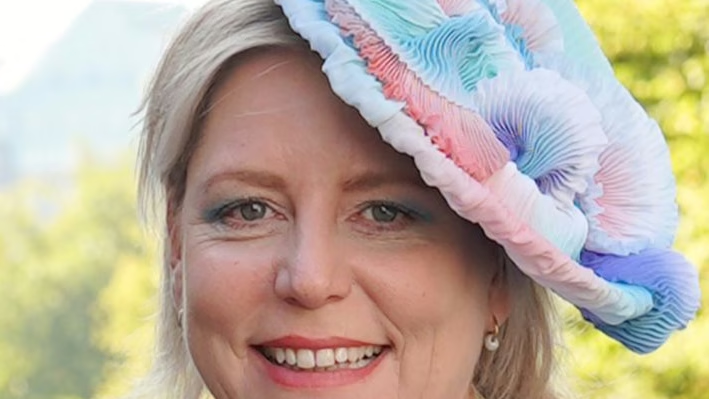
This year at the opening of the parliamentary year (Prinsjesdag) Minister of Education, Culture and Science Rianne Letschert wears a spectacular hat and shoulder ornament. Both of them are inspired by the microscopic structures studied by group leader Wim Noorduin (AMOLF/UvA), which look remarkably like tiny flowers under a microscope. Artist and designer Malou Beemer translated these shapes, normally invisible to the naked eye, into wearable art.

Read news item
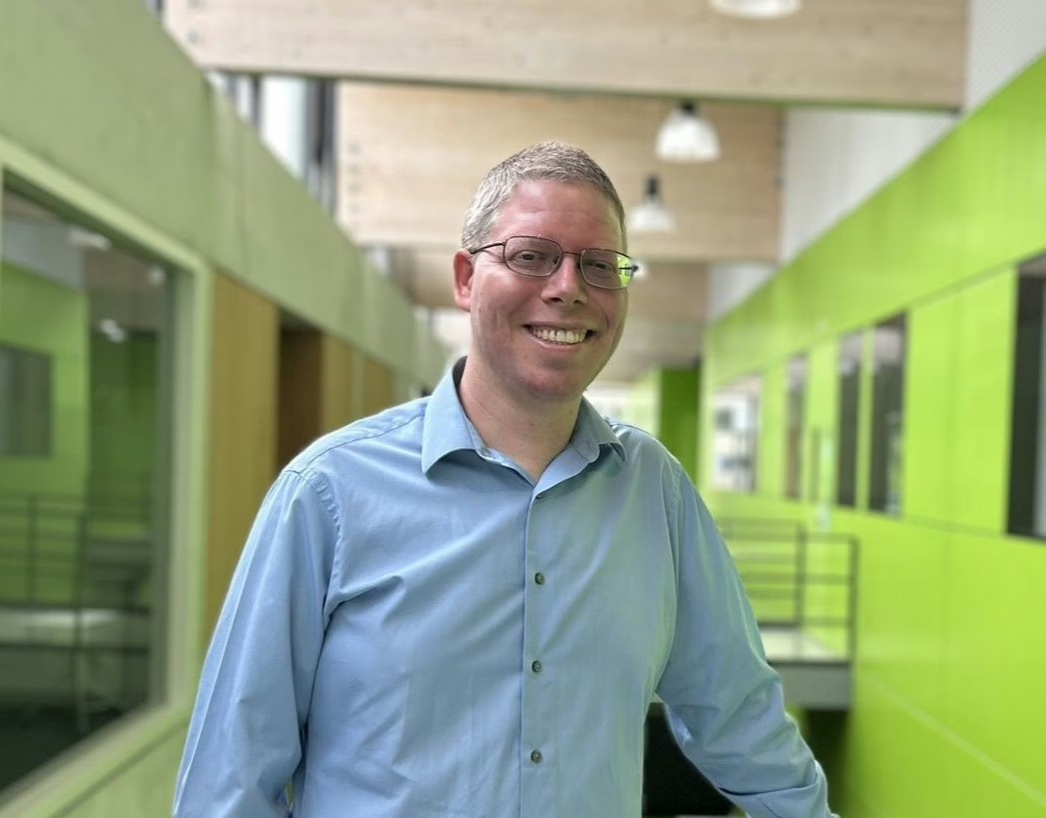
Nachi Stern, Group Leader Learning Machines at AMOLF
People and recognition

Nachi Stern awarded ERC Starting Grant to explore how matter learns

Why do brains learn, but rocks do not? Could a material one day adapt to its environment the way a living organism does? AMOLF group leader Dr. Nachi Stern has been awarded an ERC Starting Grant to investigate the physical laws of learning, in a project called, “Physical Learning in Dynamical Systems.”

Read news item
Stay informed

Get the latest research highlights, events, and news from our institute delivered to your inbox