Sustainable Energy Materials
Nanoscale Solar Cells

The Nanoscale Solar Cells group uses light to synthesize and characterize advanced metal and semiconducting nanostructures to improve our fundamental understanding of light absorption, charge separation, recombination and transport at the nanometer scale. The goal is to use these insights to accelerate the clean energy transition.
Research focus
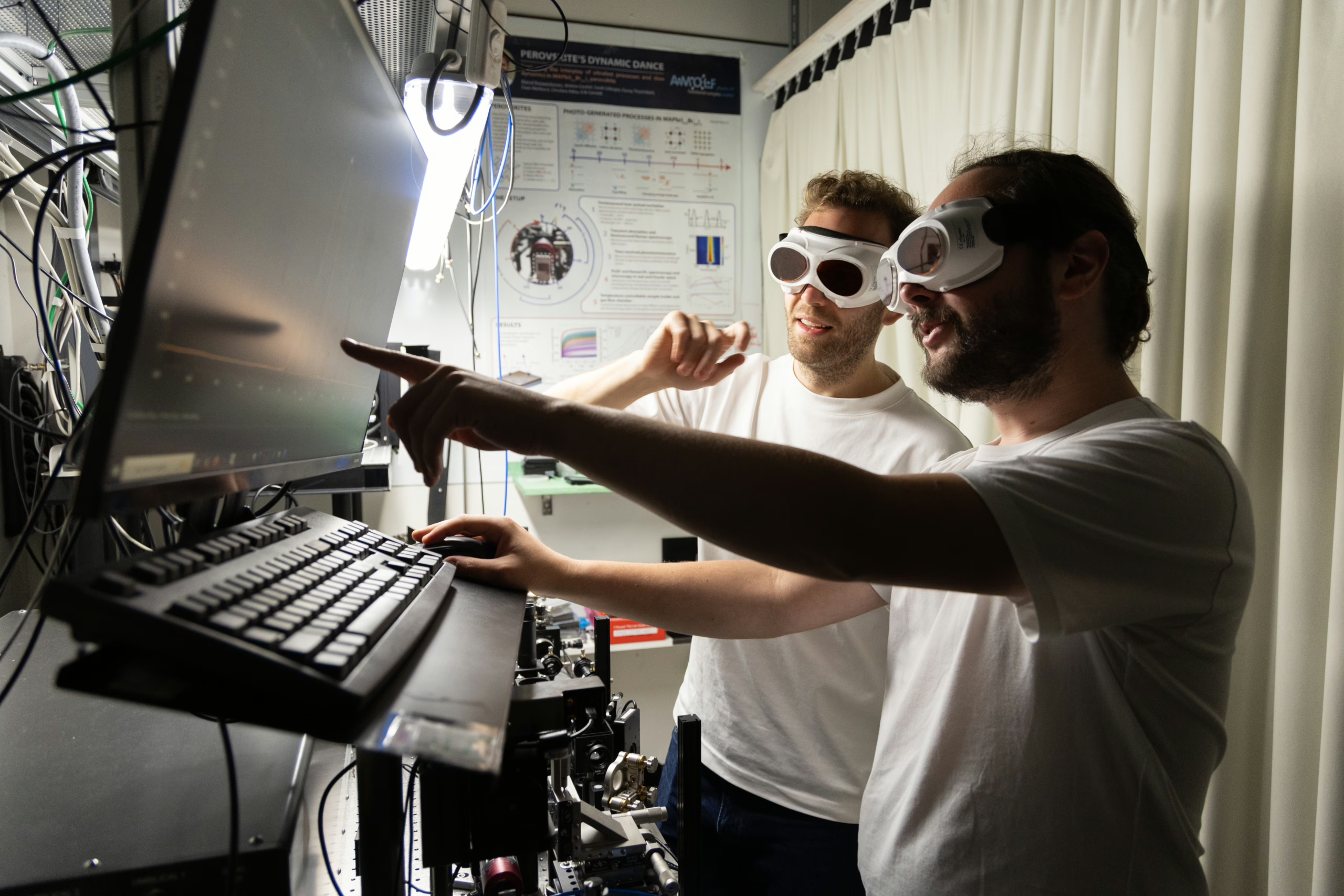
The Nanoscale Solar Cells group uses light to inject energy into material systems with high precision in space, time, and energy to simultaneously synthesize new materials and measure their properties. We focus on halide perovskites and metal nanoparticles since they are easily mutable with light and are key for future applications in solar cells, catalysis and information processing and storage.
The group focuses on the following research areas:
Halide perovskites are a promising new class of photovoltaic materials that combine high efficiency with low-cost manufacturing. We investigate how charge carriers, defects, and mobile ions influence device performance and stability, with the goal of developing next-generation solar cells that can surpass current technologies in both efficiency and scalability.
Halide perovskites display unique light-driven changes in composition and optical properties. We investigate these phenomena to understand how information can be stored and processed in these materials and to discover new ways of programming their behavior using light.
Efficient catalysts are essential for sustainable chemical manufacturing and solar fuel production. We use nanostructured materials and tailored light-matter interactions to understand and control chemical reactions at the nanoscale, with the aim of improving catalytic activity, selectivity, and energy efficiency.
To solve the climate crisis we need a material revolution by finding the materials we need to generate clean energy, store it in new generation batteries, and capture the produced carbon. However, the total chemical space is vast. There are trillions of possible chemical compositions, and a million or more different ways to make each of them. In the field of perovskite solar cells alone, the challenge is immense. The enormous number of possible combinations of atoms within the lattice makes the search space larger than 10 to the power of 20, more than the number of stars in our galaxy. This vast chemical space allows fine-tuning of both optical and structural properties through different combinations of elements. This can lead to drastically different optoelectronic properties.
Against this background, we are developing an ultra-high-throughput platform that uses artificial intelligence to synthesize, characterize, and explore the design space of next-generation materials to help address the climate crisis.











Nanoscale Solar Cells Latest news


Most recent publications
Research group alumni
- Beniamino Sciacca (CNRS, France)
- Sarah Brittman (NRL, USA)
- Eric Johlin (University of Western Ontario, Canada)
- Lai-Hung Lai (Visera Technologies, Taiwan)
- Jia Wang (ASML, Netherlands)
- Biplab Patra (CSIR-IMMT, India)
- Sven Askes (VU, Netherlands)
- Eitan Oksenberg (Single Quantum, Netherlands)
- Jian-Yao Zheng (University of Twente, Netherlands)
- Fanny Thorimbert (CNRS, France)
- Sander Mann (UvA, Netherlands)
- Sebastian Oener (Fritz-Haber Institute, Germany)
- Parisa Khoram (Climate-KIC, Austria)
- Gede Adhyaksa (Universitas Pertamina, Indonesia)
- Jenny Kontoleta (AKOS, Greece)
- Hongyu Sun (de Volksbank, Netherlands)
- Harshal Agrawal (KLA, Taiwan)
- Julia van der Burgt (ClimAd Technology, Netherlands)
- Susan Rigter (VU, Netherlands)
- Sarah Gillespie (AMOLF, Netherlands)
- Rohit Raj
- Shanti Liga (IREC, Spain)
- Annemarie Berkhout (De Nederlandsche Bank, Netherlands)
- Michiel de Goede (Aluvia Photonics, Netherlands)
- Jantina Fokkema (Hogeschool Rotterdam, Netherlands)
- Cristina Sfiligoj (Microsoft, Netherlands)
- Joëlle Siewe (Utrecht University, Netherlands)
- Alexandra Tsoukala (Radboud University, Netherlands)
- Donal van Uunen (DPI, Netherlands)
- Floris Taminiau (Raad voor Energie, Netherlands)
- Niels Agterhorst (NewCo, USA)
- Francesca Scalerandi (AMOLF, Netherlands)
- Jeroen de Boer (AMOLF, Netherlands)
- Roxy Strijdhorst (PNO Consultants, Netherlands)
- Marco Heijnen (Utrecht University, Netherlands)
- Mathijs Alting (LATEXFALT, Netherlands)
- Mateo Sanclemente Crespo (ICTA-UAB, Spain)
- Eva Stein
- Henrik Hahn (Heidelberg University, Germany)
- Jesse Goossens (Standard Fasel, Netherlands)
- John Hoang (UC Berkeley, USA)
- Linda van der Waart (Anthesis, Netherlands)
- Teo Duevski (CUHK, Hong Kong)
- Tade Hogenelst (ARCNL, Netherlands)
- Benjamin Duncan (University of Zurich, Switzerland)
- Max Mundt (Withthegrid, Netherlands)
- Haroen Nabi (University of Amsterdam, Netherlands)
- Wander Werkhoven (Hogeschool van Amsterdam, Netherlands)