Research highlights

Three AMOLF projects in NWO program Materials for Sustainability

AMOLF participates in three new research projects that will start with funding through NWO’s program Materials for Sustainability (Mat4Sus). To enable a smooth transition from fossil fuels to a more sustainable source of energy we need a wide range of materials. The AMOLF groups contribute to the energy transition by enlarging the efficiency of solar cells and developing thinner foils and colored panels.

AMOLF projects

Doubling the amount of electricity from solar cells
Bruno Ehrler (AMOLF), Han Zuilhof (Wageningen University & Research), Laurens Siebbeles (Delft University of Technology)
Partners: Surfix, Toyota Motor Europe, Energy research Centre of the Netherlands, Wageningen University & Research, Delft University of Technology,

A consortium of researchers from AMOLF, Delft University of Technology and Wageningen University will work on a new type of solar cell capable of doubling the power output per photon, in theory. This is based on the principle of ‘singlet fission’, in which the energy of a high-energy molecule is divided between two molecules. If this can be implemented efficiently, it will lead to a substantial reduction in the cost of solar cells. This, in turn, should expand and accelerate the introduction of renewable energy sources.

Record-breaking solar cell with novel crystalline structure
Jos Haverkort (Eindhoven University of Technology), Erik Bakkers (Eindhoven University of Technology), Erik Garnett (AMOLF)
Partners: AMOLF

The aim of this research is to create a silicon germanium solar cell with a novel crystalline structure. The researchers expect this new hexagonal crystalline structure to break the current efficiency records for silicon solar cells. This material has a direct bandgap, so they suspect it should even be possible to break the 33.7 percent efficiency limit (known as the Shockley Queisser limit) with this technology, which is compatible with existing silicon technology.

Meta solar cells with improved functionality
Albert Polman (AMOLF), Andrea Alù (University of Texas)
Partners: University of Texas, Energy research Centre of the Netherlands (Petten), Fraunhofer Institute for Solar Energy Systems (Freiburg), University of New South Wales (Sydney) and California Institute of Technology (Pasadena)

This project’s goal is to develop a new method for boosting the absorption and conversion of sunlight in solar cells. The team’s approach involves the use of metagratings – surfaces and interfaces featuring nanoscale patterns and structures. The metagratings consist of a periodic grid of light-scattering elements that have a specially designed shape. Using these gratings, different colours of light can be scattered at a specific angular distribution within the solar cell. The researchers plan to build these metagratings into solar cells, to boost their efficiency. Other uses include ultrathin flexible solar films, as well as coloured and transparent solar panels for applications in the built environment.

About NWO materials research
The Mat4Sus program is the first step in the development of a larger-scale materials program for the Netherlands. NWO’s 2018-2019 support for the top sectors of Energy, Chemistry, and High Tech Systems and Materials (HTSM) includes a wide range of funding options for materials research within the ‘Materials NL’ scheme. This offers scope both for public-private partnerships and for fundamental research.

Read the NWO press release (Dutch)
Share article
What's happening

Most recent news items

All news items
Natural phenomena ‘hyperuniform disorder’ enables highly efficient, thin silicon solar cells
Research highlights

Natural phenomena ‘hyperuniform disorder’ enables highly efficient, thin silicon solar cells

Silicon solar panels are rigid and heavy, and many rooftops cannot support them. This creates a need for thin, flexible solar cells that can be integrated into building materials. However, making silicon solar cells thinner makes it harder to trap light inside the material. Researchers in the 3D Photovoltaics group found a fascinating way to overcome this challenge using a phenomenon called hyperuniform disorder. They publish their findings in the journal ACS Photonics.

The researchers were able to make highly efficient silicon solar cell materials that are 30 times thinner than conventional ones. They managed to do this by integrating a layer of nanometer sized structures on top of the material. Up close, this pattern looks random, but it is remarkably when you step back: no clumps, no gaps, and no repeating pattern. This is called hyperuniform disorder (or HUD).

Read news item
Off Road grant for a better understanding of intestinal cells that communicate with the immune system
People and recognition

Off Road grant for a better understanding of intestinal cells that communicate with the immune system

AMOLF postdoc Dr. Susanna Eli received an Off Road grant from ZonMw to investigate cells known as M cells in the gut lining that connect the intestine to the immune system. Understanding how M cells develop could ultimately contribute to better treatments for intestinal and immune-related diseases. The grant amounts to 100,000 euros.

Read news item
Science for all ages at Wetenschapsdag 2026
Events and outreach

Science for all ages at Wetenschapsdag 2026

Each year during the national Weekend of Science, AMOLF opens its doors to visitors of all ages to share our enthusiasm for science. AMOLF organizes Wetenschapsdag together with four other research organizations at Amsterdam Science Park: ARCNL, Nikhef, CWI, and University of Amsterdam.

Read news item
About AMOLF

Annual AMOLF Diversity Day focuses on Impostor Phenomenon

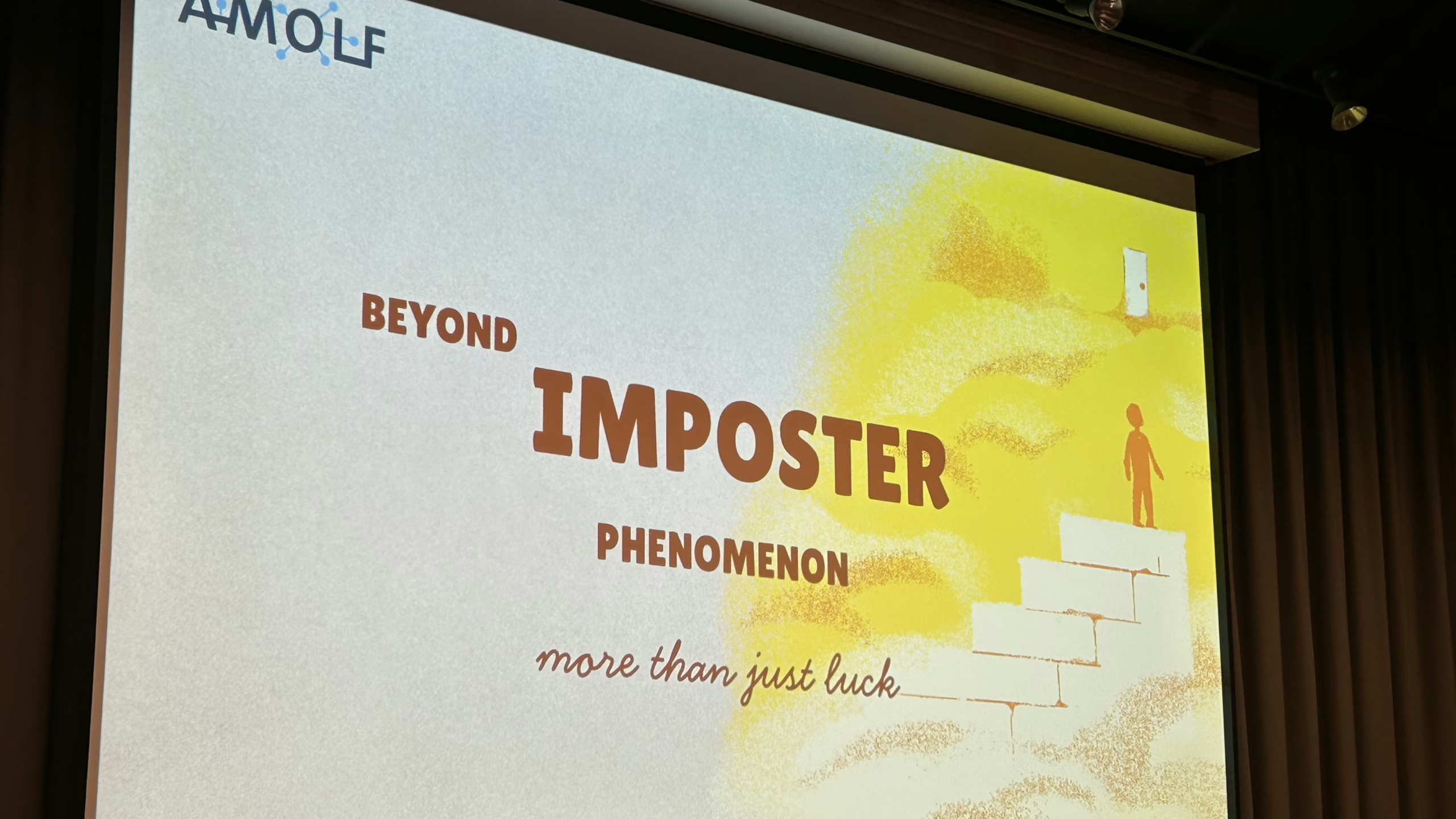
Once a year, the AMOLF Inclusion and Diversity team organizes Diversity Day for all AMOLF employees. On October 1, this year’s event took place with the theme Beyond Impostor Phenomenon – More Than Just Luck.

Read news item
Stay informed

Get the latest research highlights, events, and news from our institute delivered to your inbox