People and recognition

Three months – Three PhD celebrations  

In the past three months, three AMOLF PhD students successfully defended their thesis at a Dutch university. Their names are Christiaan van Campenhout, Susan Rigter and Balázs Antalicz.


Christiaan van Campenhout
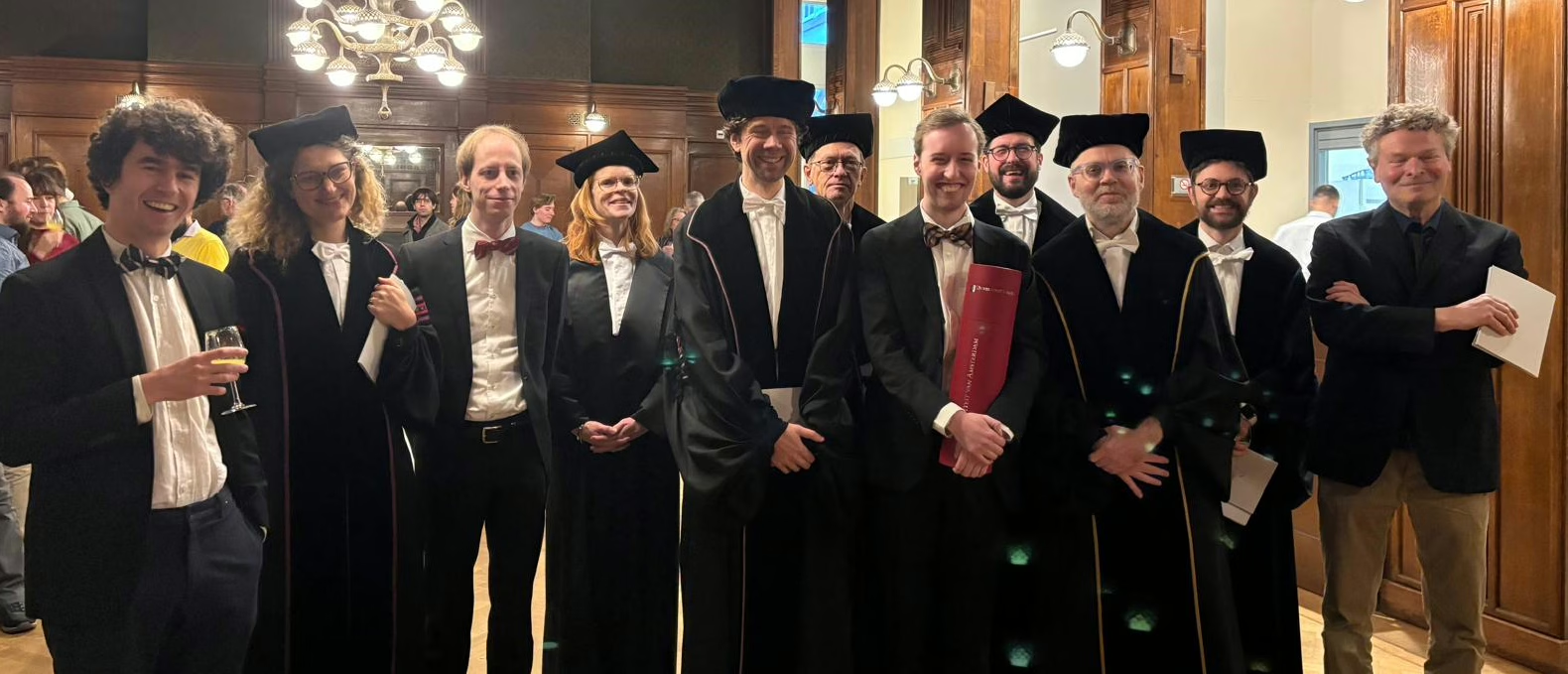
Christiaan van Campenhout after defending his thesis

Christiaan van Campenhout was a PhD student in the Self-Organizing Matter group of Wim Noorduin where he introduced groundbreaking strategies – like mechanically responsive hydrogels and immersion-controlled patterning – to overcome limitations in diffusion processes. These methods pave the way for scalable, customizable materials, using post-processing techniques akin to photography. The implications for functional materials design are substantial. On December 11th, Christiaan defended his thesis ‘Guiding Lines: Directing Reaction-Diffusion Processes to Create Functional Materials’ at the University of Amsterdam. To get an idea of the research Christiaan worked on these past four years, have a look the video.


Susan Rigter
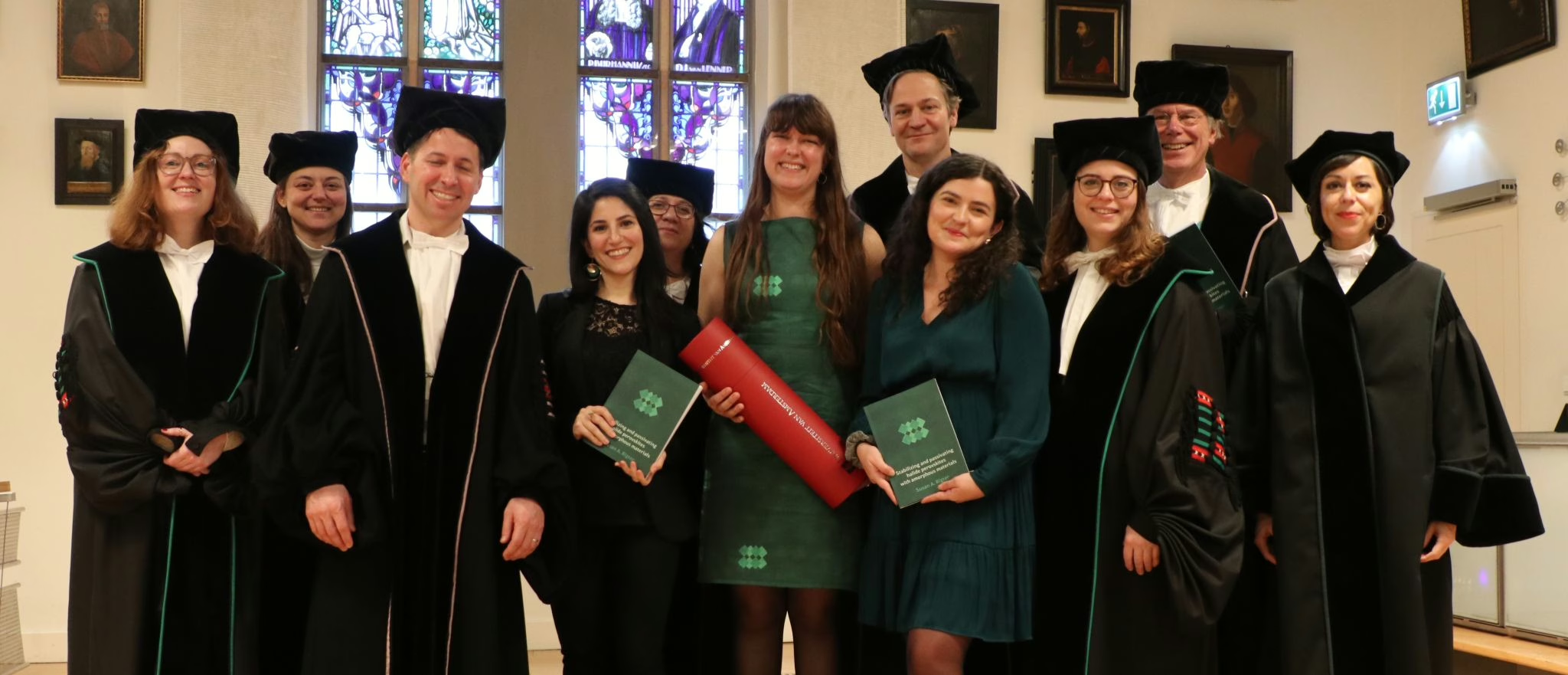
Susan Rigter after defending her thesis

Susan Rigter was a PhD student in the Nanoscale Solar Cells group of Erik Garnett. In this group she worked on stabilizing and passivating halide perovskites. These colorful, semiconducting materials are promising candidates for a wide variety of applications, such as solar cells and lighting. There are many major advantages to this material, but it is also unstable, and it contains lead, which makes it toxic. Susan’s research addressed these issues. On December 19th, she defended her thesis ‘Stabilizing and passivating halide perovskites with amorphous materials’ at the University of Amsterdam. Interested in reading more about Susan’s work?


Balázs Antalicz
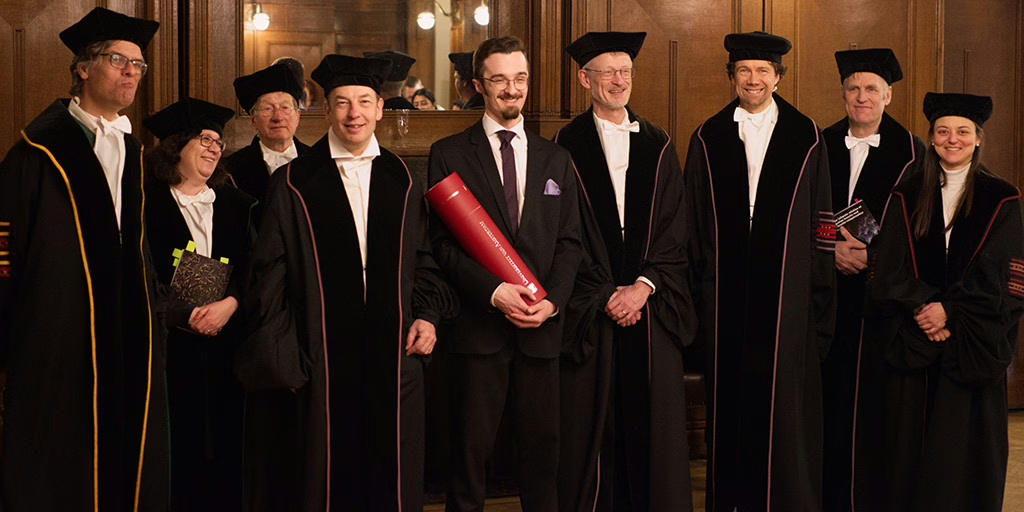
Balázs Antalicz after defending his thesis

Balázs Antalicz was a PhD student in the Ultrafast Spectroscopy group of Huib Bakker. In his thesis entitled ‘On the intimate relation of proton transfer and molecular complexation’, he describes his research on so-called proton transfer reactions. These reactions happen in water: ​a proton (H+) is transferred between acid and base molecules.  

Proton transfer is a critical step in photosynthesis, when plants harvest energy from light; and also in homeostasis, where such reactions keep the acidity of blood in a very well-defined range. 

These reactions happen very quickly. Therefore, Balázs used ultrafast laser pulses to both initiate the reactions, and to observe them at a later point in time. In addition, he also studied how such reactions steer molecular self-assembly at the water/air interface. Are you interested in Balázs’ thesis, then read the thesis of Balazs Antalicz online.

Share article
What's happening

Most recent news items

All news items
Collaboration

Successful outcomes of international EBEAM program led by AMOLF

The EU Pathfinder project Electron Beams Enhancing Analytical Microscopy (EBEAM) that was recently completed has received a highly positive review of the European Innovation Council (EIC). EBEAM brought together eight European research institutions and companies, including AMOLF, that develop new concepts and instruments combining spectroscopic analysis with electron microscopy.

Read news item
Research highlights

Everything you need to know about organoids

Organoids are instrumental in improving our understanding of processes that are otherwise hidden inside the body. For instance, these small 3D organs can be used to test medicines on tissue grown from a patient’s own cells. AMOLF researchers carry out unique and complex experiments to follow organoids in time. In order to enable other researchers to benefit from their experiences, they now publish their methods in the prestigious journal Nature Protocols.

Read news item
Events and outreach

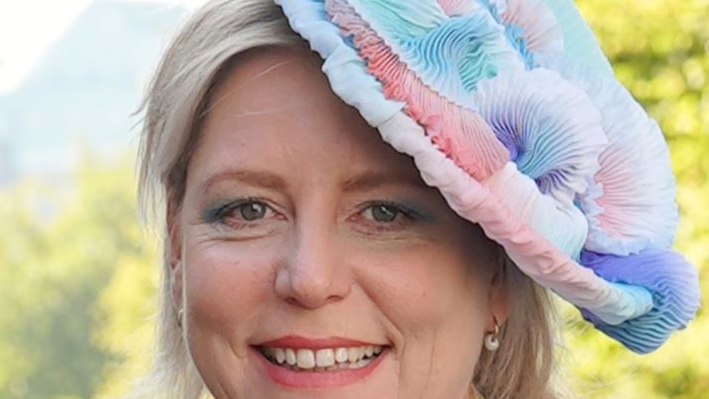
Minister Rianne Letschert wears hat and shoulder ornament inspired by Wim Noorduin’s research

This year at the opening of the parliamentary year (Prinsjesdag) Minister of Education, Culture and Science Rianne Letschert wears a spectacular hat and shoulder ornament. Both of them are inspired by the microscopic structures studied by group leader Wim Noorduin (AMOLF/UvA), which look remarkably like tiny flowers under a microscope. Artist and designer Malou Beemer translated these shapes, normally invisible to the naked eye, into wearable art.

Read news item
Nachi Stern, Group Leader Learning Machines at AMOLF
People and recognition

Nachi Stern awarded ERC Starting Grant to explore how matter learns

Why do brains learn, but rocks do not? Could a material one day adapt to its environment the way a living organism does? AMOLF group leader Dr. Nachi Stern has been awarded an ERC Starting Grant to investigate the physical laws of learning, in a project called, “Physical Learning in Dynamical Systems.”

Read news item
Stay informed

Get the latest research highlights, events, and news from our institute delivered to your inbox