Perovskite, the highly promising new material for solar cells, is naturally crystalline; in other words, the atoms pack together in an ordered pattern. From traditional silicon solar cells, we know that the efficiency of the cells can be boosted if a part of the material is amorphous, meaning the atoms pack together randomly. Erik Garnett (AMOLF Nanoscale Solar Cells) was the first to realize that amorphous perovskite could fulfill the same function. The following challenge was to produce the material and study its properties. Garnett explains why that was difficult: “Perovskite consists of ions. By nature, these easily organize in a crystal lattice, just like table salt, for example. We needed to come up with a trick to prevent those crystals from forming, and we managed to do just that. Using techniques such as X-ray diffraction, we subsequently also demonstrated that the material is amorphous. With this, we delivered the first irrefutable evidence that amorphous perovskite exists.”
Vinegar makes perovskite amorphous
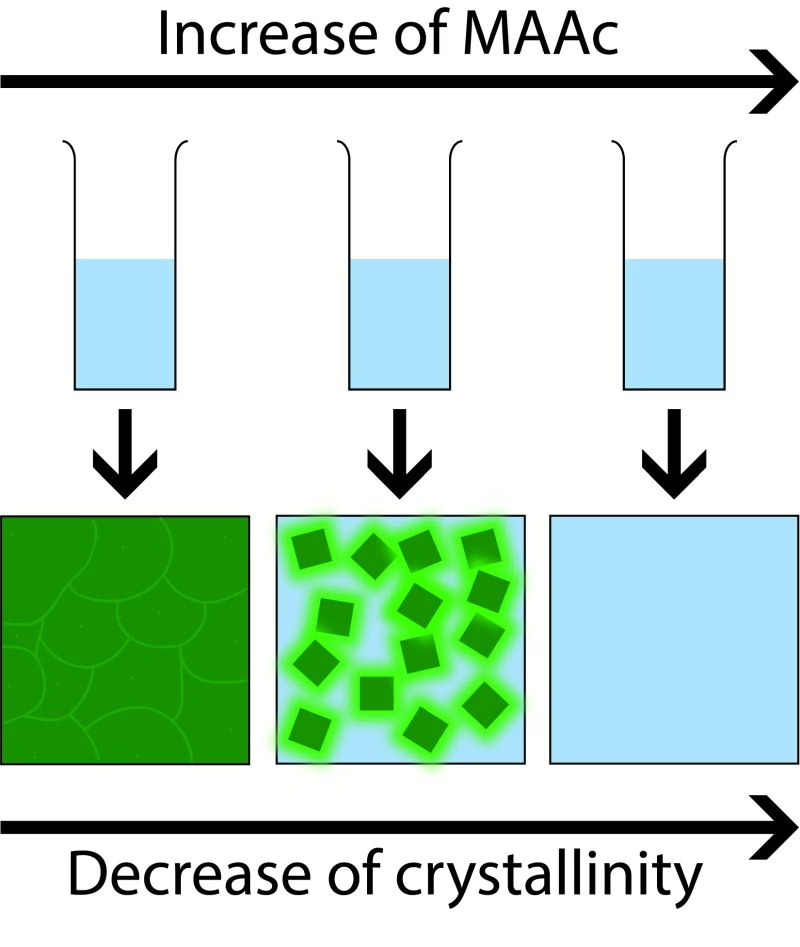
The trick that Garnett, first author of the article Susan Rigter, and their colleagues applied is varying the quantity of methylammonium acetate, one of the components of perovskite. More acetate (the key ingredient in vinegar) results in more amorphous perovskite because it hinders the crystallization process and accelerates the disappearance of the solvent. “We were actually surprised that we could form amorphous perovskite, so we wanted to investigate the formation mechanism,” says Garnett. “We demonstrated that as an intermediate stage, a complex is formed in the solution that hinders crystallization. When we subsequently heat the solution to evaporate the solvent, the complex decomposes so rapidly that it does not have time to crystallize.”
The method that the researchers devised to make amorphous perovskite is widely applicable. The most studied perovskite is methylammonium lead iodide, but the synthesis also works with other ammonium salts and with other halides such as bromide instead of iodide. Furthermore, it transpired that varying these components yielded a shift in the bandgap, a property of the substance that indicates which color light the solar cell absorbs and converts into electricity most efficiently. The ability to tune the amorphous band gap allows many materials with different bandgaps to be combined, leading to more efficient solar cells.
Efficient solar cells
Analogous to silicon solar cells, an amorphous layer of perovskite can help improve the efficiency by providing a so-called passivating layer, says Garnett. Electrons are released in the material as a result of light shining on a solar cell. These electrons move to the surface where they are removed through electronic contacts. This gives rise to a current. In a crystal, the electrons can become trapped at the boundary of the crystal. In record silicon solar cells, an amorphous passivating layer ensures that this does not happen, leading to higher power output from the solar cell. Amorphous perovskite could also fulfill this function, which would further increase the efficiency of perovskite solar cells. “We measure stronger and longer lived light emission when using the amorphous perovskite as a passivating layer, which is an indication for a better performing solar cell,” says Garnett.
Therefore, the next step in the research is producing this type of solar cell, starting with a layer of crystalline perovskite that is covered by a layer of amorphous perovskite. That is more difficult than producing just amorphous perovskite because the underlying crystalline layer provides an ordered template, making it easier for atoms to pack in an ordered fashion. “I consider the analogy with silicon to be the most exciting aspect of our research,” says Garnett. “I think that this is a significant breakthrough for perovskites with huge possibilities.”
Reference
Susan A. Rigter, Xueying L. Quinn, Rishi Kumar, David P. Fenning, Philippe Massonnet, Q2 Shane R. Ellis, Ron M. A. Heeren, Katrine L. Svane, Aron Walsh, and Erik C. Garnett, Passivation Properties and Formation Mechanism of Amorphous Halide Perovskite Thin Films, Advanced Functional Materials (2021).