
People and recognition

ERC Consolidator grant for Erik Garnett

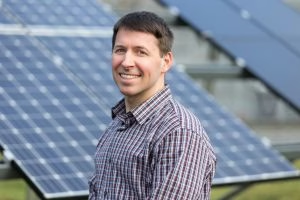
AMOLF group leader Erik Garnett (Nanoscale Solar Cells) has received an ERC Consolidator grant amounting 3.0 million euros from the European Research Council (ERC). In addition to being an AMOLF group leader, Garnett holds a professorship by special appointment at the University of Amsterdam (UvA).

Photo by Dirk Gillissen

The ERC Consolidator Grants are designed to support excellent Principal Investigators at the career stage at which they may still be consolidating their own independent research team or program. Principal Investigators must demonstrate the ground-breaking nature, ambition and feasibility of their scientific proposal.

FOCUS (Flourescent Optical Concentration of Uncollimated Sunlight)
There is an urgent need to use solar energy to produce electricity, fuels and chemicals. However, the highly diffuse nature of sunlight in angle, wavelength and space complicates its high-efficiency, low-cost and scalable conversion. FOCUS will develop thin-films that concentrate sunlight in these three aspects, creating collimated, monochromatic, high-intensity beams that can provide advantages for photovoltaics and photocatalysis. The underlying concept is a radically different design for a luminescent solar concentrator (LSC). Conventional LSCs use an emitter-doped plastic or glass sheet as a waveguide, concentrating direct and diffuse sunlight via total internal reflection of fluorescence. The losses associated with reabsorption, emission into the waveguide escape cone and Stokes shift have limited LSC efficiency to 7%. Garnett will eliminate the waveguide completely and replace it with nanophotonic lenses, solving the longstanding problems with LSCs.

Read more about ERC Consolidator Grants

Share article
What's happening

Most recent news items

All news items
Collaboration

Successful outcomes of international EBEAM program led by AMOLF

The EU Pathfinder project Electron Beams Enhancing Analytical Microscopy (EBEAM) that was recently completed has received a highly positive review of the European Innovation Council (EIC). EBEAM brought together eight European research institutions and companies, including AMOLF, that develop new concepts and instruments combining spectroscopic analysis with electron microscopy.

Read news item
Research highlights

Everything you need to know about organoids

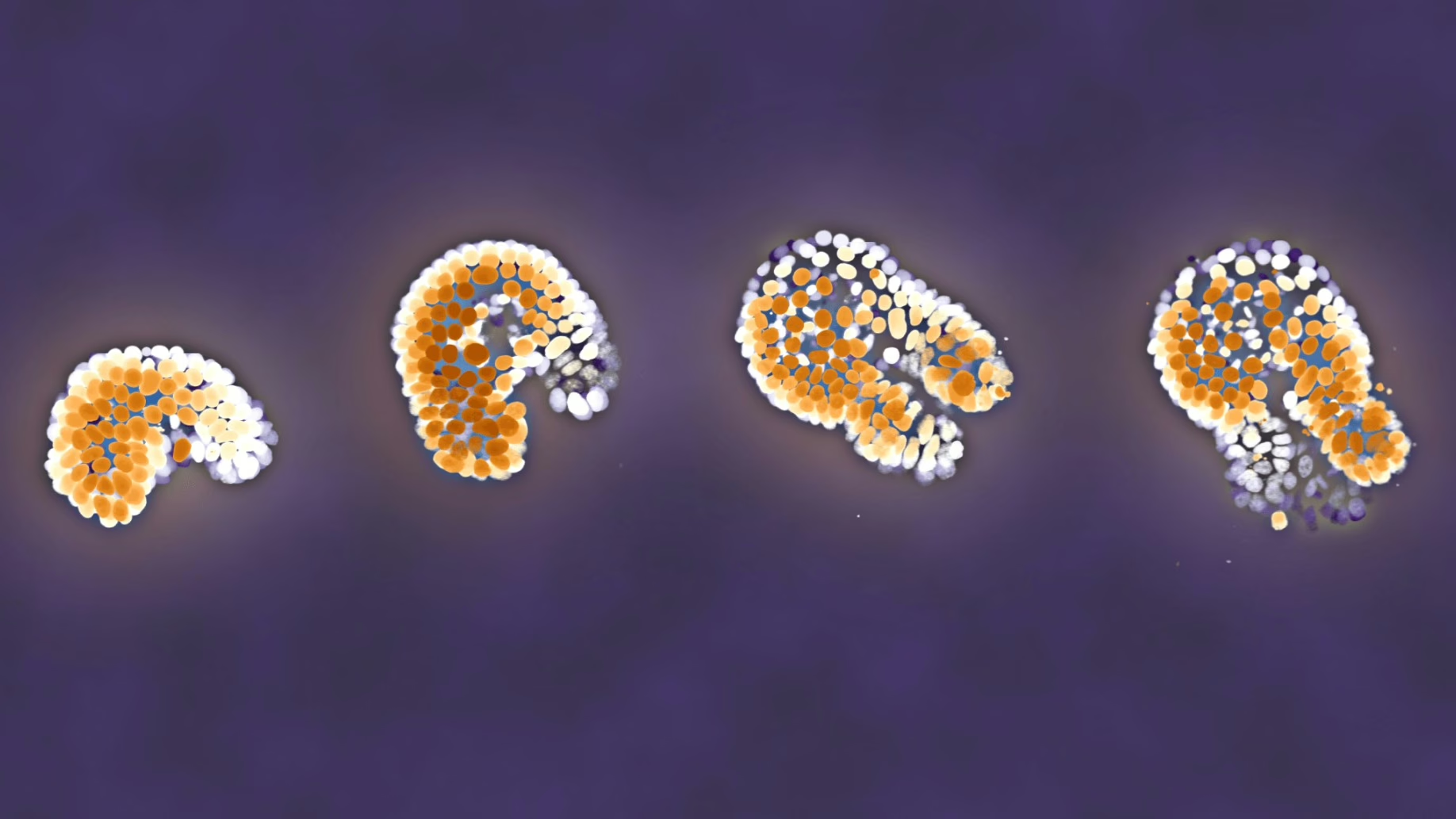
Organoids are instrumental in improving our understanding of processes that are otherwise hidden inside the body. For instance, these small 3D organs can be used to test medicines on tissue grown from a patient’s own cells. AMOLF researchers carry out unique and complex experiments to follow organoids in time. In order to enable other researchers to benefit from their experiences, they now publish their methods in the prestigious journal Nature Protocols.

Read news item
Events and outreach

Minister Rianne Letschert wears hat and shoulder ornament inspired by Wim Noorduin’s research

This year at the opening of the parliamentary year (Prinsjesdag) Minister of Education, Culture and Science Rianne Letschert wears a spectacular hat and shoulder ornament. Both of them are inspired by the microscopic structures studied by group leader Wim Noorduin (AMOLF/UvA), which look remarkably like tiny flowers under a microscope. Artist and designer Malou Beemer translated these shapes, normally invisible to the naked eye, into wearable art.

Read news item
Nachi Stern, Group Leader Learning Machines at AMOLF
People and recognition

Nachi Stern awarded ERC Starting Grant to explore how matter learns

Why do brains learn, but rocks do not? Could a material one day adapt to its environment the way a living organism does? AMOLF group leader Dr. Nachi Stern has been awarded an ERC Starting Grant to investigate the physical laws of learning, in a project called, “Physical Learning in Dynamical Systems.”

Read news item
Stay informed

Get the latest research highlights, events, and news from our institute delivered to your inbox