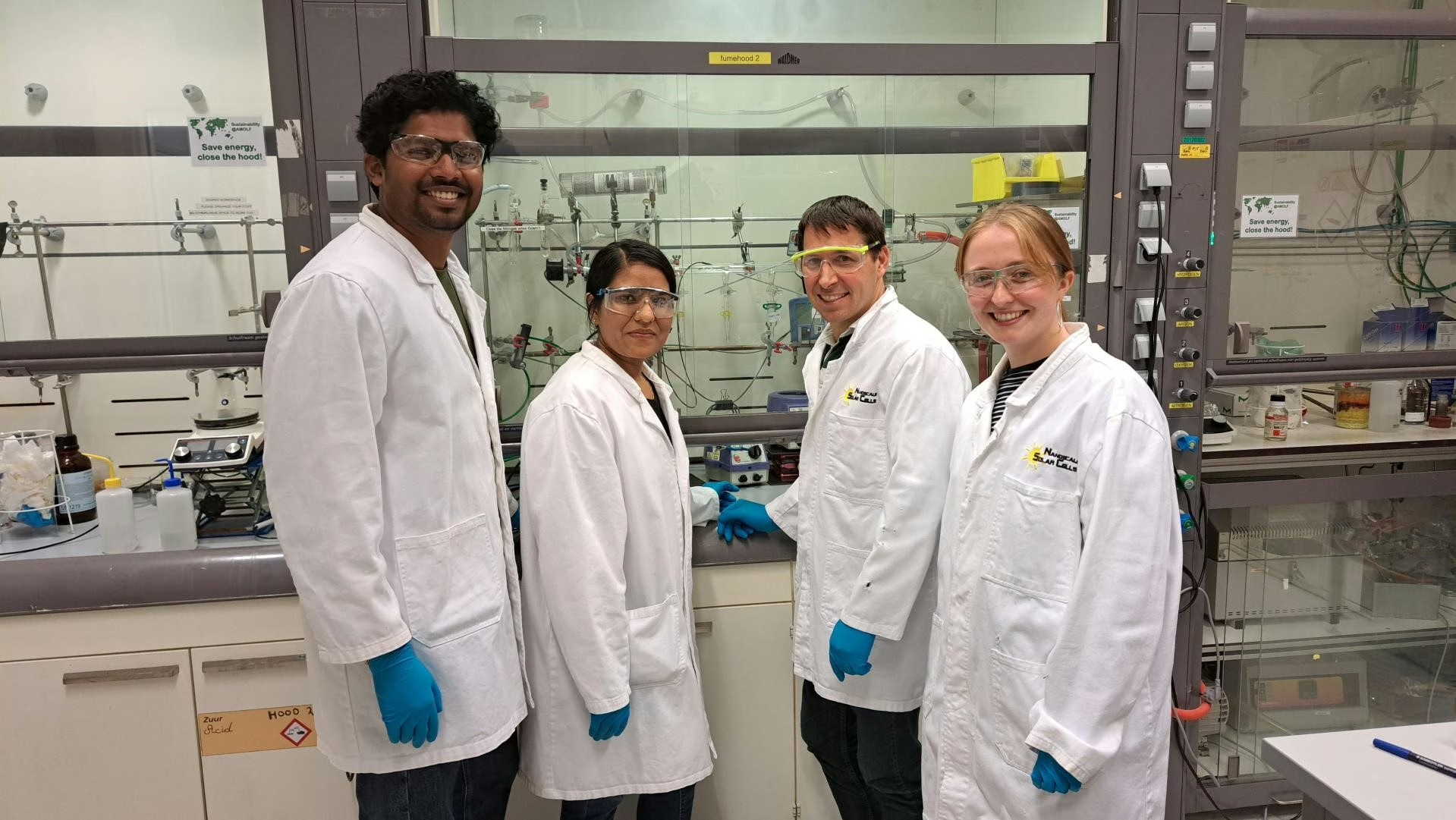
Rohit B. Raj, Jyoti Lather, Erik Garnett and Elaina Galvin and from AMOLF’s research team
Harnessing vibrations with light
At the molecular level, chemical reactions are governed by vibrations – the tiny, rapid motions of atoms within a molecule. When these vibrations interact strongly with light confined inside special cavities, new hybrid states called vibro-polaritons are formed. This vibrational strong coupling effect (VSC) can influence how molecules react, potentially changing reaction rates and even which products are formed, all without altering the molecules themselves.
Until now, vibrational strong coupling had only been observed in relatively thick films of material, far from the surfaces where most industrial chemistry occurs. “This is the first time vibrational strong coupling is shown directly at a metal surface,” says group leader Erik Garnett. “And that is exactly where it matters, because more than 90 percent of industrial chemical reactions happen at solid surfaces, especially at metal electrodes in processes like electrolysis”.
Designing nanoscale light traps
To achieve this breakthrough, the AMOLF team designed and fabricated plasmonic cavities – nanoscale structures made of silver that trap and concentrate infrared light. By carefully tuning the geometry of these cavities, the researchers matched the trapped light to the natural vibrations of water molecules. This allowed them to demonstrate strong coupling in water layers only 44 nanometers thick, and even in water molecules bound directly to the metal surface.
For first author Jyoti Lather, who led the experimental work, this was both a technical and conceptual challenge. “We had to design cavities that work in the mid-infrared range, which required precise simulations and the fabrication of ultra-high-quality silver films,” she explains. “It was only through close collaboration across the team – from simulations to fabrication and spectroscopy – that we were able to see the clear signatures of vibrational strong coupling.”

Fabricated plasmonic sample consisting of an array of square patches with varying colors, each corresponding to a different nanostructure geometry (the periodicity along one direction gives the tunable optical mode for the study)
From curiosity to real-world chemistry
The results go far beyond a proof-of-concept. By bringing VSC into the realm of surface chemistry, the study bridges the gap between scientific curiosity and potential industrial applications. “If we can use light to tune surface reactions without changing catalysts or applying extreme conditions, it could one day make processes like hydrogen production from water or CO₂ reduction more efficient and cost-effective,” says Garnett.
Lather adds: “What excites me most is that we’ve pushed vibrational strong coupling into a completely new regime – one that is directly relevant to real-world catalytic reactions. This could change how we think about controlling chemistry for sustainable energy.”
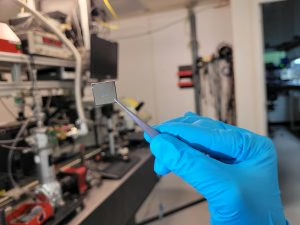
Different colors of light coming from a grating of a sample by changing the angle of light hitting
Towards sustainable impact
The implications of this research extend to some of the most pressing challenges of our time. As society transitions away from fossil fuels, new methods are urgently needed to produce green hydrogen, recycle CO₂, and make industrial chemistry more energy-efficient. Vibrational strong coupling at surfaces could become a powerful tool in this shift, enabling precise control over reactions that underpin a sustainable energy future.
This study on vibrational strong coupling highlights AMOLF’s interdisciplinary approach – combining nanophotonics, materials science, and chemistry – to tackle challenges in energy and sustainability.
Learn more
If you have questions about this study, please contact Erik Garnett (email: E.Garnett@amolf.nl) or Jyoti Lather (J.Lather@amolf.nl).
This paper was published in Advanced Optical Materials: “Vibrational Strong Coupling of Thin Water Layers Using Plasmonic Cavities” on September 30 (2025) by Jyoti Lather, Rohit B. Raj, Nikolai Orlov, Devin B. O’Neill, Elaina Galvin, Christoph Kaiser, Huib J Bakker, and Erik C. Garnett.
Read the full paper: https://doi.org/10.1002/adom.202501890