Information in Matter
Photonic Forces

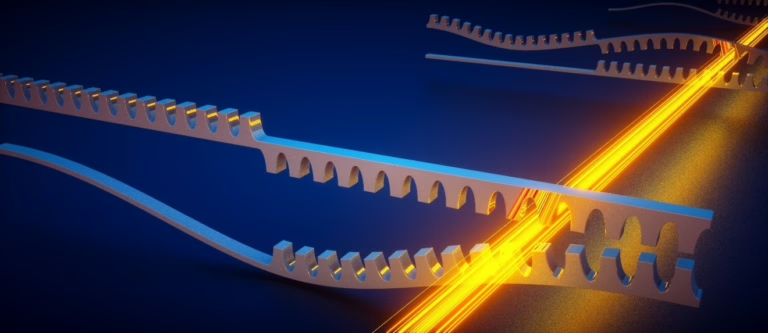
We study nanophotonics and nanomechanics. Our research exploits light-matter interactions at the nanoscale, in particular the coupling between photons and phonons in nano-optomechanical systems. We explore new ways to control both light and mechanical motion in on-chip devices, motivated by both fundamental questions and applications in sensing and information processing.
Research focus
Photonic Forces researchers study how light and mechanical motion behave in nanostructured devices on a chip. Combining experiment and theory, we seek to understand how photons and phonons are governed by fundamental principles such as the laws of quantum mechanics and spatiotemporal symmetries.
We explore how system design and controlled light-matter interactions can challenge conventional limits to photonic and mechanical functionality. We aim to uncover powerful novel wave behavior in nanoscale devices in both the quantum and classical domain, and use such fundamental insights towards performance enhancements in technological applications, ranging from quantum sensing to communication.
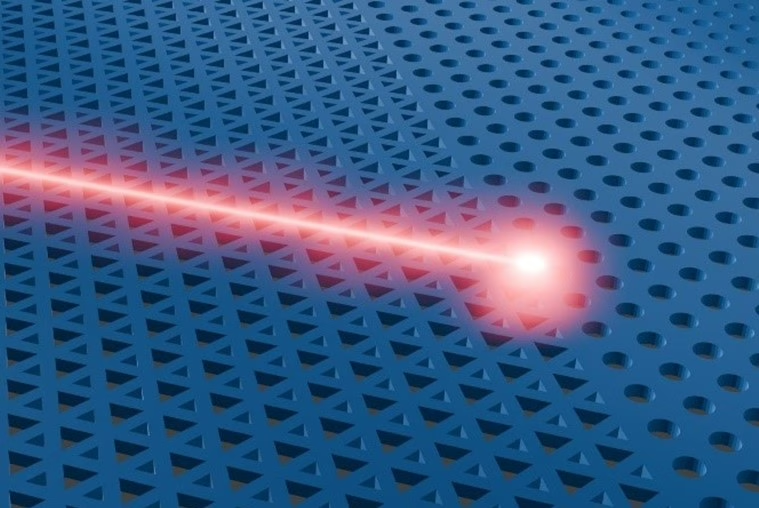
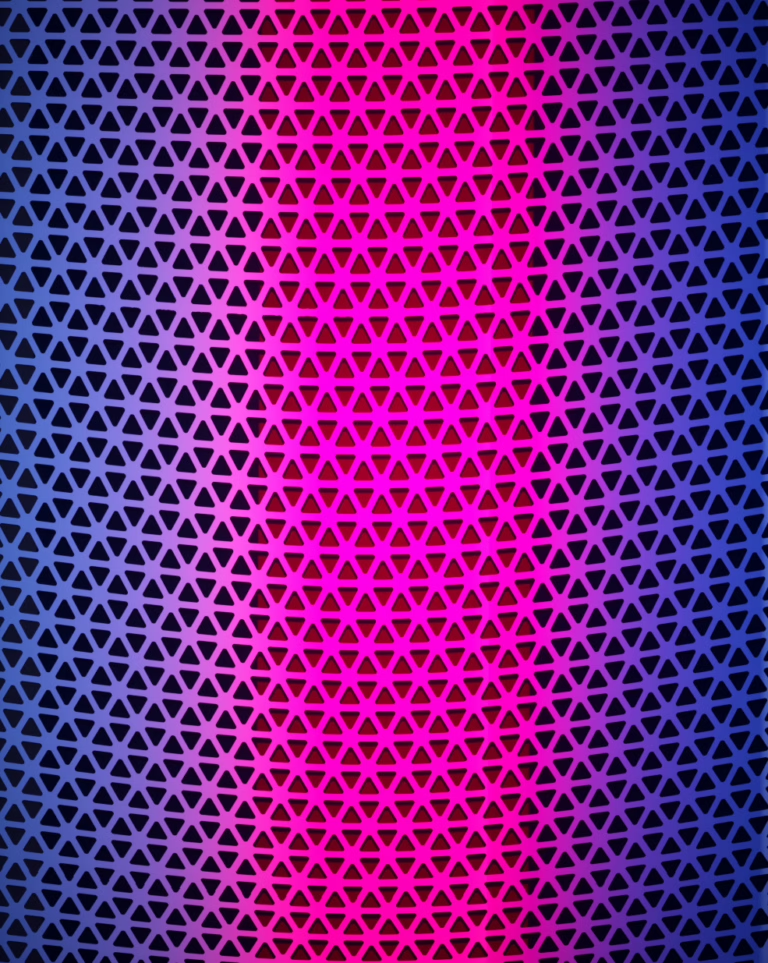
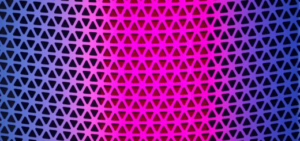 Photonic crystals in which light waves are coming to a halt. A subtle deformation can strongly affect the behavior of light, similar to the effect a magnetic field has on electrons.
We investigate the fundamental quantum limits to displacement sensing and develop strategies to probe and surpass these limits. A central goal is to control and characterize the quantum state of macroscopic mechanical systems, and to harness quantum effects to enable new capabilities in sensing technologies. We develop novel optomechanical resonators with extreme photon-phonon interactions, and use interferometry and cryogenics to study their motion down to milliKelvin temperatures.
We study topological photons and phonons, focusing on the realization of topological protection at the nanoscale and its practical use in photonic and phononic devices. We exploit both spatial crystalline symmetry breaking and temporal modulation to establish novel mechanisms for guiding and confining light and sound. We study the use of band structure engineering to create platforms for extreme light-matter interactions. Optomechanical time modulation allows breaking time-reversal symmetry as well as Hermiticity and linearity, allowing the emergence of novel bosonic states and unconventional transport phenomena.
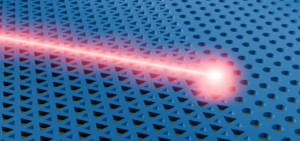
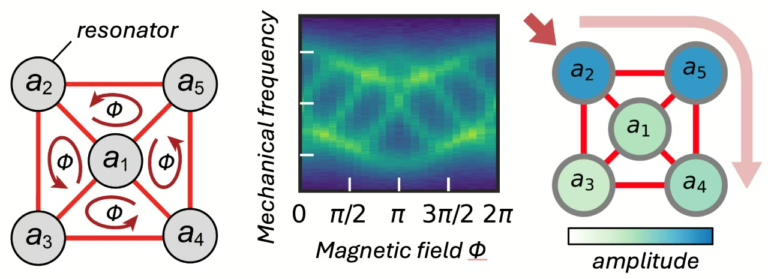
By engineering optomechanical networks with actively controlled Hamiltonians, we explore how controlled nonlinearity, nonreciprocity, and non-Hermiticity boost the functionality of bosonic metamaterials as e.g. information processors, quantum sensors, lasers, and thermal machines.
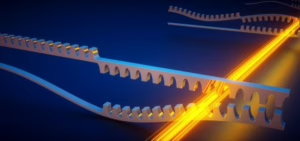
Our work in nanophotonics aims to develop new ways of routing and switching light with minimal energy consumption and beyond the constraints of reciprocity. We use nanophotonic field enhancement and quantum-limited measurement techniques to improve the sensitivity of sensors for small forces, fields, and molecules. In nanostructured silicon devices, we develop novel ways to guide acoustic waves and create quantum acoustic interfaces for spin qubits.















Photonic Forces Latest news



Most recent publications