Research highlights

Quantifying topological protection of light on a chip

Photonic topological insulators are currently at the forefront of on-chip photonic research due to their potential for loss-free information transport. Realized in photonic crystals, they enable robust propagation of optical states along domain walls. But how robust is robust? In order to answer this, researchers from AMOLF and TU Delft quantified photonic edge state transport using phase-resolved near-field optical microscopy. The findings provide a crucial step towards error-free integrated photonic quantum networks. The results were published in the journal Light Science & Applications.

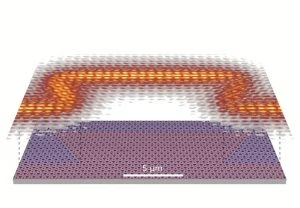
Experimental visualization of light propagation in a topological photonic crystal. The top shows a two-dimensional map of the light field flowing unhindered around four corners. It is measured with a scanning probe that detects the field just above the photonic crystal membrane in which it propagates. The bottom shows an electron microscope image of the structure, with the domain wall that guides the edge waves separating the blue and red domains of topological crystals. Credits images: Sonakshi Arora, Thomas Bauer, and co-authors

Topologically tailored photonic crystals have opened up the possibility for attaining robust unidirectional transport of photonic signals. The unprecedented guiding capabilities – supporting unhindered transport around imperfections and sharp corners without the need for any optimization – are highly beneficial for efficient distribution of information through dense on-chip photonic networks at telecom wavelengths. However, transport properties of such topologically non-trivial states have so far only been inferred by transmission measurements, and quantification of robustness remains challenging.

In a new paper published in Light: Science & Applications, a team of researchers led by former AMOLF group leader Kobus Kuipers (currently at Delft University of Technology) and Ewold Verhagen (AMOLF, Photonic Forces group), reports a rigorous robustness evaluation of photonic edge eigenstates at telecom wavelengths. They fabricated a topological photonic crystal that consists of triangular holes perforating a silicon membrane. The crystal contains two different hole sizes, which gives the mathematical description of light waves propagating in the crystal a special structure, or ‘topology’. Then, when two crystals with different arrangements of the smaller and larger holes are brought together, the boundary between both crystals supports a light wave that has intriguing properties; it can flow unhindered around any sharp corner of the boundary. The researchers visualized those photonic edge states in the photonic chip with a phase-resolved near-field optical microscope. The technique allowed them to separate forward propagating light from backward travelling waves with extreme sensitivity and thus perform local monitoring of back-scattering along the domain wall.

The researchers further complemented their quantitative analysis of the topological edge waves with light waves propagating in an ordinary photonic crystal waveguide.
They found that in stark contrast to the waves in the topological crystal, the light in the ordinary crystal shows significant loss across a ‘defect’, consisting of four sharp waveguide corners. The light waves are scattered to a back-reflected wave. The topological waves instead flow around the sharp corners seemingly unhindered. The researchers were able to conclude that the topological protection reduces the back-reflection from an individual corner by two orders of magnitude for all optical frequencies.

Reference
Sonakshi Arora, Thomas Bauer, René Barczyk, Ewold Verhagen and L. Kuipers, Direct quantification of topological protection in symmetry-protected photonic edge states at telecom wavelengths, Light: Science & Applications, 10, 9 (2021).

Share article
What's happening

Most recent news items

All news items
Joining forces to study perovskite interfaces
People and recognition

Joining forces to study perovskite interfaces

AMOLF group leaders Professor Wiebke Albrecht and Professor Bruno Ehrler have received an NWO ENW-M2 grant for their joint research project, The Dynamic Atomic Interface between Halide Perovskites and Metals. The insights gained will pave the way for sustainable, high-performance solar energy and information technology. Wiebke and Bruno will each hire a PhD student for this project. The grant amounts to €800.000.

Read news item
Wim Noorduin and Arian van Asten presenting their scientific journey
People and recognition

Wim Noorduin and Arian van Asten presenting their scientific journey

On October 8, Professor Wim Noorduin and his collaborator Professor Arian van Asten (University of Amsterdam) presented their scientific journey in a video to the audience at the ‘Avond van Wetenschap en Maatschappij’. They did so alongside the other nominees for the Huibregtsen Prize.

Read news item
Natural phenomena ‘hyperuniform disorder’ enables highly efficient, thin silicon solar cells
Research highlights

Natural phenomena ‘hyperuniform disorder’ enables highly efficient, thin silicon solar cells

Silicon solar panels are rigid and heavy, and many rooftops cannot support them. This creates a need for thin, flexible solar cells that can be integrated into building materials. However, making silicon solar cells thinner makes it harder to trap light inside the material. Researchers in the 3D Photovoltaics group found a fascinating way to overcome this challenge using a phenomenon called hyperuniform disorder. They publish their findings in the journal ACS Photonics.

The researchers were able to make highly efficient silicon solar cell materials that are 30 times thinner than conventional ones. They managed to do this by integrating a layer of nanometer sized structures on top of the material. Up close, this pattern looks random, but it is remarkably when you step back: no clumps, no gaps, and no repeating pattern. This is called hyperuniform disorder (or HUD).

Read news item
Stay informed

Get the latest research highlights, events, and news from our institute delivered to your inbox