The response of electrons and other charged particles to magnetic fields leads to many unique phenomena in materials. “For a long time, we have wanted to know whether an effect similar to a magnetic field on electrons could be achieved on sound, which has no charge,” says Verhagen. “The influence of a magnetic field on electrons has a wide impact: for example, an electron in a magnetic field cannot move along the same path in the opposite direction. This principle lies at the basis of various exotic phenomena at the nanometer scale, such as the quantum Hall effect and the functioning of topological insulators (materials that conduct current perfectly at their edges and not in their bulk). For many applications, it would be useful if we could achieve the same for vibrations and sound waves and therefore break the symmetry of their propagation, so it is not time-reversal symmetric anymore.”
Magnetic field for sound
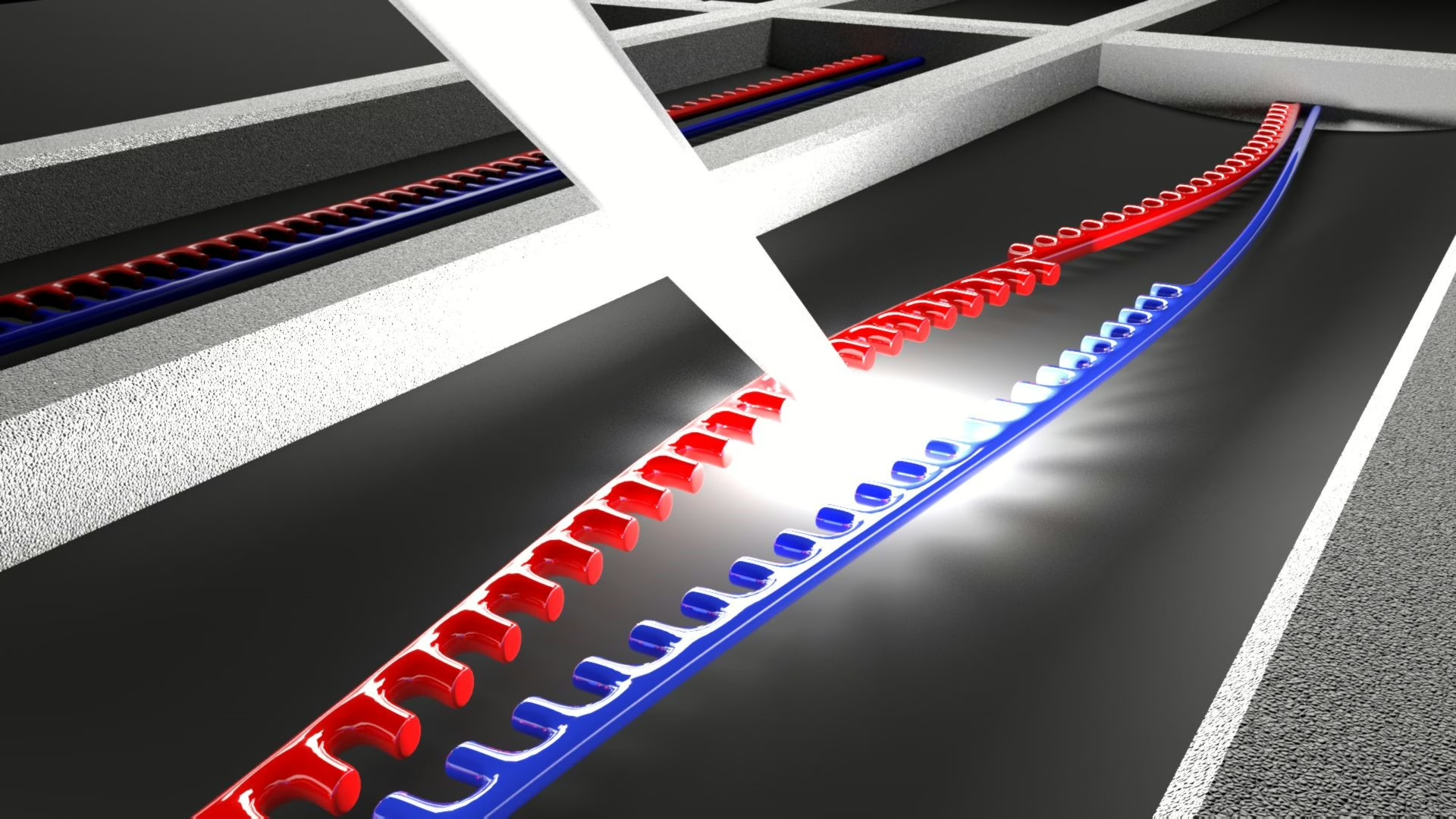
Unlike electrons, mechanical vibrations have no charge, and so they do not respond to magnetic fields. However, they are sensitive to the radiation pressure of light. Verhagen’s group therefore used laser light to influence mechanical nano-resonators. In 2020, they used these same vibrating strings to demonstrate that time-reversal symmetry could be broken for sound that jumps from one resonator to another: sound transfer from one string to another is different than in the opposite direction. See also the news item of February 3rd, 2020. “We have now shown that if we make a network of multiple vibrating nano-strings, we can realize a range of unconventional vibrational patterns by illuminating the strings with laser light,” states Verhagen. “For example, we managed to get sound particles (phonons) to move in a single direction in the same way as electrons in the quantum Hall effect.”

Amplification
The researchers realized that they could also use the radiation pressure to control the amplification and attenuation of the sound. “That works in a similar manner to a child on a swing extending or pulling back its legs at the right moment,” explains Verhagen. “Such amplification or attenuation is not possible for electrons in a magnetic field.”
The researchers were the first to conduct experiments in which the driving light amplifies the sound waves while at the same time ensuring that these experience an effect similar to that of a magnetic field. “We discovered that the combination of amplification and breaking the time-reversal symmetry leads to a range of new and unexpected physical effects,” says Verhagen. “First of all, laser light determines the direction in which the sound is amplified. In the other direction, the sound is blocked. This is caused by a geometric phase: a quantity that indicates the extent to which the sound wave is shifted as it passes through the network of nano-strings, which in this case is caused by the radiation pressure. Our experiment allowed us to fully control and alter that geometric phase. In addition, we used the radiation pressure of the laser light to amplify the sound. That sound can even spontaneously start to oscillate, like light in a laser. We discovered that the geometric phase we apply determines whether that happens or not, and with what strength of amplification.”
New materials
The researchers discovered that new geometric phases could be realized in systems where that was not considered to be possible. In all of these, the phases influence the amplification, direction, and pitch of the sound waves. “Geometric phases are important in many branches of physics, describing the behavior of different systems and materials. When combined with magnetic fields, they can lead to a topological insulator for electrons, but which properties a ‘sound’ variant based on the discovered principles could have is something we still need to learn. However, we do know that this will not be similar to anything we know,” states Verhagen. “We could further investigate the effects by linking more nano-strings in acoustic ‘metamaterials’ that we control with light. But the effects that we have observed should apply to a range of waves without charge, including light, microwaves, cold atoms, et cetera. We expect that with the new mechanisms we have discovered, it will be possible to produce new (meta)materials with properties that we do not yet know from existing materials.”
Such materials and systems have unusual properties that might have useful applications. Verhagen: “It is still too early to provide a complete overview of the possibilities. However, we can already recognize some potential directions. For example, a unidirectional amplifier for waves could have useful applications in quantum communication. We could also make sensors far more sensitive by breaking the time-reversal symmetry.”
Reference
Javier del Pino, Jesse J. Slim, Ewold Verhagen, Non-Hermitian chiral phononics through optomechanically-induced squeezing, Nature, 2 June (2022).
doi:10.1038/s41586-022-04609-0