
Research highlights

Nanoscale motion sends light into overdrive

Researchers demonstrate record strong conversion of motion into light

 AMOLF researchers have developed nanoscale strings whose motion can be converted to light signals with unprecedented strength. This could allow for extremely precise sensors and comes with an important side-effect. “Analogous to a guitar amplifier in overdrive producing distorted sound waves, our strong motion-to-light conversion leads to distorted light signals”, says group leader Ewold Verhagen. “But these signals actually carry information about the motion that may lead to new ways of measuring quantum mechanical motion.” The researchers published their results on 7 July 2017 in Nature Communications.

When a guitar player turns up the volume of the amplifier to the highest gain levels, the ‘clean’ harmonic vibrations of the guitar strings are converted to distorted sound waves. This ‘dirty’ sound is often highly desired: the screaming of overdriven guitar amplifiers has defined the sound of rock music for decades.

Tightly confined light
The Photonic Forces group at AMOLF studies the interaction of motion and light using nanoscale silicon strings that vibrate like guitar strings at millions of times per second. The researchers use light to measure these vibrations with extreme precision. PhD student Rick Leijssen and his colleagues developed strings with a particular shape to squeeze light between the strings at a scale of tens of nanometers. “The tight confinement causes mechanical motion to be converted to light signals with unprecedented strength. This is a big step forward to creating motion sensors with extreme precision”, Leijssen says. “Such sensors could detect string vibrations with amplitudes as small as the size of a proton and could be used to measure small forces and masses.”
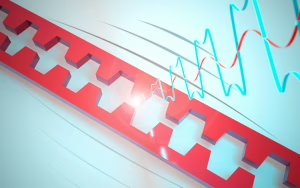
Artist impression: Tiny vibrations of nanoscale strings are converted to light signals. Whereas this usually produces a ‘clean’ modulation (shown in red), the extremely strong interaction between motion and light produces light signals that are distorted like the sound of an overdriven rock guitar (shown in blue).

Distorted signals
The record strong conversion of motion into light in the silicon strings has a side-effect. In fact, the conversion is so strong that even for the tiny intrinsic fluctuations of the strings the light gets ‘overdriven’, analogous to what happens in rock guitar amplifiers. Verhagen: “Similar to the screaming sound of an overdriven amplifier, the light signals in our experiment contain many higher harmonics (‘overtones’) of the fundamental string resonance. This is because the conversion between motion and light is no longer linear.”

Revealing quantum mechanical behavior
In a way, this nonlinear conversion forms a practical limit to the motion sensitivity. However, the distorted light signals could be put to new use. An important reason why the AMOLF physicists study tiny string vibrations is to reveal whether objects like strings behave according to the laws of quantum mechanics. Postdoctoral researcher Juha Muhonen: “The higher harmonics of the produced light signals carry different kinds of information about the nanostring motion. For example, we demonstrated that they allow measuring the energy of the vibration with a high accuracy. This could potentially lead to direct observations of quantized energy in the string, as we would expect from the theory of quantum mechanics.”

Reference
Rick Leijssen, Giada R. La Gala, Lars Freisem, Juha T. Muhonen, and E. Verhagen, Nonlinear cavity optomechanics with nanomechanical thermal fluctuations, Nature Commun. 2017 (DOI: 10.1038/ncomms16024)
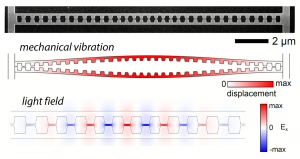
(top) Electron microscope image of the silicon nanostrings in the shape of a sliced photonic crystal. Their vibration (middle, motion exaggerated) strongly affects light that is trapped between the ‘teeth’ of the strings (bottom).


Share article
What's happening

Most recent news items

All news items
Collaboration

Successful outcomes of international EBEAM program led by AMOLF

The EU Pathfinder project Electron Beams Enhancing Analytical Microscopy (EBEAM) that was recently completed has received a highly positive review of the European Innovation Council (EIC). EBEAM brought together eight European research institutions and companies, including AMOLF, that develop new concepts and instruments combining spectroscopic analysis with electron microscopy.

Read news item
Research highlights

Everything you need to know about organoids

Organoids are instrumental in improving our understanding of processes that are otherwise hidden inside the body. For instance, these small 3D organs can be used to test medicines on tissue grown from a patient’s own cells. AMOLF researchers carry out unique and complex experiments to follow organoids in time. In order to enable other researchers to benefit from their experiences, they now publish their methods in the prestigious journal Nature Protocols.

Read news item
Events and outreach

Minister Rianne Letschert wears hat and shoulder ornament inspired by Wim Noorduin’s research

This year at the opening of the parliamentary year (Prinsjesdag) Minister of Education, Culture and Science Rianne Letschert wears a spectacular hat and shoulder ornament. Both of them are inspired by the microscopic structures studied by group leader Wim Noorduin (AMOLF/UvA), which look remarkably like tiny flowers under a microscope. Artist and designer Malou Beemer translated these shapes, normally invisible to the naked eye, into wearable art.

Read news item
Nachi Stern, Group Leader Learning Machines at AMOLF
People and recognition

Nachi Stern awarded ERC Starting Grant to explore how matter learns

Why do brains learn, but rocks do not? Could a material one day adapt to its environment the way a living organism does? AMOLF group leader Dr. Nachi Stern has been awarded an ERC Starting Grant to investigate the physical laws of learning, in a project called, “Physical Learning in Dynamical Systems.”

Read news item
Stay informed

Get the latest research highlights, events, and news from our institute delivered to your inbox