
News & updates
Latest developments from our institute
Stay informed about new research results, awards, events, and collaborations across our scientific community.
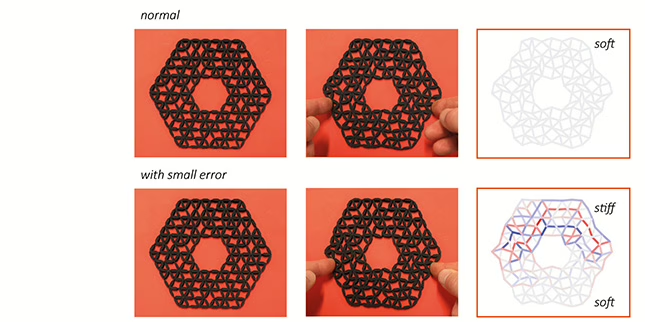
The peculiar effect of a small error
Metamaterials have properties that depend on their shape and architecture. Researchers at AMOLF, Leiden University and Tel Aviv University have found a new way of designing these metamaterials and their properties by deliberately incorporating small errors. They published their results on January 27th in Nature Physics.

Hybrid Heart shortlisted for £30 million research grant
On 21 January 2020, the British Heart Foundation (BHF) announced that Hybrid Heart project with AMOLF group leader Bas Overvelde is one of four finalists out of 75 initial submissions that will compete in the Big Beat Challenge. The winner will receive 30 million GBP to explore and develop a radical new approach to treat cardiovascular diseases. With the World Health Organization (WHO) forecasting an increase in cardiovascular deaths worldwide, the Big Beat Challenge is a global initiative to encourage researchers and inspire transformational solutions to tackle the world’s biggest killer. As the next step, the Hybrid Heart team has to submit a full application in June 2020. The winner of the prestigious award will be announced by the end of 2020.
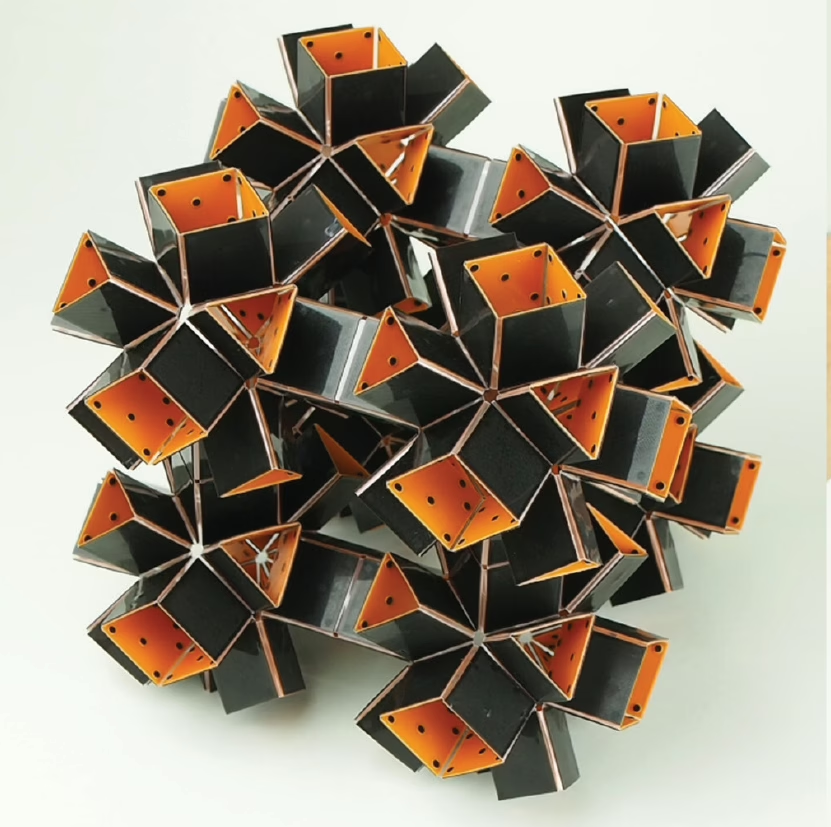
Smart simulations chart the behavior of surprising structures
AMOLF researchers are studying three-dimensional prismatic structures that can assume different shapes, with the aim of producing metamaterials that have multiple properties. Researchers have found a new way to simulate the deformations in such structures, and in doing so, they discovered a wide range of unexpected shapes. The results will be published today in the scientific journal Nature Communications.

Said Rodriguez wins Early Career Award
Today the Royal Academy announced that AMOLF group leader Said Rodriguez is one of the winners of the Early Career Award. With this new prize the Academy wishes to reward talented researchers that have just started their career in the Netherlands. To further develop their original research ideas, the group of twelve researchers are rewarded today by the Academy. The prize consists of 15.000 euros and an artwork.
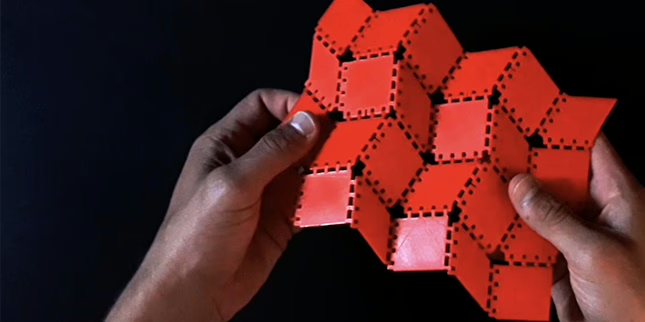
Alphabet of 140 puzzle-pieces programs origami
How can a single origami crease pattern be folded into two precisely defined target shapes? Researchers at AMOLF and Leiden University have created an ‘alphabet’ of 140 origami ‘puzzle-pieces’ that allows them to do just that, as described today in Nature Physics. This discovery could help in the construction of origami robots and towards designing smart programmable materials.
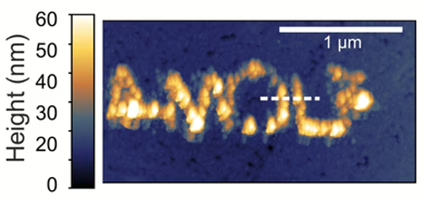
Microscope prints patterns at the nanoscale
Researchers from AMOLF’s 3D-Photovoltaics group have successfully used an atomic force microscope to electrochemically print at the nanoscale. This technique can print structures for a new generation of solar cells on chips. The researchers published their results today in the journal Nanoscale.

AMOLF 70th year anniversary
This year September 15th is a special day for AMOLF. On this day exactly 70 years ago the Netherlands established AMOLF as a new research institute. At the time the task of the institute, which was called FOM Laboratory for Mass Spectrography, focused on finding out how to separate uranium isotopes. The research concentrated on the construction of a large electromagnetic isotope separator. The first sample (10 mg) of enriched 235U was made in 1953. In 1955 as a result of the Dutch developments, the American Congress decided to ‘declassify’ electromagnetic uranium separation technology.
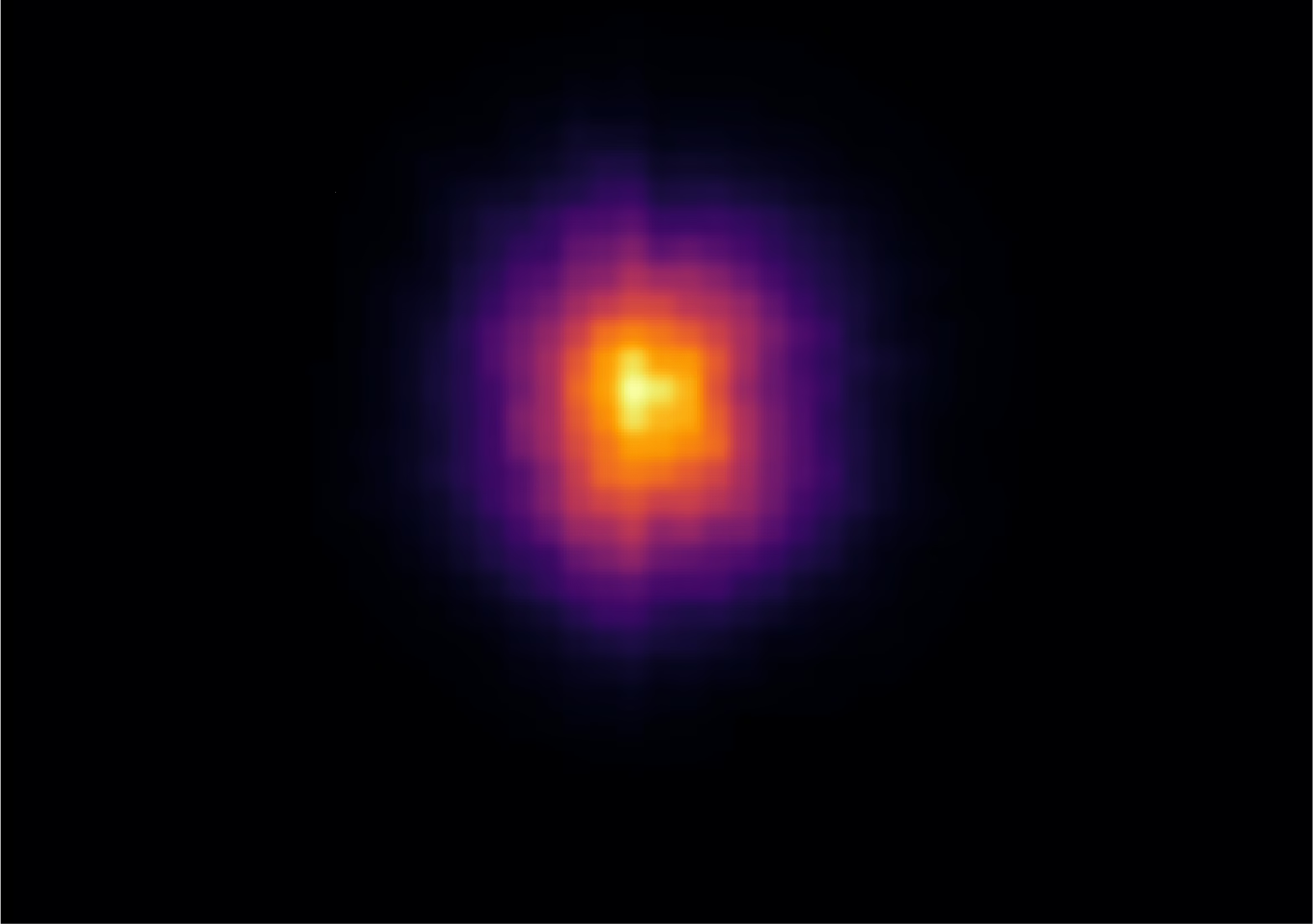
Snapshots freezing a nanoswing : Accurate position measurement overcomes thermal fluctuations
Physicists at AMOLF have managed to cool a swinging nanosized string to near-zero temperature without using external refrigeration. In their experiment, the cooling is an intrinsic result of the ‘snapshot’ position measurement they did on a specially designed nanostructure. The snapshot method, developed in AMOLF’s Photonic Forces group, offers opportunities for new applications in quantum sensing with unprecedented sensitivity.