
People and recognition

ERC Advanced Grant for Pieter Rein ten Wolde

Today the European Research Council (ERC) announced that 185 scientists receive an Advanced Grant of 2.5 million euros. One of them is AMOLF group leader Pieter Rein ten Wolde. He will use the grant to determine how accurately single-celled organisms can predict changes in their environment.

Optimal Cellular Prediction
We all live in a highly dynamic environment to which we continually have to respond and adapt. Yet, taking action takes time. We have therefore evolved the ability to anticipate changes in our environment and mount a response ahead of time. Experiments in recent years have vividly demonstrated that even single-celled organisms such as bacteria can predict, for example, future nutrient levels. Yet, how reliably they can do so, and what the costs and benefits of prediction are, have remained unclear. In this project Pieter Rein ten Wolde will combine measures from information theory and ideas from statistical physics to derive the fundamental limit to the prediction accuracy. He will determine how close living cells can come to this limit as set by resource constraints to build and operate the sensing system – protein copies, time, and energy. Finally, he will use this theoretical framework to set up experiments that will make it possible to test whether two specific biological systems, bacteria and yeast cells, have implemented the uncovered design principles for optimal cellular prediction.
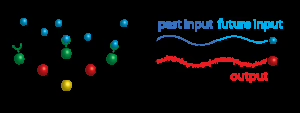
Fig.:Living cells use biochemical networks of interacting proteins to predict the future.

About the ERC’s grants
The European Research Council, set up by the European Union in 2007, is the premiere European funding organisation for excellent frontier research. Every year, it selects and funds the very best, creative researchers of any nationality and age, to run projects based in Europe. The ERC offers four core grant schemes: Starting, Consolidator, Advanced and Synergy Grants. With its additional Proof of Concept grant scheme, the ERC helps grantees to bridge the gap between their pioneering research and early phases of its commercialisation.

The European Research Council uses the ERC Advanced grants to allow outstanding research leaders to pursue ground-breaking, high-risk projects in Europe.

Read the ERC press release

Share article
What's happening

Most recent news items

All news items
Collaboration

Successful outcomes of international EBEAM program led by AMOLF

The EU Pathfinder project Electron Beams Enhancing Analytical Microscopy (EBEAM) that was recently completed has received a highly positive review of the European Innovation Council (EIC). EBEAM brought together eight European research institutions and companies, including AMOLF, that develop new concepts and instruments combining spectroscopic analysis with electron microscopy.

Read news item
Research highlights

Everything you need to know about organoids

Organoids are instrumental in improving our understanding of processes that are otherwise hidden inside the body. For instance, these small 3D organs can be used to test medicines on tissue grown from a patient’s own cells. AMOLF researchers carry out unique and complex experiments to follow organoids in time. In order to enable other researchers to benefit from their experiences, they now publish their methods in the prestigious journal Nature Protocols.

Read news item
Events and outreach

Minister Rianne Letschert wears hat and shoulder ornament inspired by Wim Noorduin’s research

This year at the opening of the parliamentary year (Prinsjesdag) Minister of Education, Culture and Science Rianne Letschert wears a spectacular hat and shoulder ornament. Both of them are inspired by the microscopic structures studied by group leader Wim Noorduin (AMOLF/UvA), which look remarkably like tiny flowers under a microscope. Artist and designer Malou Beemer translated these shapes, normally invisible to the naked eye, into wearable art.

Read news item
Nachi Stern, Group Leader Learning Machines at AMOLF
People and recognition

Nachi Stern awarded ERC Starting Grant to explore how matter learns

Why do brains learn, but rocks do not? Could a material one day adapt to its environment the way a living organism does? AMOLF group leader Dr. Nachi Stern has been awarded an ERC Starting Grant to investigate the physical laws of learning, in a project called, “Physical Learning in Dynamical Systems.”

Read news item
Stay informed

Get the latest research highlights, events, and news from our institute delivered to your inbox