
Research highlights

Olive oil sheds new light on universality in phase transitions

A simple drop of olive oil in a system of photons bouncing between two mirrors, has revealed universal aspects of phase transitions in physics. Researchers at AMOLF used an oil-filled optical cavity in which light undergoes phase transitions similar to those in boiling water. The system they studied has memory because the oil causes photons to interact with themselves. By varying the distance between the two mirrors and measuring the transmission of light through the cavity, they discovered a universal law describing phase transitions in systems with memory. These results are published on April 15th in Physical Review Letters.

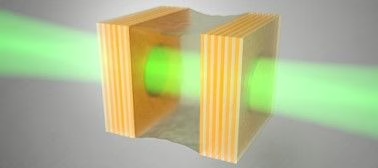
The experiments were performed with an optical cavity formed by two mirrors. Light sent through the cavity bounces between the mirrors before getting out where the transmission is measured. The researchers have filled this cavity with olive oil and changed the relative position of the mirrors at different speeds. Image by: Henk-Jan Boluijt (AMOLF)

The Interacting Photons research group at AMOLF studies non-linearity and noise in photonic systems. One of such systems is a cavity, formed by two mirrors facing each other at a close distance. Within the cavity, light bounces back and forth as it is reflected by the mirrors. Putting something inside such an optical cavity, changes the properties of the system. “We created a system with memory by placing a drop of olive oil inside the cavity”, says group leader Said Rodriguez. “The oil mediates effective photon-photon interactions, which we can see by measuring the transmission of laser light through this cavity.”

Scanning speed
Rodriguez and his PhD students Zou Geng and Kevin Peters analyzed the transmission while increasing and decreasing the distance between the two mirrors at different speeds. They found that the amount of light transmitted through the cavity depends on the direction of movement of the mirrors. “The transmission of light through the cavity is non-linear. At a certain distance between the mirrors, the amount of transmitted light depends on whether we are opening the cavity or closing it,” Rodriguez explains. “This behavior is called hysteresis. It is also observed in certain phase transitions, like in boiling water or magnetic materials.”

Universal
However, in the cavity with olive oil, hysteresis is not always present, the researchers observed when they increased the speed at which the cavity opens and closes. Rodriguez: “In faster scans, we saw the hysteresis vanish as a function of the scanning speed. This happens at a universal rate, independent of parameters like light intensity or the strength of the non-linearity. The equations that describe how light behaves in our oil-filled cavity are similar to those describing collections of atoms, superconductors and even high energy physics. Therefore, the universal behavior we discovered is likely to be observed in such systems as well.”

Coupling cavities
While it would be interesting to investigate the universal scaling behavior in other systems with memory, Rodriguez will keep his focus on oil-filled cavities. “Our system has a strong optical non-linearity at room temperature, which offers opportunities for potential applications”, he says. “We are currently investigating what happens when we couple two or more cavities. Because each system has memory, an array of cavities might eventually be useful as a computational tool, or maybe even in sensing applications.”

Reference
Z. Geng, K.J.H. Peters, A.A.P. Trichet, K. Malmir, R. Kolkowski, J.M. Smith and S.R.K. Rodriguez, Universal scaling in the dynamic hysteresis, and non-Markovian dynamics, of a tunable optical cavity, Physical Review Letters, 124, (2020)
Share article
What's happening

Most recent news items

All news items
Collaboration

Successful outcomes of international EBEAM program led by AMOLF

The EU Pathfinder project Electron Beams Enhancing Analytical Microscopy (EBEAM) that was recently completed has received a highly positive review of the European Innovation Council (EIC). EBEAM brought together eight European research institutions and companies, including AMOLF, that develop new concepts and instruments combining spectroscopic analysis with electron microscopy.

Read news item
Research highlights

Everything you need to know about organoids

Organoids are instrumental in improving our understanding of processes that are otherwise hidden inside the body. For instance, these small 3D organs can be used to test medicines on tissue grown from a patient’s own cells. AMOLF researchers carry out unique and complex experiments to follow organoids in time. In order to enable other researchers to benefit from their experiences, they now publish their methods in the prestigious journal Nature Protocols.

Read news item
Events and outreach

Minister Rianne Letschert wears hat and shoulder ornament inspired by Wim Noorduin’s research

This year at the opening of the parliamentary year (Prinsjesdag) Minister of Education, Culture and Science Rianne Letschert wears a spectacular hat and shoulder ornament. Both of them are inspired by the microscopic structures studied by group leader Wim Noorduin (AMOLF/UvA), which look remarkably like tiny flowers under a microscope. Artist and designer Malou Beemer translated these shapes, normally invisible to the naked eye, into wearable art.

Read news item
Nachi Stern, Group Leader Learning Machines at AMOLF
People and recognition

Nachi Stern awarded ERC Starting Grant to explore how matter learns

Why do brains learn, but rocks do not? Could a material one day adapt to its environment the way a living organism does? AMOLF group leader Dr. Nachi Stern has been awarded an ERC Starting Grant to investigate the physical laws of learning, in a project called, “Physical Learning in Dynamical Systems.”

Read news item
Stay informed

Get the latest research highlights, events, and news from our institute delivered to your inbox