
News & updates
Latest developments from our institute
Stay informed about new research results, awards, events, and collaborations across our scientific community.

Evolutionary conflicts predicted
Evolution seems to be an unpredictable process. However, predicting the constraints of evolution is possible. Researchers from AMOLF and the French ESPCI have demonstrated this using their mathematical method, followed by experiments on bacteria. On June 24, they publish their results in the journal Cell Systems.
Olive oil sheds new light on universality in phase transitions
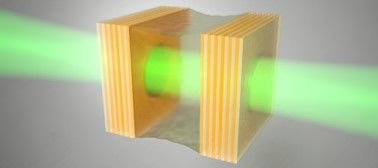
A simple drop of olive oil in a system of photons bouncing between two mirrors, has revealed universal aspects of phase transitions in physics. Researchers at AMOLF used an oil-filled optical cavity in which light undergoes phase transitions similar to those in boiling water. The system they studied has memory because the oil causes photons to interact with themselves. By varying the distance between the two mirrors and measuring the transmission of light through the cavity, they discovered a universal law describing phase transitions in systems with memory. These results are published on April 15th in Physical Review Letters.

Rubicon grant for Hugo Doeleman
Former PhD student Hugo Doeleman has received a Rubicon grant from NWO to carry out his research proposal at ETH Zurich. At AMOLF Doeleman was a group member of the Resonant Nanophotonics group led by Femius Koenderink. His doctoral research was done in close collaboration with Ewold Verhagen (AMOLF) and Robert Spreeuw (UvA). Doeleman left AMOLF after defending his thesis ‘Hybrid Resonators for Light Trapping and Emission Control’, for which he obtained a cum laude degree.

Bela Mulder appointed at Utrecht University
As of 1 January, Bela Mulder (Theory of Biomolecular Matter) has been appointed Professor by Special Appointment in Theoretical Biophysics at Utrecht University.

ERC Advanced Grant for Pieter Rein ten Wolde
Today the European Research Council (ERC) announced that 185 scientists receive an Advanced Grant of 2.5 million euros. One of them is AMOLF group leader Pieter Rein ten Wolde. He will use the grant to determine how accurately single-celled organisms can predict changes in their environment.
Topology protects light propagation in photonic crystal
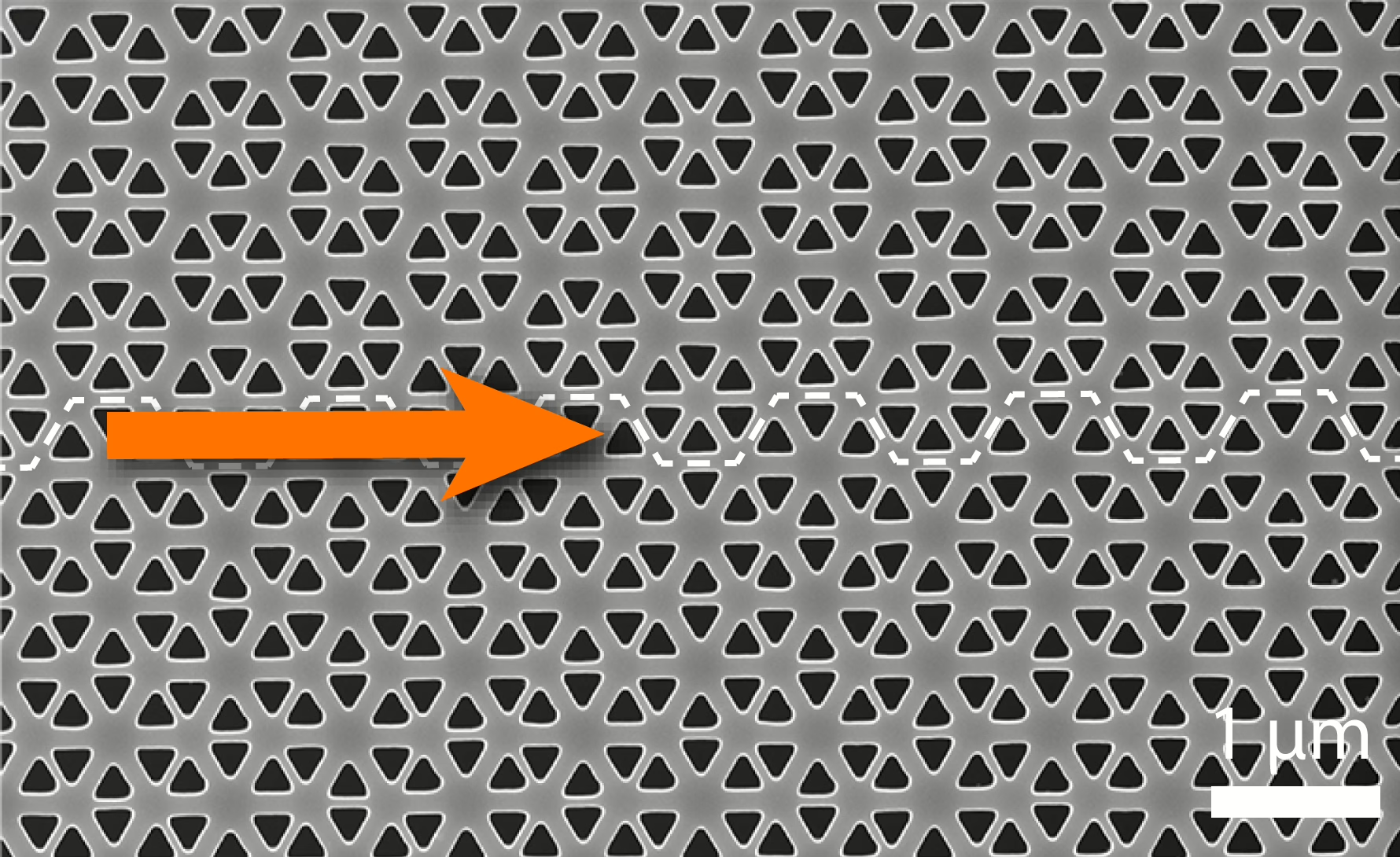
Researchers of AMOLF and TU Delft have seen light propagate in a special material without it suffering from reflections. The material, a photonic crystal, consists of two parts that each have a slightly different pattern of perforations. Light can propagate along the boundary between these two parts in a special way: it is ‘topologically protected’ and, therefore, does not bounce back at imperfections. Even when the boundary forms a sharp corner, the light follows it without a problem. “For the first time, we have seen these fascinating light waves move at the technologically relevant scale of nanophotonics,” says Ewold Verhagen, group leader at AMOLF. The results are published on March 6th in the scientific journal Science Advances.
Organoid project granted in NWO Open Competition Domain Science
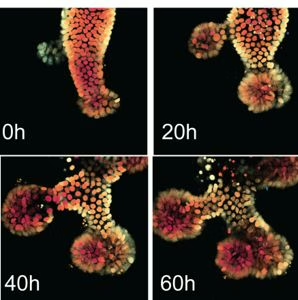
The project ‘Organoids in time’ is one out of twenty new consortia that can start thanks to NWO funding: the Open Competition Domain Science. The grant consists of a total of 2.5 million euros.
Researchers discover new mechanism for the coexistence of species
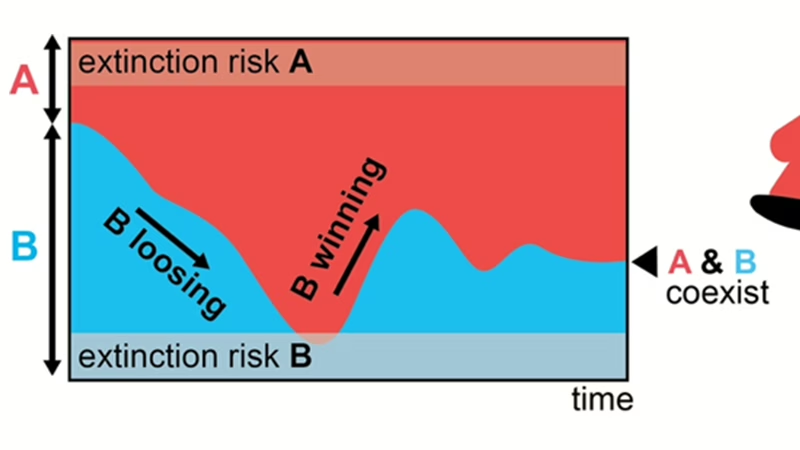
Researchers from AMOLF and Harvard University (USA) show how the ability of organisms to move around plays a role in stabilizing ecosystems. In their paper published 19 February 2020 in Nature, they describe how the competition between ‘movers’ and ‘growers’ leads to a balance in which both types of bacteria can continue to exist alongside each other.