Research highlights

Triple PV highlights: three articles on light management in thin-film solar cells

Within a relatively short time span three leading scientific journals published papers on solar cell research carried out at AMOLF in the Light Management in New Photovoltaic Materials (LMPV) research program. The first author of these three papers is former AMOLF PhD student Claire van Lare. She demonstrates new scattering patterns for efficient light management in ultrathin solar cells. Van Lare graduated in October 2014 on a PhD thesis “Light-trapping in thin-film solar cells using dielectric and metallic nanostructures”.

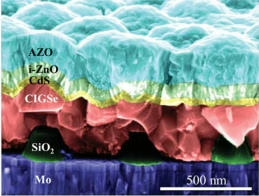
Van Lare wrote the most recent paper, published in ACS Nano, together with colleagues from the Helmholtz Centre in Berlin. They show how SiO2 nanoparticles, made using soft nanoimprinting, can be used to enhance light trapping in ultrathin CuInGaSe solar cells. Nanoparticles positioned on the molybdenum back contact are able to not only reduce unwanted light absorption in the Mo, but also increase the cell voltage, by reducing interface recombination at the Mo/CuInGaSe interface. As a result cell efficiency is raised from 11.1% to 12.3%.

In a paper in Nano Letters Van Lare presents a new light trapping geometry for thin-film solar cells composed of dielectric light scattering nanocavities at the interface of the metal back contact and the semiconductor absorber layer. The geometry is based on resonant Mie scattering and avoids the Ohmic losses found in plasmonic nanopatterns that are widely studied. The insights can be applied to improve the efficiency of ultrathin amorphous Si solar cells. The paper also reveals the role of resonant light scattering from both the AZO nanostructures and the embedded Si nanostructures. The results are generic and can be applied to nearly all thin-film solar cells.

In a third paper, in ACS Photonics, Van Lare presents an approach to optimize the spatial frequency spectrum of nanopatterns that are used for scattering light into the solar cell. A Monte Carlo algorithm is used to optimize the scattering power spectral density of an array of Mie scatterers on top of ultrathin amorphous Si solar cells in such a way that it overlaps with the discrete spectrum of waveguide modes in the cell. The optimized geometry outperforms other options, such as optimized periodic patterns, purely random arrays and commercially used Asahi-U-type geometries.

References
M.C. van Lare, F. Lenzmann, and A. Polman, Dielectric scattering patterns for efficient light trapping in thin-film solar cells Nano Lett. 15, 4846 (2015) | DOI: 10.1021/nl5045583

M.C. van Lare and A. Polman, Optimized scattering power spectral density of photovoltaic light trapping patterns ACS Photon. 2, 822 (2015) | DOI: 10.1021/ph500449v

M.C. van Lare, G. Yin, A. Polman, and M. Schmid, Light trapping in ultra-thin CIGSe solar cells using dielectric scattering patterns ACS Nano, (2015) | DOI: 10.1021/acsnano.5b04091
photonic materials albert polman claire van lare


Cross section of CIGS solar cell with light-trapping SiO2 nanoparticles at the Mo/CIGS interface. Collaboration between AMOLF and Helmholz Centre Berlin
.

Share article
What's happening

Most recent news items

All news items
Collaboration

Successful outcomes of international EBEAM program led by AMOLF

The EU Pathfinder project Electron Beams Enhancing Analytical Microscopy (EBEAM) that was recently completed has received a highly positive review of the European Innovation Council (EIC). EBEAM brought together eight European research institutions and companies, including AMOLF, that develop new concepts and instruments combining spectroscopic analysis with electron microscopy.

Read news item
Research highlights

Everything you need to know about organoids

Organoids are instrumental in improving our understanding of processes that are otherwise hidden inside the body. For instance, these small 3D organs can be used to test medicines on tissue grown from a patient’s own cells. AMOLF researchers carry out unique and complex experiments to follow organoids in time. In order to enable other researchers to benefit from their experiences, they now publish their methods in the prestigious journal Nature Protocols.

Read news item
Events and outreach

Minister Rianne Letschert wears hat and shoulder ornament inspired by Wim Noorduin’s research

This year at the opening of the parliamentary year (Prinsjesdag) Minister of Education, Culture and Science Rianne Letschert wears a spectacular hat and shoulder ornament. Both of them are inspired by the microscopic structures studied by group leader Wim Noorduin (AMOLF/UvA), which look remarkably like tiny flowers under a microscope. Artist and designer Malou Beemer translated these shapes, normally invisible to the naked eye, into wearable art.

Read news item
Nachi Stern, Group Leader Learning Machines at AMOLF
People and recognition

Nachi Stern awarded ERC Starting Grant to explore how matter learns

Why do brains learn, but rocks do not? Could a material one day adapt to its environment the way a living organism does? AMOLF group leader Dr. Nachi Stern has been awarded an ERC Starting Grant to investigate the physical laws of learning, in a project called, “Physical Learning in Dynamical Systems.”

Read news item
Stay informed

Get the latest research highlights, events, and news from our institute delivered to your inbox