Research highlights

Transforming Self-Assembled Architectures into Functional Materials

Imagine if a material would arrange itself into a shape suited for its application. It may result in a catalyst that maximizes its own surface area for improved efficiency or a micro-actuator that forms appendages to grab nearby objects. This is the promise that self-assembly holds: making complex, functional materials by letting matter shape itself. Yet, not all matter that self-assembles into interesting forms turns out to have a useful function in its final shape. Researchers of the Self-Organizing Matter group recently discovered that ion exchange allows them to separate the self-assembly process from the resulting material. Their findings were published in Advanced Materials on November 16th and highlighted in Nature and Nature Reviews Materials.

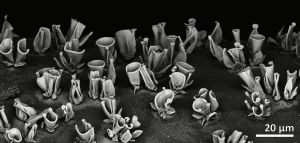
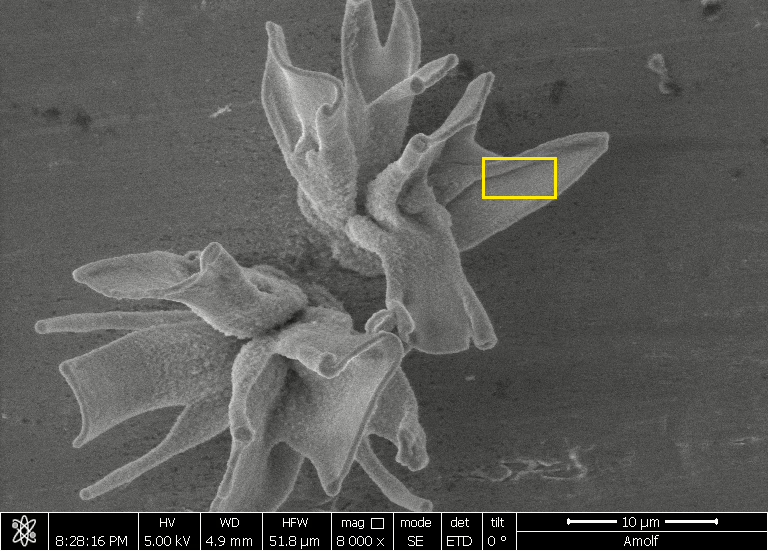
A field of converted nanocomposites, their shape formed with self-assembly and their composition tuned with conversion reactions.

With their beautiful and intricate shapes the nanocomposites studied by the Self-Organizing Matter group look quite remarkable (see illustration). Yet, PhD students Hans Hendrikse and Arno van der Weijden wanted more than beautiful structures and had an itch to also utilize the functionality of the nanocomposites. Encouraged by the shapeability and structural layout of their nanocomposites, they started investigating the options together with researchers from the University of Amsterdam, ARNCL, Leiden University and Virginia Tech.

The research team started off with nanocomposites that consisted of barium carbonate (BaCO3) nanocrystals embedded in a silica (SiO2) matrix and converted these to cadmium sulphide (CdS). First, they established a route to reproducibly convert the nanocomposites to this final material, while investigating the properties of the nanocomposites during ion exchange. Through analysis with electron microscopy and x-ray diffraction the team learned something fascinating: the small size of the BaCO3 nanocrystals made them exceptionally susceptible to ion exchange reactions, while the surrounding SiO2 matrix provided mechanical stability to maintain the original nanocomposite’s shape during conversion. Hans Hendrikse says, “it is almost like we are changing out some of the bricks of a house while keeping the overall structure intact.”

Based on these insights, expanding the selection of materials was straightforward and new routes were developed to change the nanocomposite’s composition to various cadmium, iron, nickel and manganese salts. Moreover, the original nanocomposite can be shaped in a large selection of pre-determined shapes. All these shapes can be converted to any of the above mentioned compositions. So not only is it possible to convert nanocomposites, there is also a variety of materials and shapes to interchangeably choose from.
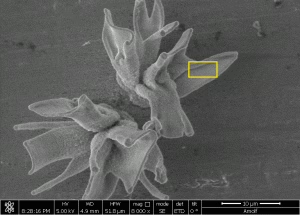
Click on picture to see: animated gif illustrating a micro-actuator created by applying ion exchange techniques on a nanocomposite

Finally, the team explored the potential applications of this new approach. For instance, they discovered that the nickel-containing nanocomposites can be used as catalysts for the dry-reforming process, which outperforms traditional catalysts at low temperatures. Furthermore, the team synthesized shape-controlled magnetite (Fe3O4) nanocomposites that can be moved and reorientated using their magnetic properties. Finally, they created e-beam activated microscopic actuators by utilizing flexibility introduced during one of the ion exchange reactions in conjunction with the shrinking properties of the silica matrix. In short, they discovered shape-preserving ion-exchange reactions that open up new routes towards self-assembled materials with various novel, functional properties.

Reference
H.C. Hendrikse, A. van der Weijden, M. Ronda‐Lloret, T. Yang, R. Bliem, N. Raveendran Shiju, M. van Hecke, L. Li and W.L. Noorduin, Shape‐preserving chemical conversion of architected nanocomposites, Advanced Materials (2020).



Share article
What's happening

Most recent news items

All news items
Collaboration

Successful outcomes of international EBEAM program led by AMOLF

The EU Pathfinder project Electron Beams Enhancing Analytical Microscopy (EBEAM) that was recently completed has received a highly positive review of the European Innovation Council (EIC). EBEAM brought together eight European research institutions and companies, including AMOLF, that develop new concepts and instruments combining spectroscopic analysis with electron microscopy.

Read news item
Research highlights

Everything you need to know about organoids

Organoids are instrumental in improving our understanding of processes that are otherwise hidden inside the body. For instance, these small 3D organs can be used to test medicines on tissue grown from a patient’s own cells. AMOLF researchers carry out unique and complex experiments to follow organoids in time. In order to enable other researchers to benefit from their experiences, they now publish their methods in the prestigious journal Nature Protocols.

Read news item
Events and outreach

Minister Rianne Letschert wears hat and shoulder ornament inspired by Wim Noorduin’s research

This year at the opening of the parliamentary year (Prinsjesdag) Minister of Education, Culture and Science Rianne Letschert wears a spectacular hat and shoulder ornament. Both of them are inspired by the microscopic structures studied by group leader Wim Noorduin (AMOLF/UvA), which look remarkably like tiny flowers under a microscope. Artist and designer Malou Beemer translated these shapes, normally invisible to the naked eye, into wearable art.

Read news item
Nachi Stern, Group Leader Learning Machines at AMOLF
People and recognition

Nachi Stern awarded ERC Starting Grant to explore how matter learns

Why do brains learn, but rocks do not? Could a material one day adapt to its environment the way a living organism does? AMOLF group leader Dr. Nachi Stern has been awarded an ERC Starting Grant to investigate the physical laws of learning, in a project called, “Physical Learning in Dynamical Systems.”

Read news item
Stay informed

Get the latest research highlights, events, and news from our institute delivered to your inbox