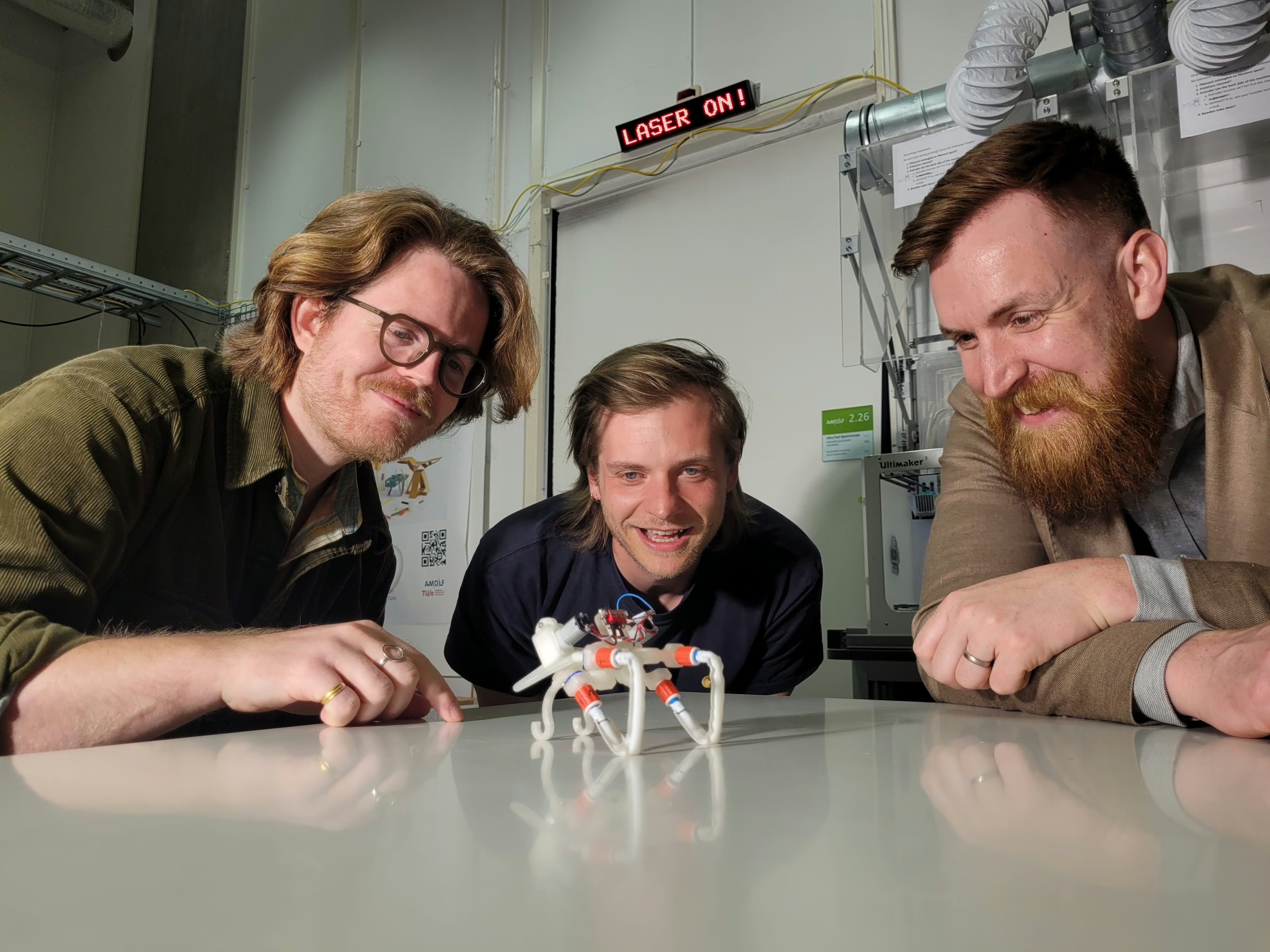
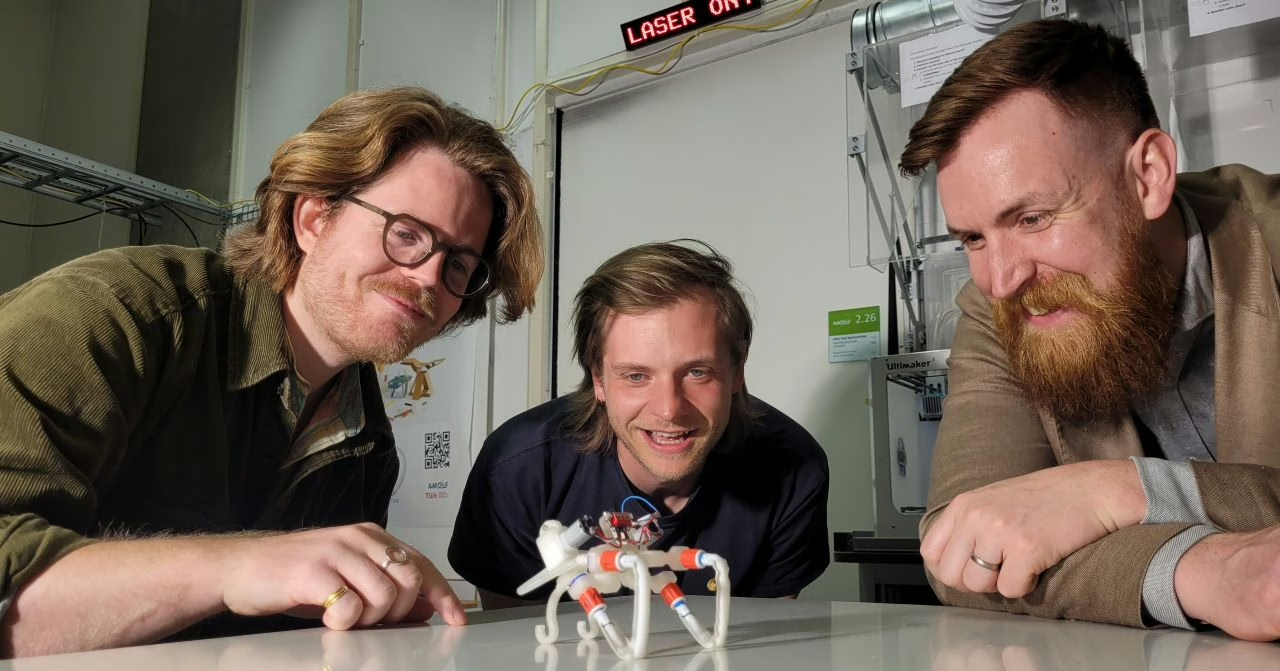
The study published this week in Science describes one of the fastest soft robots yet, and one of the simplest. It has no computer, no software, and no sensors. And still, it moves with surprising coordination and autonomy, simply because of its body and how it interacts with the world.
How does it work?
So, what’s really driving it? Underneath the movement is a principle you’ve probably seen, though maybe overlooked. Think of those wobbly, inflatable tube dancers flailing around in front of gas stations. The same physics that makes them wiggle could hold the key to the next generation of autonomous robots.
Watch a short movie showcasing the machine’s behavior and underlying physics:
Chaos turns into order
Powered by a continuous stream of air alone, each of the robot’s soft, tubular legs begins to oscillate — not unlike those tube dancers. On its own, each leg waves around randomly. But when many are coupled together, something unexpected happens: their motions quickly synchronize, falling into rhythmic locomotion gaits.
“Suddenly, order emerges from chaos,” says first author Alberto Comoretto. “There’s no code, no instructions. The legs simply fall into sync spontaneously, and the robot takes off.” As with fireflies flashing in synchrony or heart cells pulsating in unison, complex collective motions arise from simple interactions.
And it’s fast. When a flow of air is given as input, the robot hits 30 body lengths per second. Relatively speaking, a Ferrari reaches “only” 20 lengths per second. This speed is orders of magnitude faster than other air-powered robots, which typically require centralized control.
Decentralized intelligence
Even more surprising: the synchronization adapts. If the robot runs into an obstacle, it reorients itself. When it moves from land to water, the gait spontaneously shifts from an in-phase hopping pattern to a swimming freestyle. These transitions happen without any central processor or control logic. Instead, movement emerges from the tight coupling between body and environment.
“In biology, we often see similar decentralized intelligence,” explains co-author Mannus Schomaker. “Sea stars, for example, coordinate hundreds of tube feet using local feedback and body dynamics, not a centralized brain.”
The research challenges the conventional idea that robots need complicated control systems to realize lifelike behavior. “Simple objects, like tubes, can give rise to complex and functional behavior, provided we understand how to harness the underlying physics,” says principal investigator Bas Overvelde. In fact, Overvelde prefers not to call it a robot at all. “There is no brain, no computer. Essentially, it’s a machine. But when properly designed, it can outperform many robotic systems and behave like an artificial creature.”
How can this be applied?
Possible future applications range from smart pills to space tech. Safe microrobots without microelectronics, that can be swallowed and release drugs after autonomously reaching the target tissue. Robotic wearable exosuits that sync to the walking steps without processors — reducing their power consumption while enhancing human strength. Autonomous mechanical machines suited for extreme environments like space, where traditional electronics may fail. More broadly, these examples illustrate how this research opens doors to mechanical systems that behave as if they had a computer, without actually needing one.
With this work, the team hopes to inspire new ways of thinking about robotic design: simpler systems that are more adaptive and robust. Not through computation and AI, but through physics.
Reference:
Alberto Comoretto, Harmannus A.H. Schomaker, Johannes T.B. Overvelde, “Physical synchronization of soft self-oscillating limbs for fast and autonomous locomotion,” Science, May 8th (2025).
Read the full article: doi.org/10.1126/science.adr3661
Contact
Do you have questions or ideas that you want to discuss? Then you can contact Alberto Comoretto (email: a.comoretto@amolf.nl) or Bas Overvelde (email: b.overvelde@amolf.nl).