Discovery unlocks new exotic properties for soft robotics, smart devices, and more.
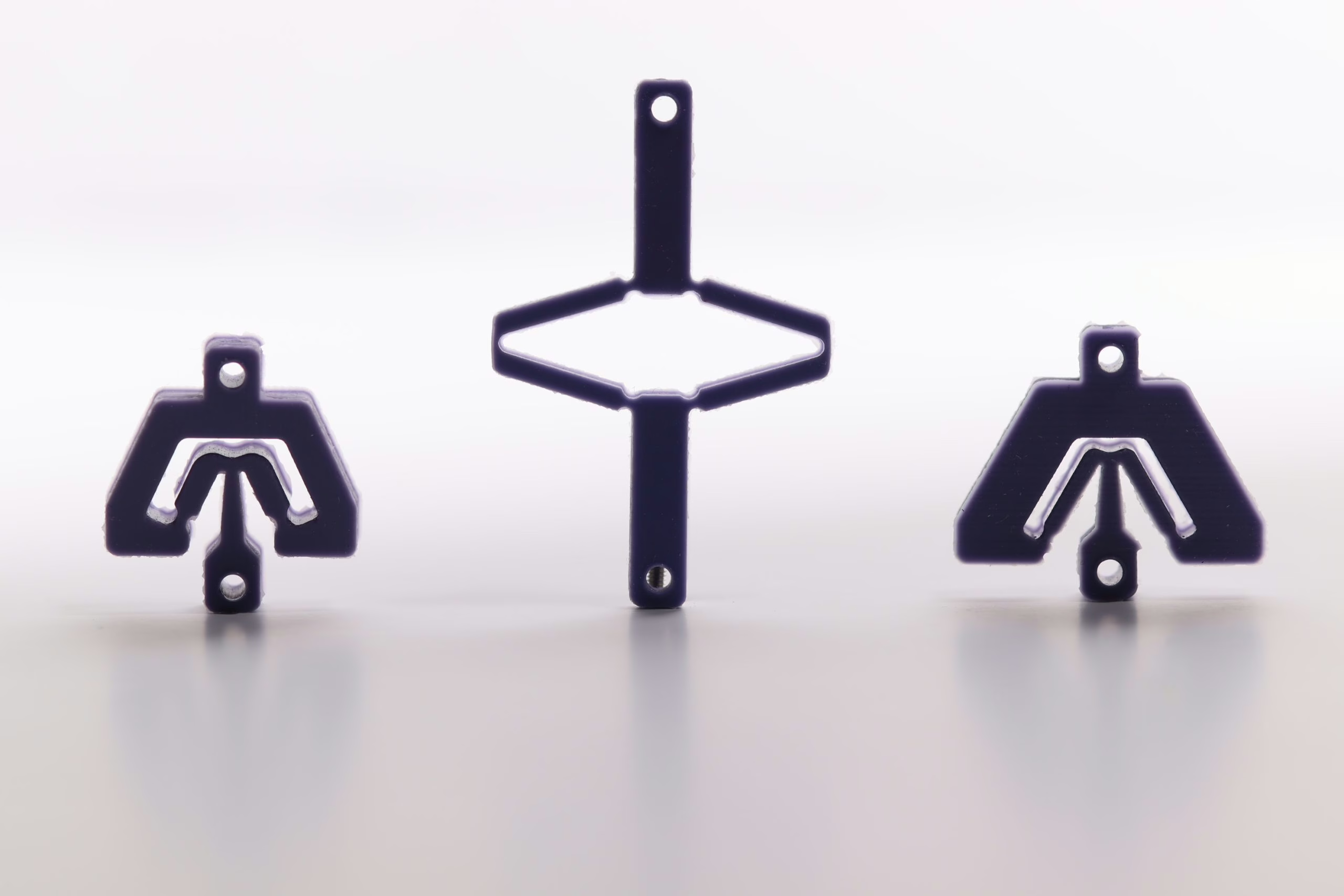
When you pull something—like a rubber band—you expect it to get longer. But what if it did the opposite? What if it suddenly shrank instead? In a study published on April 14 in Proceedings of the National Academy of Sciences (PNAS), researchers from AMOLF and ARCNL have made this possible. They created structures that snap inward when pulled outward. This surprising behavior defies conventional understanding of materials and opens up exciting applications in soft robotics, smart devices, and vibration control systems.
Countersnapping
“We’ve shown that mechanical systems can be designed to behave in ways that seem almost paradoxical” says Bas Overvelde, principal investigator of the Soft Robotic Matter Group. “This new kind of behavior – that we coin ‘countersnapping’ – has never been seen in experiments before. This could transform how we design everything from medical robotic devices to earthquake-resistant buildings.”
Combining building blocks
To make this counterintuitive behavior happen, the team developed a clever design strategy: instead of trying to build the complex behavior all at once, they started with small, more simple parts and combined them in a specific way.
The result? Structures that suddenly contract when pulled – something previously thought to be nearly impossible to achieve in practice. According to first author Paul Ducarme: “It’s like discovering a new building block for mechanical systems. It behaves in a completely unexpected way—but once you understand it, you can use it to do amazing things.” Below you can watch the cuplifting demonstration. Adding weight to the cup increases the tension—until suddenly, it lifts!
Applications
The researchers demonstrated that these countersnapping structures can lead to exotic properties that could potentially be useful in a range of applications. Examples include:
- One-way sliding motion without motors or electronics — potentially useful in soft robots that need to move forward without slipping backward, such as medical robots navigating through the body.
- Materials that switch stiffness on demand — ideal for wearable exosuits or prosthetics that need to be flexible during movement but stiffen instantly for support or safety.
- Structures that dampen excessive vibration all by themselves — potentially lifesaving in systems like airplanes, wind turbines, or even buildings in earthquake-prone areas.
Beyond using individual structures, the team also explored combining multiple structures together. “This opens new possibilities for metamaterials that act like computers”, says Martin van Hecke, principal investigator of the Mechanical Metamaterial group at AMOLF.
Just the beginning
The researchers believe this is just the beginning. Much like traditional snapping is used in things like pop-up tents, snapping toys, and deployable space structures, countersnapping could find its way into a new generation of technologies that are smarter, faster, and more adaptive.
Interested in more? You can watch the video about these structures that shrink when pulled on the AMOLF YouTube channel.
Reference
Paul Ducarme, Bart Weber, Martin van Hecke and Johannes T.B. Overvelde, “Exotic mechanical properties enabled by countersnapping instabilities,” Proceedings of the National Academy of Sciences (PNAS), April 14 (2025).
https://doi.org/10.1073/pnas.2423301122