Research highlights

The optimal design of cellular sensing systems

To survive and prosper living cells continually have to respond and adapt to changes in their environment. To this end, they have developed sensing systems that rival the best man-made sensing devices. Yet, how accurately these systems can measure chemical concentrations remains poorly understood. Researchers from AMOLF have now developed a theory that predicts the optimal design that maximizes the sensing precision of these systems. An analysis of experimental data revealed that the sensing system of the bacterium E. coli obeys the design principles as predicted by their theory. The AMOLF team presented their work in the journal eLife.

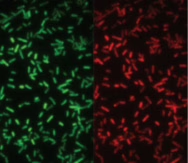
Image of a measurement of the sensing system of the bacterium E. coli. The colors show the activity of two proteins that are involved in the chemical sensing process. Image courtesy of Johannes Keegstra and Tom Shimizu link publication Keegstra and Shimizu in eLife 2017;6:e27455.

Living cells, be it bacteria searching for food or cells differentiating inside an embryo, continually need to respond to signals in their environment. These signals are typically chemical concentrations of some species – proteins or food molecules. Cells have developed dedicated sensing systems that enable them to measure such chemical concentrations.

Like any information-processing device, resources are required to build and operate the cellular sensing system. Components are needed to construct the system, time is needed to process the information, and energy is required to process the information reliably. Yet, how these resources constrain the sensing performance was not understood.

The AMOLF researchers have now developed a theory that allows them to predict the optimal design of cellular sensing systems. This optimal design maximizes the sensing precision given constraints on the availability of the cellular resources. The theory allows the researchers to predict how much energy and how many proteins are needed to reach a required sensing precision, and how this depends on the speed and strength of the signal fluctuations in the environment.

The researchers applied their theory to the best characterized sensing system in biology, the chemotaxis system of E. coli. It has been known for a long time that this system can detect extremely small concentration changes, which vary by less than a pro mille over the body length of the bacterium. Measuring such shallow concentration gradients is very challenging. The theory of the authors predicts that E. coli can nonetheless do so, precisely because its sensing system has been designed optimally, leaving no resource wasted.

Reference
Giulia Malaguti and Pieter Rein ten Wolde, Theory for the optimal detection of time-varying signals in cellular sensing systems, eLife 2021;10:e62574.

Share article
What's happening

Most recent news items

All news items
Collaboration

Successful outcomes of international EBEAM program led by AMOLF

The EU Pathfinder project Electron Beams Enhancing Analytical Microscopy (EBEAM) that was recently completed has received a highly positive review of the European Innovation Council (EIC). EBEAM brought together eight European research institutions and companies, including AMOLF, that develop new concepts and instruments combining spectroscopic analysis with electron microscopy.

Read news item
Research highlights

Everything you need to know about organoids

Organoids are instrumental in improving our understanding of processes that are otherwise hidden inside the body. For instance, these small 3D organs can be used to test medicines on tissue grown from a patient’s own cells. AMOLF researchers carry out unique and complex experiments to follow organoids in time. In order to enable other researchers to benefit from their experiences, they now publish their methods in the prestigious journal Nature Protocols.

Read news item
Events and outreach

Minister Rianne Letschert wears hat and shoulder ornament inspired by Wim Noorduin’s research

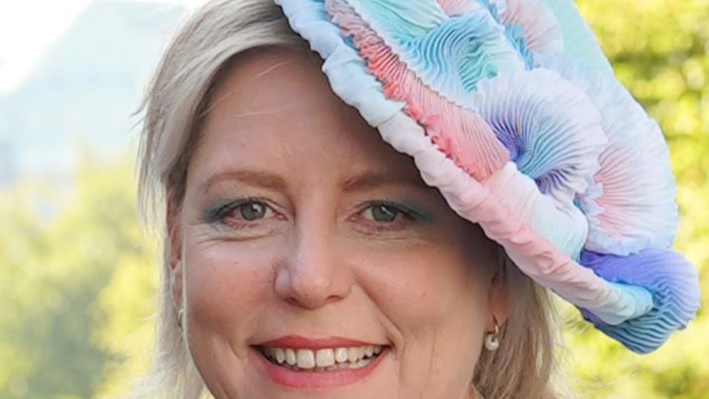
This year at the opening of the parliamentary year (Prinsjesdag) Minister of Education, Culture and Science Rianne Letschert wears a spectacular hat and shoulder ornament. Both of them are inspired by the microscopic structures studied by group leader Wim Noorduin (AMOLF/UvA), which look remarkably like tiny flowers under a microscope. Artist and designer Malou Beemer translated these shapes, normally invisible to the naked eye, into wearable art.

Read news item
Nachi Stern, Group Leader Learning Machines at AMOLF
People and recognition

Nachi Stern awarded ERC Starting Grant to explore how matter learns

Why do brains learn, but rocks do not? Could a material one day adapt to its environment the way a living organism does? AMOLF group leader Dr. Nachi Stern has been awarded an ERC Starting Grant to investigate the physical laws of learning, in a project called, “Physical Learning in Dynamical Systems.”

Read news item
Stay informed

Get the latest research highlights, events, and news from our institute delivered to your inbox