Research highlights

Soft robots that learn to follow the light

Soft robots made of simple, identical building blocks can learn to move toward a light source without a central controller or explicit communication, according to new research published in Advanced Functional Materials. The study shows how phototaxis, directed movement in response to light, can emerge from local sensing and learning alone. This finding is relevant because it demonstrates how adaptive, goal-oriented behavior can arise in robotic systems without centralized control.

Soft robot that has learned to follow light

A collective discovery

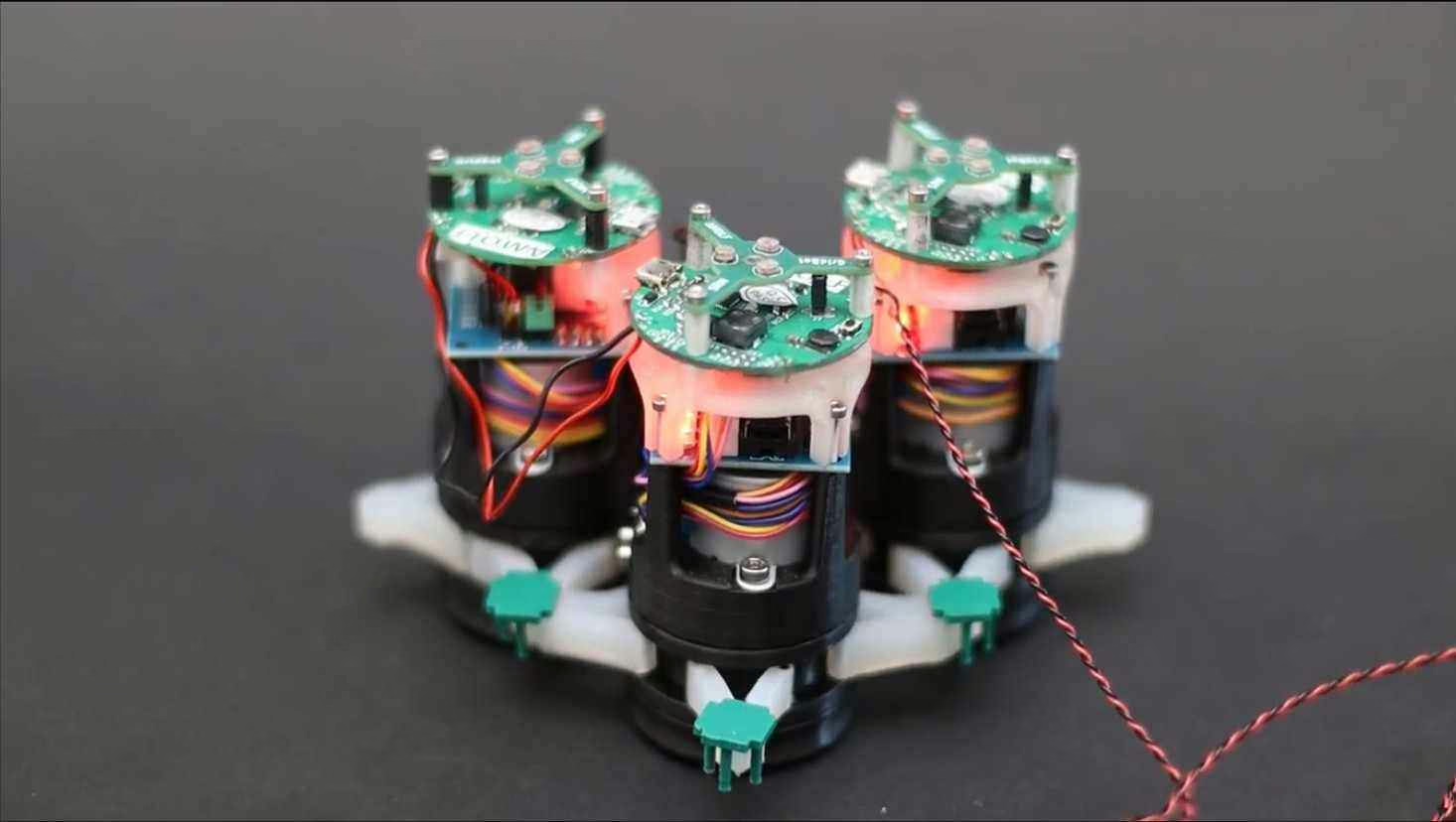
The research was carried out by AMOLF researcher Mannus Schomaker (Soft Robotic Matter) in collaboration with Eindhoven University of Technology. The team developed a modular soft robotic platform in which each unit contains its own motor, light sensor, and microcontroller. By assembling these identical units into different shapes, the researchers demonstrated that robots can consistently move across a surface toward a light source, despite having no knowledge of their overall geometry.

Why phototaxis without a brain matters

In most robots, sensing and decision making are handled by a central computer. This makes them powerful but also vulnerable in unpredictable environments. In contrast, many natural systems rely on distributed intelligence, where global behavior emerges from local interactions. By focusing on phototaxis, a clear and measurable task, the AMOLF team investigated how complex behavior can arise without centralized control. The study directly contributes to research on emergent behavior by showing how coordinated motion can appear even though no individual module has an overview of the system.

What makes the findings special

A key result is that the robotic modules do not communicate with each other directly. Each unit only measures changes in light intensity at its own location and adjusts the timing of its movement based on a simple learning rule. Coordination emerges implicitly through the physical connections between modules and their interaction with the environment. The same rule works across different robot geometries, from small clusters to larger assemblies, without retuning. This combination of simplicity, generality, and robustness makes the findings distinctive.

Robust behavior in changing environments

The researchers tested the system under a range of challenging conditions. When the direction of the light source was suddenly changed, the robots adapted and learned to move in the new direction. When obstacles were placed in their path, the assemblies adjusted their motion and continued progressing toward the light. In a striking demonstration, a larger robot was physically cut in half during an experiment. Both halves independently relearned how to perform phototaxis, highlighting the resilience of the decentralized approach.

Learn more

If you have questions about this research, please contact Bas Overvelde (email: b.overvelde@amolf.nl).

This paper was published in Advanced Functional Materials, Robust Phototaxis by Harnessing Implicit Communication in Modular Soft Robotic Systems, by H.A.H. Schomaker, S. Picella, A. Küng Garcia, L.C. van Laake, J.T.B. Overvelde.

Read the full paper



Share article
What's happening

Most recent news items

All news items
Collaboration

Successful outcomes of international EBEAM program led by AMOLF

The EU Pathfinder project Electron Beams Enhancing Analytical Microscopy (EBEAM) that was recently completed has received a highly positive review of the European Innovation Council (EIC). EBEAM brought together eight European research institutions and companies, including AMOLF, that develop new concepts and instruments combining spectroscopic analysis with electron microscopy.

Read news item
Research highlights

Everything you need to know about organoids

Organoids are instrumental in improving our understanding of processes that are otherwise hidden inside the body. For instance, these small 3D organs can be used to test medicines on tissue grown from a patient’s own cells. AMOLF researchers carry out unique and complex experiments to follow organoids in time. In order to enable other researchers to benefit from their experiences, they now publish their methods in the prestigious journal Nature Protocols.

Read news item
Events and outreach

Minister Rianne Letschert wears hat and shoulder ornament inspired by Wim Noorduin’s research

This year at the opening of the parliamentary year (Prinsjesdag) Minister of Education, Culture and Science Rianne Letschert wears a spectacular hat and shoulder ornament. Both of them are inspired by the microscopic structures studied by group leader Wim Noorduin (AMOLF/UvA), which look remarkably like tiny flowers under a microscope. Artist and designer Malou Beemer translated these shapes, normally invisible to the naked eye, into wearable art.

Read news item
Nachi Stern, Group Leader Learning Machines at AMOLF
People and recognition

Nachi Stern awarded ERC Starting Grant to explore how matter learns

Why do brains learn, but rocks do not? Could a material one day adapt to its environment the way a living organism does? AMOLF group leader Dr. Nachi Stern has been awarded an ERC Starting Grant to investigate the physical laws of learning, in a project called, “Physical Learning in Dynamical Systems.”

Read news item
Stay informed

Get the latest research highlights, events, and news from our institute delivered to your inbox