
What if materials could think?
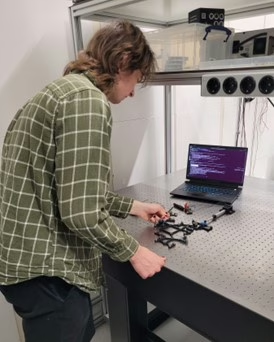
Imagine a piece of rubber not just sensing your movement but actually processing it – detecting gait patterns or even recognizing speech – all without using a single watt of electrical power. That’s the vision behind the new work published by Théophile Louvet, Parisa Omidvar and Marc Serra-Garcia in Advanced Intelligent Systems. The material developed by the AMOLF team can perform computations mechanically, making it a promising candidate for future applications in soft robotics, wearable AI, and edge computing where power efficiency is critical.
At the core of this innovation lies a concept called floppy modes – a term for movements in a material that cost virtually no energy. By smartly designing a network of interconnected elements, the researchers created a metamaterial whose shape responds in precisely calculated ways to physical inputs (metamaterial is material with a designed micro-structure that achieves properties not present in natural materials). The result: the material itself carries out calculations like a miniature calculator made of soft rubber.
Why matrix-vector multiplication matters
Matrix-vector multiplication may sound complicated, but it’s a key part of how modern computers work. Every time your phone translates a sentence or identifies a face in a photo, it’s performing millions of these operations. Traditionally, this is done using silicon chips like CPUs or GPUs. But what if the material itself could do the job?
This study demonstrates, for the first time, that a mechanical metamaterial can do just that – multiply matrices with vectors – using only its shape and structure, with no electronics involved. Better yet, it can be reprogrammed to compute different matrices by altering its internal configuration.
How does it work?
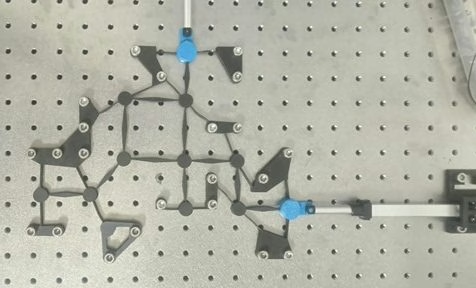
The metamaterial is made up of a grid of tiny building blocks. Each one reacts in a certain way when you push or pull on it. You can think of each block as a mini calculator that does a small piece of a bigger math problem. They’re all linked together so that movement in one area spreads through the whole material, creating complex changes.
What’s more, by using compliant mechanisms (flexible parts that can switch between stiff and soft states), the material can change its function. Just like flipping a switch on a circuit board, these mechanisms rewire the internal behavior of the material, enabling it to compute different sets of mathematical operations – all while preserving the essential “floppy” behavior that makes it efficient.
Key advantages of these metamaterials
- Zero-power computing: Since the material responds mechanically, it can compute without any electricity – ideal for low-power or embedded AI.
- Reconfigurability: Unlike traditional mechanical systems, this metamaterial can be dynamically reprogrammed to change its function.
- Embodied intelligence: The research opens the door to materials that not only sense but actually make things move.
Looking ahead
The implications are far-reaching. The study suggests that even large matrix operations – essential in neural networks – could eventually be carried out by mechanical systems, especially at the micro-scale, like in MEMS devices (mini-machines built onto chips). And because the approach is inherently energy-efficient, it could transform how we build AI for the Internet of Things, environmental sensors, and even future prosthetics.
As artificial intelligence spreads into every corner of our lives, the way we build intelligent systems is bound to evolve. This research from AMOLF hints at a future where computation doesn’t just live in chips – it lives in the very material world around us.
Read about it in the research article: Reprogrammable, In‐Materia Matrix‐Vector Multiplication with Floppy Modes