Extraordinary properties
Hydrophobins, small surface proteins that are expressed only by filamentous fungi (“mould”), only recently came to the attention of Konrad Meister, post-doc in the ultrafast spectroscopy research group of Huib Bakker at AMOLF. ‘During my literature search on hydrophobins, I learned how unique these proteins actually are,’ says Meister. ‘The molecules self-assemble in robust microscopic films that have extraordinary properties, such as a very high stability and elasticity.’ It is due to these properties and the fact that hydrophobins form an “amphiphilic” surface (water-repellent on the outside and water-loving from within) that fungi can cope with so many different environments.’
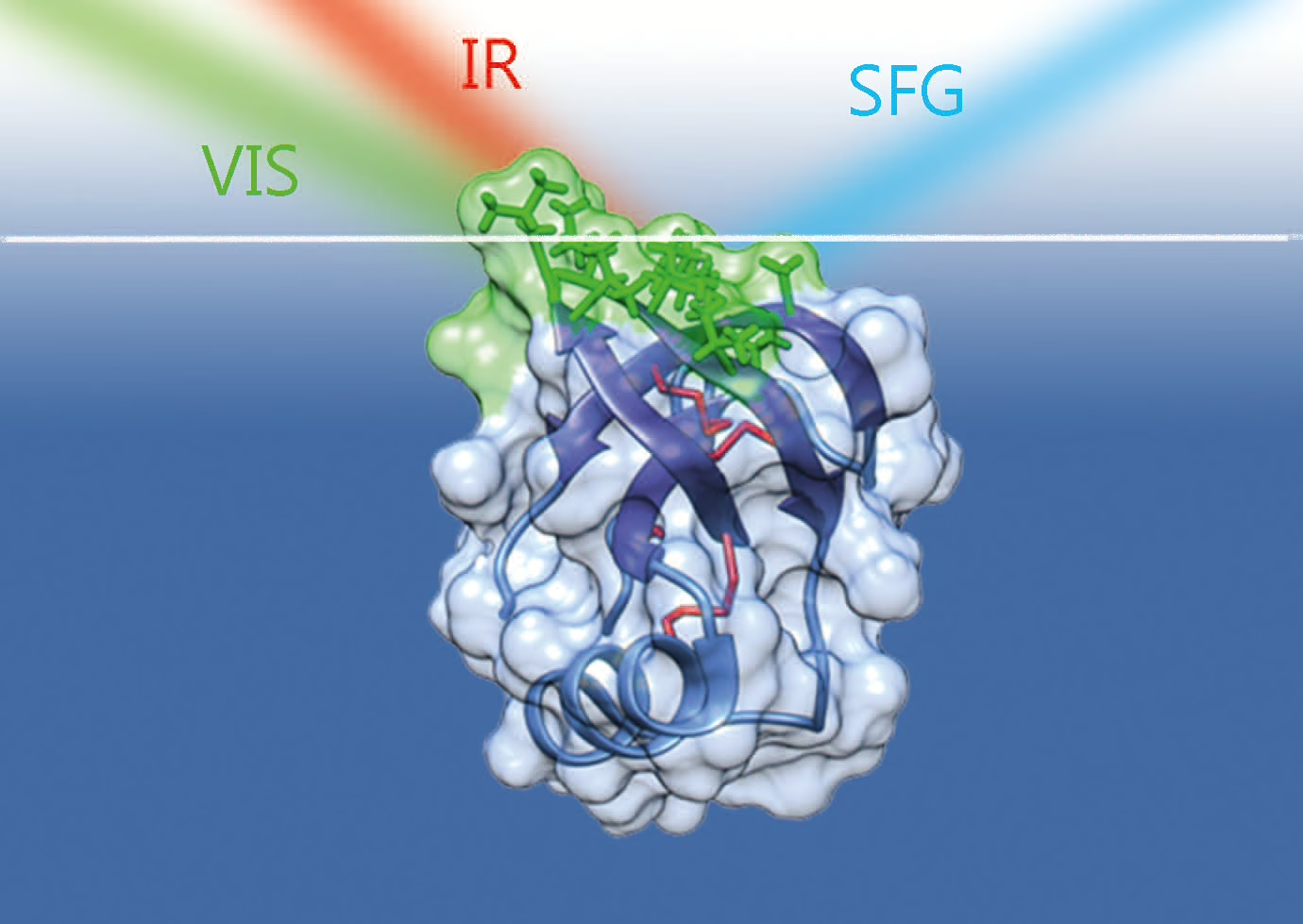
How hydrophobins, which were only discovered in the beginning of the 1990s, rivet together and create firm elastic surfaces is not yet well understood. Mostly because the study of liquid surfaces is difficult and most spectroscopy techniques simply do not come up to the mark. ‘The main problem with most techniques is that they are not sufficiently surface specific’, says Meister, ‘the signals are completely dominated by molecules in the underlying solution that you are not interested in. Only few techniques are capable of selectively probing molecular surfaces.’
The Bakker group was able to study the surfaces formed by hydrophobins using a special technique named nonlinear sum-frequency generation spectroscopy. ‘We combined invisible infrared light pulses with visible pulses fired at our sample. This leads to the generation of a new light beam at the sum frequency of the input infrared and visible beams, but only if the frequencies of the infrared light match the frequencies of the molecular vibrations of ordered interfacial molecules – here: assembled hydrophobins. This aspect makes our technique extremely surface-specific.’
Varying the tilt of molecules
With their measurements the team confirmed that the structure of the hydrophobin layer is extremely robust and highly ordered. However, the main finding was the observation of a strong relation between the orientation of the individual hydrophobin molecules and the acidity of the water on which the hydrophobin film is floating. This discovery is the result of a collaboration with Steven Roeters and Sander Woutersen from the University of Amsterdam (UvA), who performed calculations that could directly be compared with the experimental results of Meister. Meister emphasizes that the observation of an acidity induced tilt of the hydrophobins was only possible because the hydrophobins could be measured in the proteins’ natural (aqueous) place of action. i.e. floating on an aqueous phase.
As the water phase becomes more acidic, Meister and Roeters discovered, the individual proteins become more tilted. ‘We also observed that this acidity-induced reorientation decreased the elasticity of the surface,’ says Meister. There thus seems to be a way – by altering an external factor, in this case the acidity – to fine-tune the properties of hydrophobin films.’
Designer microfilms
Particles whose surfaces have two (or more) distinct properties, tend to attract a great deal of attention from industrial parties, like the chemical and food industry, who are always looking for improved emulsifiers. In reply to the demand from these industries, synthetic chemists create so-called “Janus particles”, by clinching a hydrophobic (water-repellent) functional group to a hydrophilic (water-loving) one. However, creating stable coatings with these opposite traits is extremely difficult. For this reason chemical companies, such as BASF are currently producing hydrophobins from fungal sources. ‘Now that we found a way to influence the hydrophobin structure by altering the pH, we have a new method to create hydrophobin films with desired visco-elastic properties,’ says Meister. ‘Ultimately, this can lead to the creation of novel designer microfilms.’
Reference
Konrad Meister, Steven J. Roeters, Arja Paananen, Sander Woutersen, Jan Versluis, Géza R. Szilvay, and Huib J. Bakker, Observation of Ph-induced protein reorientation at the water surface, Journal of Physical Chemistry Letters, DOI: 10.1021/acs.jpclett.7b00394