
How often have you folded up a roadmap incorrectly? The folding principle is simple but it involves several steps that need to be performed in the right order. And roadmaps are peanuts compared to the sunshields and instrument arms that satellites fold in and out. Each step requires a small motor that performs its task at the right moment. Physicists Martin van Hecke (Leiden University/AMOLF) and Corentin Coulais (University of Amsterdam), together with their students, have now designed a structure that folds itself up in several steps when slight pressure is exerted on the sides.
Built-in folding process
“Many multistage folding processes can be found in nature,” says Coulais. “Proteins fold themselves up in several steps, including inbuilt self-corrections. In technology, however, such steps do not occur autonomously and several motors are required. We wanted to see if you could make artificial materials that have an inbuilt, automatic, multistage folding process so that folding motors are no longer required.”
Rubber construction
The researchers work with a 10 cm wide rubber construction made of blocks that can rotate due to their flexible connections. They program the folding order by giving the connections different thicknesses. Exerting pressure on the sides of the construction forces it to assume a new, more compact structure in which some blocks lie against each other. Subsequently applying more pressure leads to the next steps in the folding process. The construction or so-called metamaterial, folds itself up in three steps, which is a record. It also has an inbuilt self-correction mechanism as well. If a production error gives rise to a connection that falls outside the formation, neighboring blocks will rotate incorrectly. However, these blocks subsequently bump into other blocks that in turn push them into the right position.
From fundamental to applied
For the time being, the researchers consider their discovery to be a step forward at a fundamental level even though many applications are conceivable. Van Hecke: “Automatic folding and self-correction are important in the space industry for example, because a lot can go wrong, and errors cannot be tolerated. Equally, if a medical probe gets stuck while folding up, it will be harder to remove from the body. We are now trying to simulate that automatic folding process and to understand it by using far simpler structures. Only once we understand it at a fundamental level will it be possible to design complex structures with a practical application.”
Publication
Corentin Coulais, Alberico Sabbadini, Fré Vink and Martin van Hecke, Multi-step self-guided pathways in shape-changing metamaterials, Nature 561, 512-515 (2018)
DOI: 10.1038/s41586-018-0541-0
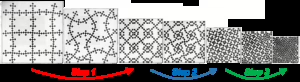
Figure: A metamaterial that folds itself up in three steps.