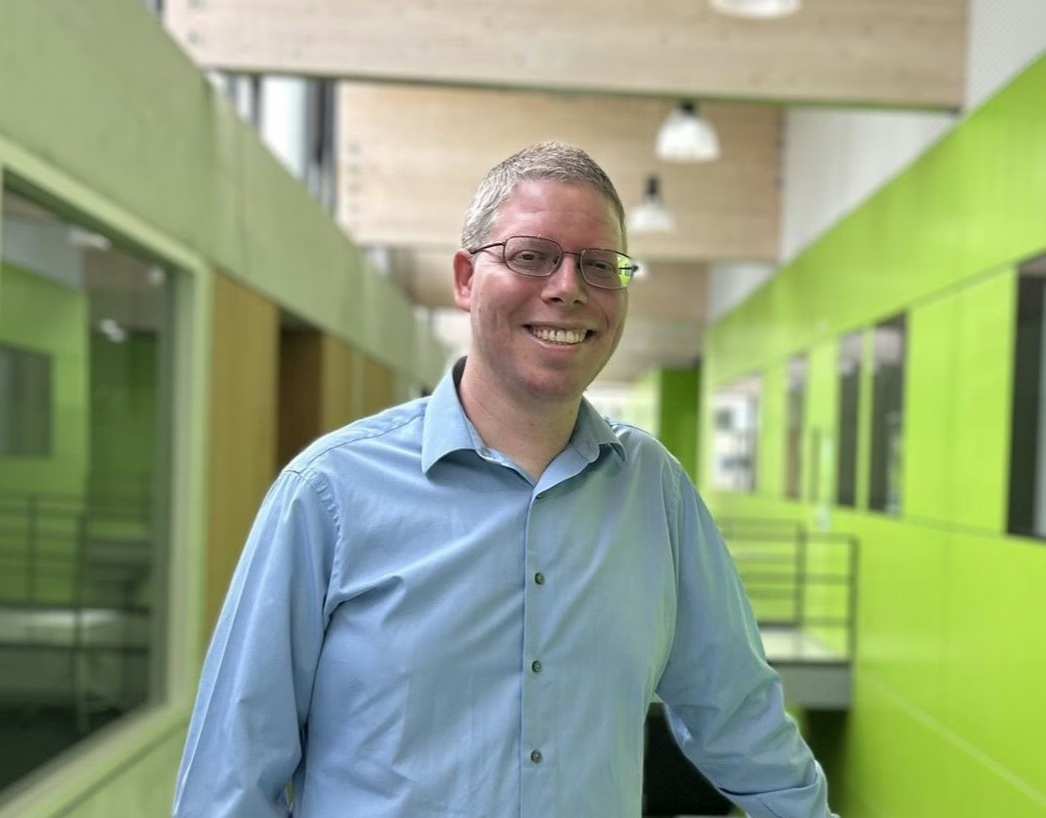

Asked about his ambitions as a new professor, Said Rodriguez says: “I’m excited to strengthen the connection with Utrecht University, both personally and through AMOLF. I really look forward to engaging with staff and students, fostering new collaborations and reinforcing existing ones. It’s also important to me to showcase AMOLF’s research environment to Utrecht PhD and masters students so that they can benefit from it. Most of all, I look forward to the privilege of supervising and graduating students at the University of Utrecht!”
The Chair of ‘Emergence and Information in Light’ is established at Utrecht University by the ‘Stichting tot Bevordering van de Atoom- en de Molecuulfysica’. It will investigate emergent phenomena and information processing capabilities of complex optical systems. It will develop such systems, study nonlinear and stochastic processes in them, and uncover fundamental principles enabling energy efficient, fast, and accurate information processing. In this way, the Chair connects and strengthens existing expertise at the Debye Institute in Nanophotonics and at the Institute for Theoretical Physics (ITP) in statistical physics and information theory.
The appointment letter states: “With your appointment we express our appreciation for the strong national and international reputation you have acquired within the field of nanophotonics and information processing with light. We expect that your appointment will lead to a strengthening of the research collaboration between NWO Institute AMOLF and the Debye Institute, including through PhD students supervised by you and who will pursue a PhD at University of Utrecht.”
Said:“In academia, the journey begins with a Bachelor’s, a Master’s, then a PhD – each important milestones. The postdoc years follow, often intense but without formal recognition. Then comes the leap to assistant professor or group leader, and after years of relentless effort, the hard-won reward of tenure. To then be appointed professor – the highest step on the academic ladder – is an immense honor.”
Becoming a professor was never a goal for Said, but it came to his path. Said:
“Throughout my career, I often looked at my professors with admiration. Now, reaching the level of professor feels like a fulfilling achievement. My motivation has always come from the people who inspired me and the desire to contribute meaningfully to science.”
Next to his part-time appointment at Utrecht University, Said will remain scientific group leader at AMOLF.
To learn more, visit the website of the Debye Institute for Nanomaterials Science, the Institute for Theoretical Physics or AMOLF’s Interacting Photons group.