
Research highlights

Promising Hybrid Heart prototype

AMOLF group leader Bas Overvelde and his collaborators working on the Holland Hybrid Heart project have developed a new concept for a total artificial heart with several significant advantages. This so-called LIMO Heart prototype has a fluidic transmission mechanism that enables a relatively small and efficient device. The researchers published their results in Science Advances on July 2nd.

The Holland Hybrid Heart consortium is a multidisciplinary collaboration of 15 Dutch partners led by Erasmus MC, in partnership with, amongst others, Eindhoven University of Technology and AMOLF. The consortium is focused on developing a soft total artificial heart, specifically designed for patients with end-stage heart failure. The Holland Hybrid Heart uniquely integrates synthetic and living materials to ensure optimal functionality and enhanced biocompatibility. This innovative approach holds a strong promise as an alternative to current artificial hearts, which are often associated with serious complications.

Benefits of the LIMO prototype
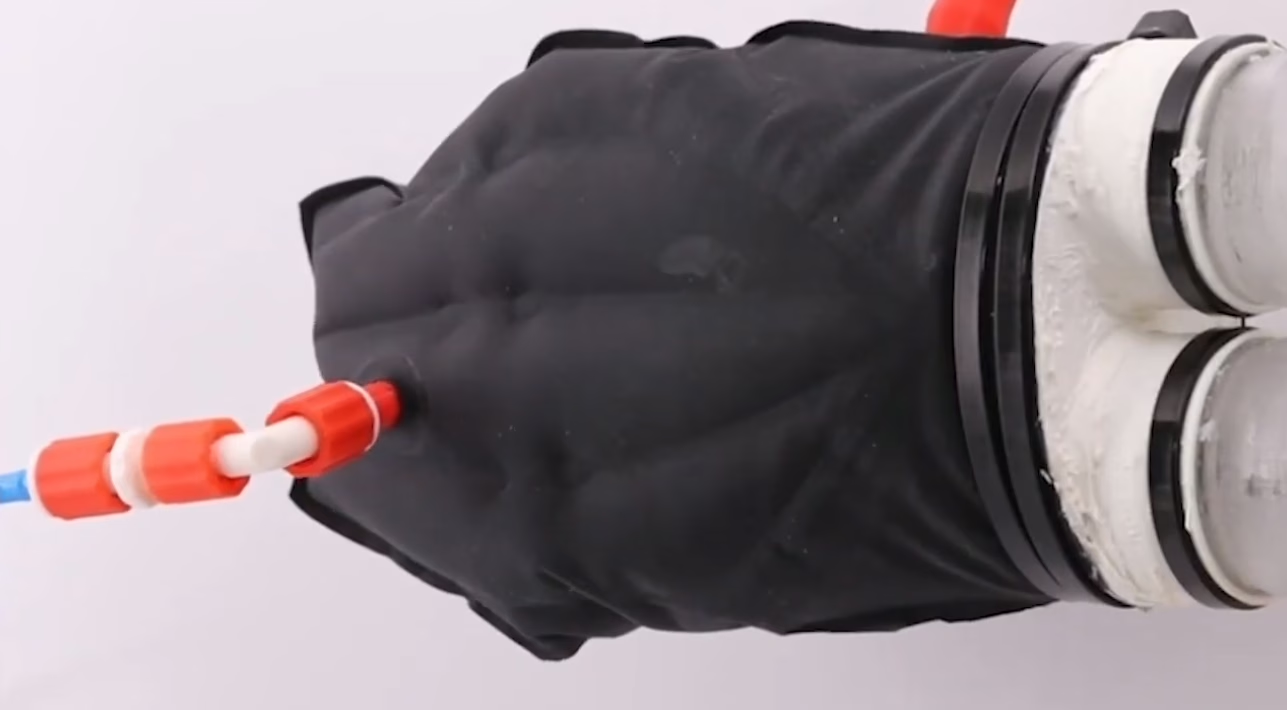
The LIMO prototype

To make the Holland Hybrid Heart suitable for future patient use, it must be both highly efficient and compact. The LIMO concept addresses these essential requirements. LIMO stands for “Less In, More Out” – a name that reflects its core function. Using advanced engineering, the researchers achieved a fluidic transmission ratio greater than one.

Researcher Maziar Arfaee (AMOLF/Erasmus) explains: “We introduce a small amount of fluid at high pressure into the system, and on the other side, we get a larger volume at lower pressure.” This mechanism is made possible by a heart chamber surrounded by inflatable pouches. Upon inflation, the heart chamber contracts and ejects blood.

Another major advantage of the LIMO prototype is its high efficiency, which ranges between 82 and 91%. This means minimal energy loss within the system. As a result, external components, such as pumps and batteries, can be made smaller, improving patient mobility.

Next steps

When asked whether this will be the final prototype of the Hybrid Heart, AMOLF group leader Bas Overvelde says: “It is quite common in engineering to try different approaches to find out what works best, and it may well be that the final product is a combination of different prototypes. Our LIMO prototype resembles a natural heart in the way it beats; the contraction of the pouches function much like natural muscles. The main achievement in this prototype is the demonstration of an efficient fluidic transmission system that allows for a more compact artificial heart.”

Learn more

Maziar Arfaee, Lucas C. van Laake, Shibo Zou, Charlotte Bording, Jolanda Kluin and Johannes T.B. Overvelde, Toward developing a compact total artificial heart using a soft robotic fluidic transmission system, Science Advances, 11, 2 July (2025). Read the scientific publication via DOI: 10.1126/sciadv.adv4854

Watch the video below to see the LIMO prototype in action:

Share article
What's happening

Most recent news items

All news items
Collaboration

Successful outcomes of international EBEAM program led by AMOLF

The EU Pathfinder project Electron Beams Enhancing Analytical Microscopy (EBEAM) that was recently completed has received a highly positive review of the European Innovation Council (EIC). EBEAM brought together eight European research institutions and companies, including AMOLF, that develop new concepts and instruments combining spectroscopic analysis with electron microscopy.

Read news item
Research highlights

Everything you need to know about organoids

Organoids are instrumental in improving our understanding of processes that are otherwise hidden inside the body. For instance, these small 3D organs can be used to test medicines on tissue grown from a patient’s own cells. AMOLF researchers carry out unique and complex experiments to follow organoids in time. In order to enable other researchers to benefit from their experiences, they now publish their methods in the prestigious journal Nature Protocols.

Read news item
Events and outreach

Minister Rianne Letschert wears hat and shoulder ornament inspired by Wim Noorduin’s research

This year at the opening of the parliamentary year (Prinsjesdag) Minister of Education, Culture and Science Rianne Letschert wears a spectacular hat and shoulder ornament. Both of them are inspired by the microscopic structures studied by group leader Wim Noorduin (AMOLF/UvA), which look remarkably like tiny flowers under a microscope. Artist and designer Malou Beemer translated these shapes, normally invisible to the naked eye, into wearable art.

Read news item
Nachi Stern, Group Leader Learning Machines at AMOLF
People and recognition

Nachi Stern awarded ERC Starting Grant to explore how matter learns

Why do brains learn, but rocks do not? Could a material one day adapt to its environment the way a living organism does? AMOLF group leader Dr. Nachi Stern has been awarded an ERC Starting Grant to investigate the physical laws of learning, in a project called, “Physical Learning in Dynamical Systems.”

Read news item
Stay informed

Get the latest research highlights, events, and news from our institute delivered to your inbox