Research highlights

Physical origins of randomness in a primitive brain

Group leader Tom Shimizu was awarded a so called ‘Vrije FOM Programma’ on The signal is the noise: seeking physical origins of fluctuation in organism-scale behaviour.

Variability in the behavior of living organisms has traditionally been studied by distinguishing the effects of ‘nature’ (i.e. genetics) from those of ‘nurture’ (i.e. environmental effects). Yet from a physical perspective, sources of variability exist even among genetically identical individuals in exactly the same environment. Fluctuations in physical processes at the level of molecules inject randomness into biological dynamics, and it is now well established that such molecular ‘noise’ in key biochemical processes (for example, in the production of proteins) can cause highly variable behaviors at the level of individual cells. On the other hand, physical principles suggest that fluctuations at such minute scales will have little impact on phenomena at macroscopic scales. Thus, how a complex multi-cellular organism made of many cells generates random behavior remains a fundamental mystery.

In this program, researchers address this challenging question by focusing on the nematode worm C. elegans – one of the simplest forms of life with a nervous system. These organisms demonstrate strong behavioral variability and feature a remarkably simple and comprehensively characterized neural anatomy (302 neurons connected by ~7000 synapses). By connecting fluctuations in the worms’ motile behavior, the production and movement of proteins, and the activity of neurons, they seek to explain variability at the organism level in terms of physical principles.

Program leader Tom Shimizu (AMOLF): “Our program brings together a unique combination of expertise in precision biophysical measurements at multiple scales – from molecules to the whole organism – as well as theoretical methods to bridge these scales. We’re very excited that this FOM Program will seed a new effort to develop biophysics at the organism scale through studies of fluctuations.”

This program is a collaboration between:

  • AMOLF: Dr. T.S. Shimizu, Dr. J.S. van Zon
  • Vrije Universiteit Amsterdam: Dr. G.J. Stephens, Prof. dr. E.J.G. Peterman
  • Hubrecht Institute (KNAW): Prof. dr. A. van Oudenaarden, Dr. H.C. Korswagen
  • Utrecht University: Prof. dr. S.J.L. van den Heuvel
  • Erasmus MC: Dr. G. Jansen

With the ‘Vrije programma’s’ FOM brings together the best research groups in their respective fields in the Netherlands. In each research program the specialists from the various Dutch knowledge institutes combine their strengths. With this FOM realises what is termed ‘focus and mass’ in policy jargon: working on a limited number of challenging scientific subjects, with a large number of the best researchers in the Netherlands, with the research being coordinated at a national level.

Read the FOM press release.
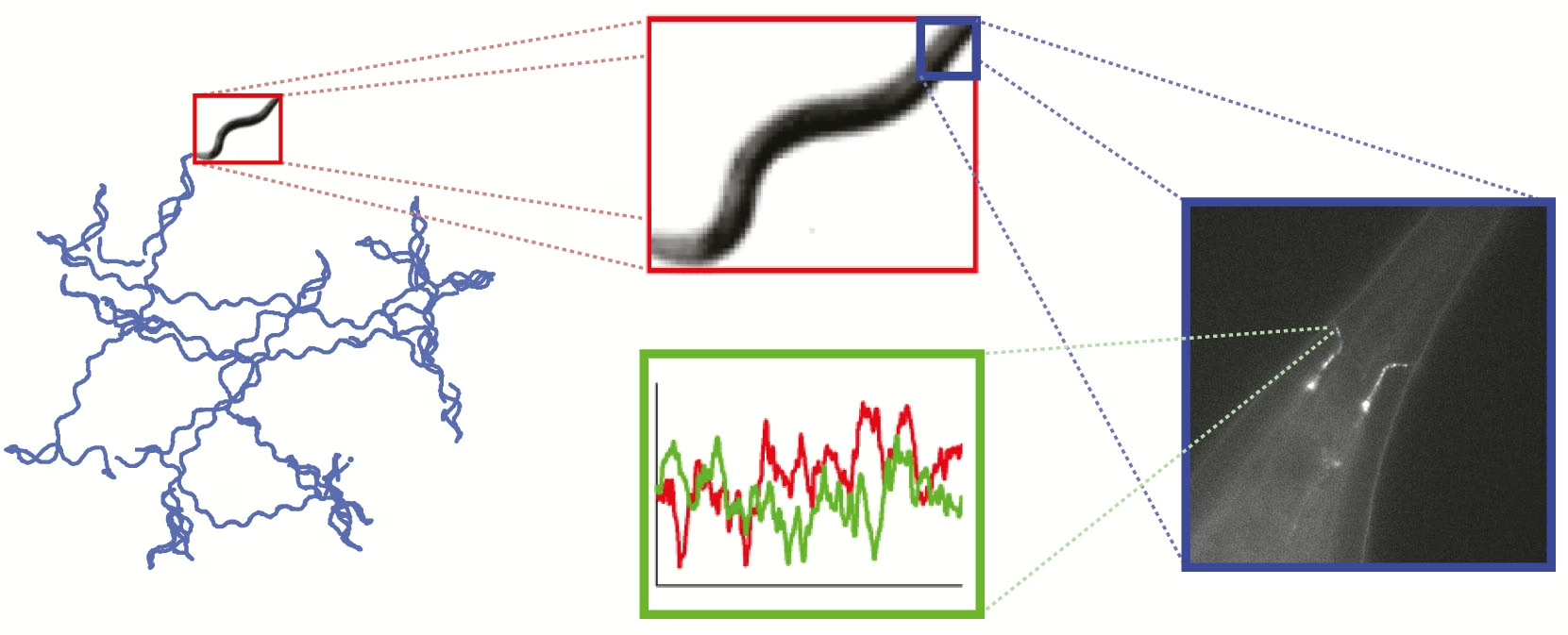
Connecting variability across scales. Fluctuations in the behavior of C. elegans worms will be studied at multiple scales: at the level of the worm’s random-walk trajectories in space (blue curves, left), at the level of postural movements (red box, above), at the level of neuronal activity and protein movement (blue box, right), and at the level of protein production (green box, below).
Share article
What's happening

Most recent news items

All news items
Joining forces to study perovskite interfaces
People and recognition

Joining forces to study perovskite interfaces

AMOLF group leaders Professor Wiebke Albrecht and Professor Bruno Ehrler have received an NWO ENW-M2 grant for their joint research project, The Dynamic Atomic Interface between Halide Perovskites and Metals. The insights gained will pave the way for sustainable, high-performance solar energy and information technology. Wiebke and Bruno will each hire a PhD student for this project. The grant amounts to €800.000.

Read news item
Wim Noorduin and Arian van Asten presenting their scientific journey
People and recognition

Wim Noorduin and Arian van Asten presenting their scientific journey

On October 8, Professor Wim Noorduin and his collaborator Professor Arian van Asten (University of Amsterdam) presented their scientific journey in a video to the audience at the ‘Avond van Wetenschap en Maatschappij’. They did so alongside the other nominees for the Huibregtsen Prize.

Read news item
Natural phenomena ‘hyperuniform disorder’ enables highly efficient, thin silicon solar cells
Research highlights

Natural phenomena ‘hyperuniform disorder’ enables highly efficient, thin silicon solar cells

Silicon solar panels are rigid and heavy, and many rooftops cannot support them. This creates a need for thin, flexible solar cells that can be integrated into building materials. However, making silicon solar cells thinner makes it harder to trap light inside the material. Researchers in the 3D Photovoltaics group found a fascinating way to overcome this challenge using a phenomenon called hyperuniform disorder. They publish their findings in the journal ACS Photonics.

The researchers were able to make highly efficient silicon solar cell materials that are 30 times thinner than conventional ones. They managed to do this by integrating a layer of nanometer sized structures on top of the material. Up close, this pattern looks random, but it is remarkably when you step back: no clumps, no gaps, and no repeating pattern. This is called hyperuniform disorder (or HUD).

Read news item
Stay informed

Get the latest research highlights, events, and news from our institute delivered to your inbox