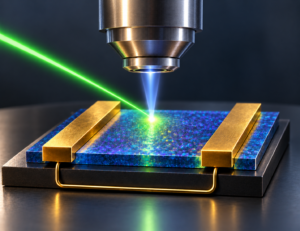
Perovskites are a promising material for future generation solar cells, because they are made from cheap ingredients and it is easy to change their composition to fit specific needs, like solar cells in any desired color. Researchers in the Hybrid Solar Cells group at AMOLF try to increase the efficiency and lifetime of hybrid perovskite semiconductors by uncovering the fundamental properties of perovskites. One of these properties is the speed at which so-called hot carrier cooling occurs, which is also relevant if perovskites are used in other applications.
Hot carrier cooling
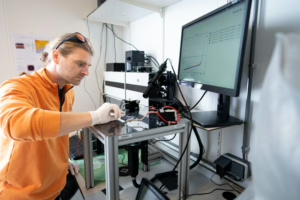
In solar cells, the energy of light that matches the bandgap of the semiconductor is converted into electricity directly. This direct route is not available for photons with a higher energy. These photons generate so-called hot carriers: high-energy electrons (and holes) that have to cool down before they can be harvested in the form of electrical energy. Hot carrier cooling occurs spontaneously: the hot carriers lose their excess energy in the form of heat through scattering until they match the conduction energy level of the semiconductor. Trying to understand this process in perovskites, PhD student Loreta Muscarella encounters various difficulties, one of them being the timescale. She says, “Hot carrier cooling occurs very fast, typically on a timescale of femtoseconds to picoseconds, which makes it hard to manipulate or even investigate the process. We are lucky to have a unique set-up with a Transient Absorption Spectrometer (TAS) in combination with pressure equipment in our group. This allows us to measure the electronic properties of perovskite under external stress a few femtoseconds after shining light onto the material.”
Manipulating with pressure
It was already known that under abundant illumination hot carrier cooling in perovskite semiconductors is much slower than in silicon semiconductors. This makes the investigation of the process much more feasible in perovskite rather than silicon. Muscarella and her colleagues assumed that the speed of the cooling process might be pressure-dependent. “The hot carriers lose their excess energy through vibration and scattering. Applying pressure increases vibrations inside the material, and should thus increase the speed of hot carrier cooling”, she says. “We decided to test this assumption and found that we can indeed manipulate the cooling time with pressure. At 3000 times ambient pressure the process is two to three times faster.”
A solar cell would not be able to operate at such high pressures, but a similar effect can be obtained with internal strain. Muscarella: “We did our experiments with external pressure, but in perovskites it is possible to induce an internal strain by chemically altering the material or its growth, as we have previously shown in our group.”
Cooling speed for different applications
Being able to control the hot carrier cooling speed allows for various other applications of perovskites besides solar cells. “The possibility to design perovskites for specific colors not only makes them very interesting for colored solar cells, but also for lasers or LED technology. In such applications, fast cooling of hot carriers is essential, just like it is in conventional solar cells. Slow cooling on the other hand would make perovskites suitable for thermoelectric devices that convert a temperature difference into electricity. So the possibility to tune the hot carrier cooling speed allows for a whole range of devices that could be made with perovskites”, says Muscarella. She even envisions applying a negative pressure on the material to make the hot carrier cooling process even slower for a specific type of solar cell. “Since heat dissipation accounts for almost thirty percent of efficiency loss in solar cells, scientists are looking for ways to harvest the hot carriers before they have cooled. Currently, even the ‘slow’ cooling in perovskites at ambient pressure is still too fast for such so-called hot-carrier solar cells. Now, these hot carriers lose their excess energy as heat within picoseconds. However, if we could induce a negative strain it might be possible to make the process slow enough to be applied in a working device.”
Reference
Loreta A. Muscarella, Eline M. Hutter, Jarvist M. Frost, Gianluca G. Grimaldi, Jan Versluis, Huib J. Bakker, and Bruno Ehrler, Accelerated Hot-Carrier Cooling in a MAPbI3 Perovskite by Pressure-Induced Lattice Compression, The Journal of Physical Chemistry Letters, 12, 4118−4124 (2021)
DOI: 10.1021/acs.jpclett.1c00676