Puppeteering is the art of pulling and pushing strings and rods to cause a puppet to move in a coordinated fashion. The puppeteer’s job is not very different from that of a physicist, engineer, or materials scientist, who commonly seek to convert input forces into resulting motions.
For the physicist, predicting the pronounced (or in more technical terms: nonlinear) deformations of elastic objects is a difficult game, where progress is slow. Precise recipes to choose input pushes and pulls to produce the desired deformation – the dance of the puppet – are quite rare. This is what makes the “puppetry” achieved in the paper “Conformal Elasticity of Mechanical Metamaterials”, so remarkable. In this work, physicists Corentin Coulais (University of Amsterdam), Martin van Hecke (AMOLF and Leiden University), and Michael Czajkowski and D. Zeb Rocklin (Georgia Tech, USA), approach a highly-studied exotic elastic material, uncover an intuitive geometrical description of the pronounced, nonlinear ‘soft’ deformations, and show how to activate any of these deformations on-demand with minimal inputs.
A puppet is made with hinges and ball-in-socket joints, soft cloth, silicone, and flexible filaments. It is this maneuverability that makes the puppeteer’s job possible: without flexibility, a puppet cannot dance. Puppet design is therefore much like the work of a researcher in mechanical metamaterials. Metamaterials – materials that are not found in nature but are constructed in the lab – similarly rely on the use of hinges, folds, cuts, and “flexible” ingredients to display a variety of counterintuitive physics. The diverse and unexpected possibilities of metamaterials have been steadily revealed over the past 10 years of intense research. Many of the new behaviors have emerged from the development of ‘auxetics’, materials that tend to shrink in all directions when they are compressed, rather than expanding, as we are used to. The so-called “Rotating Squares” metamaterial is one of the most common and intuitive examples of this behavior. Although the Rotating Squares material is already one of the most heavily researched metamaterials, researchers are still able to uncover entirely new and powerful physics hiding within.
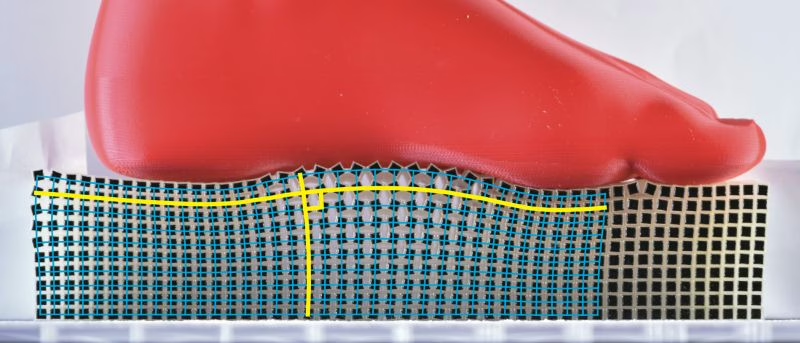
The new results rely on the observation that maximally auxetic metamaterials like the Rotating Squares material deform conformally. Conformal deformation, put simply, means that any angle drawn on the material before and after deformation will look the same. This observation may seem mundane, but for mathematicians the conformal property can be very powerful in studying and describing a material’s behavior. Therefore, the researchers carefully show that the deformations that arise from a set of arbitrary “loadings” on the material, including the foot pictured above, to a high degree of accuracy have the property of conformality.
This insight allows for a variety of theoretical advances in the description of the material. These advances culminated in a recipe to choose any of the conformal deformations of the whole material, and reverse engineer how to cause it by the manipulating boundary springs. These boundary springs are the “strings” the puppeteer may use to influence the puppet, and by variably choosing the spring lengths, the overall shape of the material can be chosen from an infinite variety of possibilities.
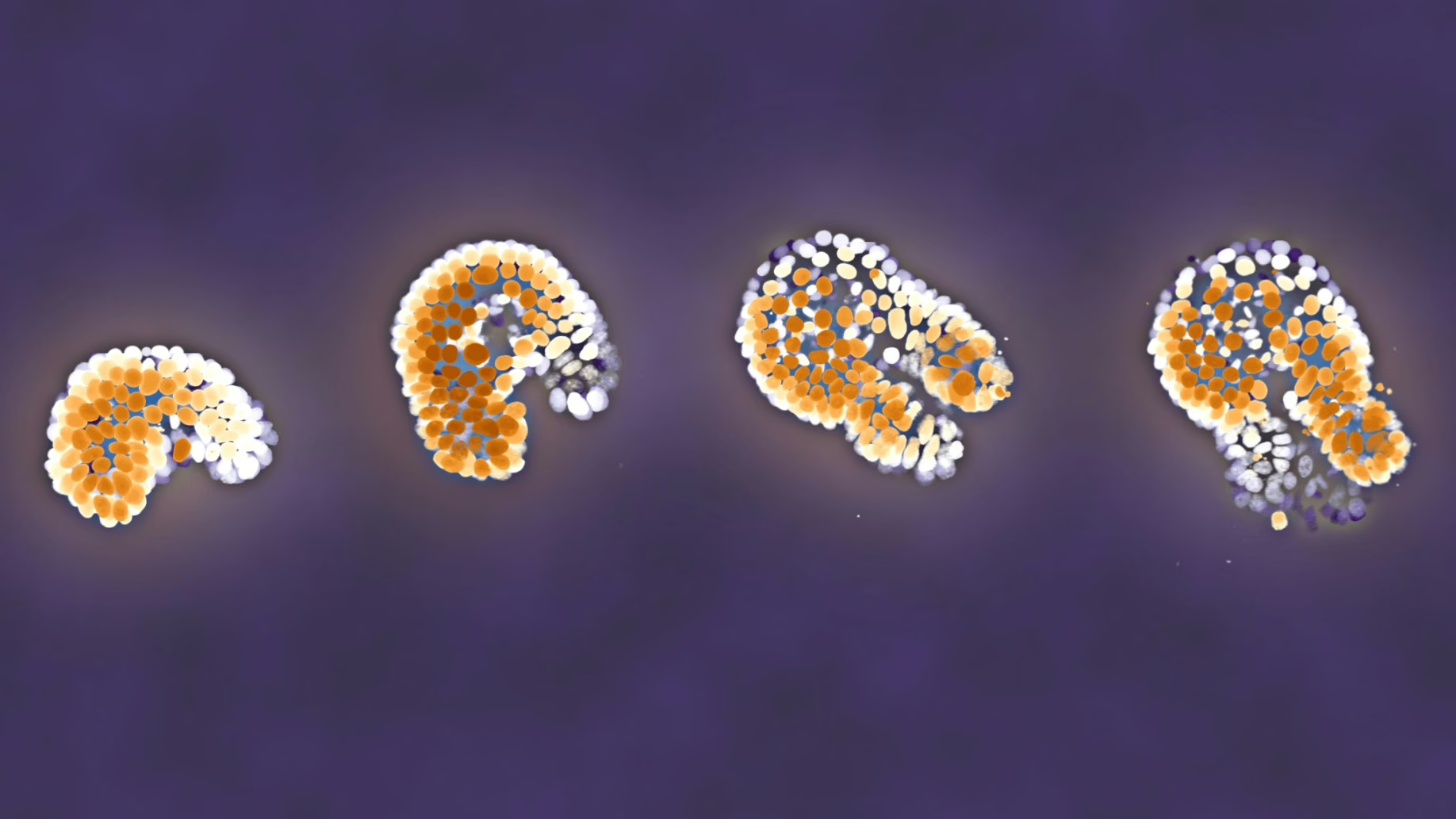
Deformation control is still quite limited by the essential nature of conformal deformations – the only ones allowed – and by the range of motions available to the Rotating Square structure. As a result, the square chunk that the researchers choose to manipulate is not very suggestive of an actual puppet. However, these ideas are expected to apply beyond the Rotating Squares material, to a much wider range of mechanical metamaterials, such as the Kagome example pictured below. As the image shows, these materials can show much more drastic and interesting deformations.

The jump to more life-like ‘puppets’ is likely not far off either, as the realm of metamaterials has steadily become populated with manipulable faces, a variety of new grabbers and hands, even resulting in an elastic worm that can thread a series of needles. Advances like these will become essential in the effort to develop soft microscopic robots that can be externally manipulated, for example to crawl through a body and perform noninvasive surgeries.
Reference
Michael Czajkowski, Corentin Coulais, Martin van Hecke and D. Zeb Rocklin, Conformal elasticity of mechanism-based metamaterials, Nature Communications 13, 211 (2022).
doi.org/10.1038/s41467-021-27825-0