Research highlights

Nanoparticles give solar panels a green color

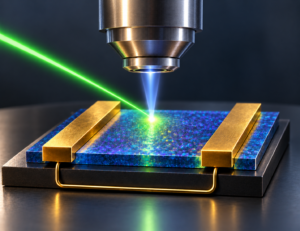
Researchers from AMOLF, the University of Amsterdam (UvA) and the Energy Research Centre of the Netherlands (ECN) have developed a technology to create efficient bright green colored solar panels. Arrays of silicon nanoparticles integrated in the front module glass of a silicon heterojunction solar cell scatter a narrow band of the solar spectrum and create a green appearance for a wide range of angles. The remainder of the solar spectrum is efficiently coupled into the solar cell. The current generated by the solar panel is only  reduced by 10%. The realization of efficient colorful solar panels is an important step for the integration of solar panels into the built environment and landscape. The new design was published online on August 15, 2017, in the journal Applied Physics Letters.

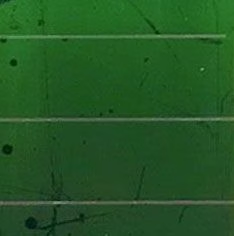
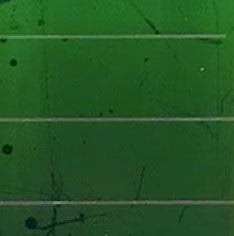
Green silicon solar minimodule (0,7 x 0,7 cm2)

Photovoltaic research has much focused on maximizing the electricity yield obtained from solar panels: nowadays, commercial panels have a maximum conversion efficiency from sunlight into electricity of around 22%. To reach such high efficiency, silicon solar cells have been equipped with a textured surface with an antireflection layer to absorb as much light as possible. This creates a dark blue or black appearance of the solar panels.

Green solar panels
To create the colored solar panels the researchers have used the effect of Mie scattering, the resonant backscattering of light with a particular color by nanoparticles. They integrated dense arrays of silicon nanocylinders with a diameter of 100 nm in the top module cover slide of a high-efficiency silicon heterojunction solar cell. Due to the resonant nature of the light scattering effect, only the green part of the spectrum is reflected; the other colors are fully coupled into the solar cell. The current generated by the mini solar panel (0,7 x 0,7 cm2)  is only reduced by 10%. The solar panel appears green over a broad range of angles up to 75 degrees. The nanoparticles are fabricated using soft-imprint lithography, a technique that can readily be scaled up to large-area fabrication.

Building materials
The light scattering effect due to Mie resonances is easily controllable: by changing the size of the nanoparticles the wavelength of the resonant light scattering can be tuned. Following this principle the researchers are now working to realize solar cells in other colors, and on a combination of different colors to create solar panels with a white appearance. For the large-scale application of solar panels, it is essential that their color can be tailored. In this way, solar panels become building materials that can be used in many different ways: red panels can serve as roof tiles, white ones can serve as walls in buildings. And solar panels placed in nature are ideally green, so they are invisible.
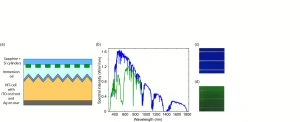
Green solar cell (a) Schematic of green solar cell design (b) AM1.5G solar spectrum (dark blue) and solar spectrum after transmission of the nanoparticle array (green). Because green light is reflected from the nanoparticle array, the transmitted spectrum has a dip at 550-580 nm. Photographs under diffused sunlight (0.5 x 0.5 cm²) of (c) untreated solar cell and (d) green silicon heterojunction solar minimodule

Reference:
Verena Neder, Stefan L. Luxembourg, and Albert Polman, Efficient colored silicon solar modules using integrated resonant dielectric nanoscatterers, Appl. Phys. Lett. 111, in press (2017) DOI:10.1063/1.4986796

Share article
What's happening

Most recent news items

All news items
Joining forces to study perovskite interfaces
People and recognition

Joining forces to study perovskite interfaces

AMOLF group leaders Professor Wiebke Albrecht and Professor Bruno Ehrler have received an NWO ENW-M2 grant for their joint research project, The Dynamic Atomic Interface between Halide Perovskites and Metals. The insights gained will pave the way for sustainable, high-performance solar energy and information technology. Wiebke and Bruno will each hire a PhD student for this project. The grant amounts to €800.000.

Read news item
Wim Noorduin and Arian van Asten presenting their scientific journey
People and recognition

Wim Noorduin and Arian van Asten presenting their scientific journey

On October 8, Professor Wim Noorduin and his collaborator Professor Arian van Asten (University of Amsterdam) presented their scientific journey in a video to the audience at the ‘Avond van Wetenschap en Maatschappij’. They did so alongside the other nominees for the Huibregtsen Prize.

Read news item
Natural phenomena ‘hyperuniform disorder’ enables highly efficient, thin silicon solar cells
Research highlights

Natural phenomena ‘hyperuniform disorder’ enables highly efficient, thin silicon solar cells

Silicon solar panels are rigid and heavy, and many rooftops cannot support them. This creates a need for thin, flexible solar cells that can be integrated into building materials. However, making silicon solar cells thinner makes it harder to trap light inside the material. Researchers in the 3D Photovoltaics group found a fascinating way to overcome this challenge using a phenomenon called hyperuniform disorder. They publish their findings in the journal ACS Photonics.

The researchers were able to make highly efficient silicon solar cell materials that are 30 times thinner than conventional ones. They managed to do this by integrating a layer of nanometer sized structures on top of the material. Up close, this pattern looks random, but it is remarkably when you step back: no clumps, no gaps, and no repeating pattern. This is called hyperuniform disorder (or HUD).

Read news item
Stay informed

Get the latest research highlights, events, and news from our institute delivered to your inbox