People and recognition

Kevin Peters receives prestigious physics thesis prize

Kevin Peters is the winner of the Ehrenfest-Afanassjewa physics thesis prize 2025. He carried out his research in the group of Said Rodriguez at AMOLF and successfully defended his PhD at Utrecht University on September 4. His thesis, entitled A Symphony of Noise in Nonlinear Optical Resonators, describes his research which combines photonics, nonlinear dynamics, statistical physics, and related fields.

The Ehrenfest-Afanassjewa thesis award
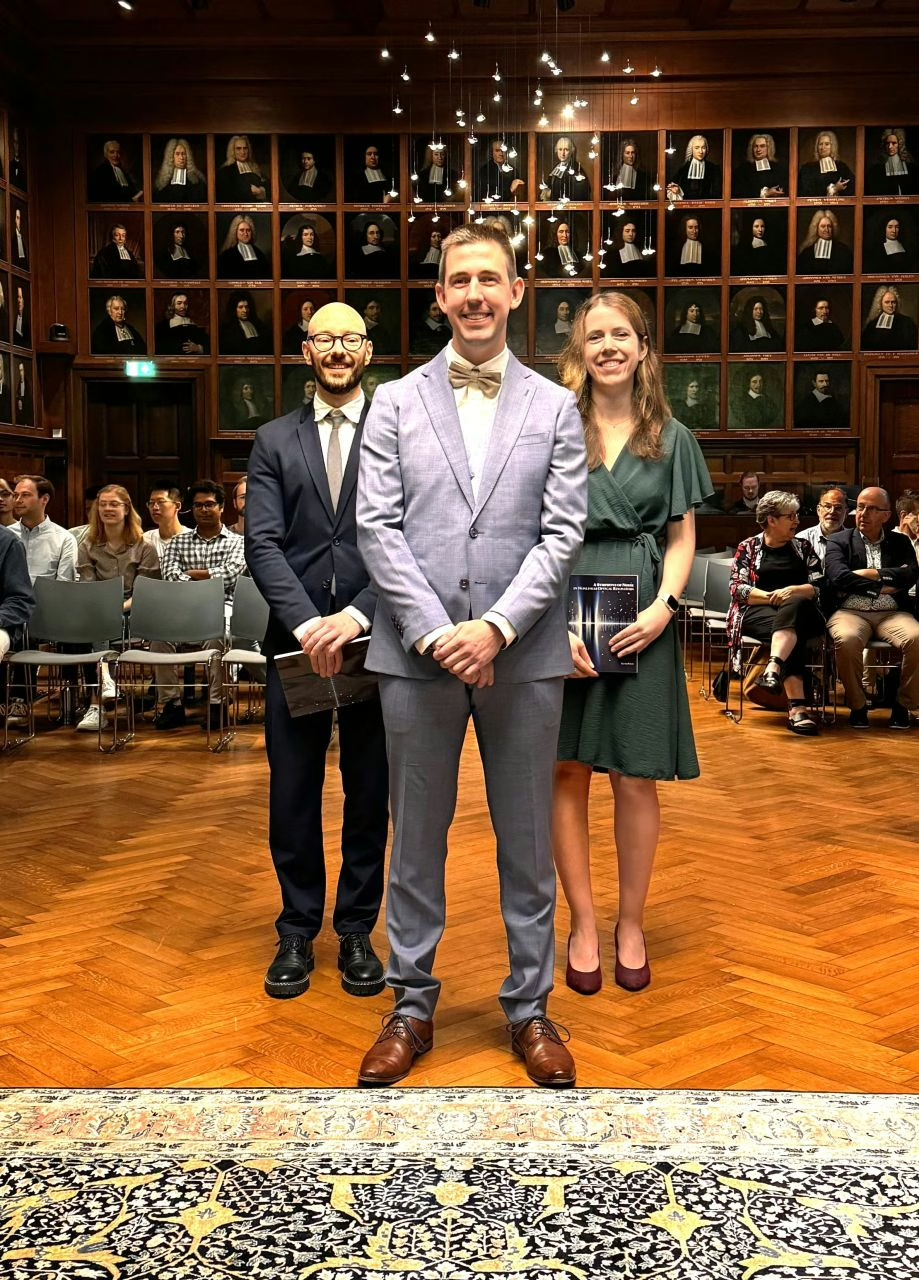
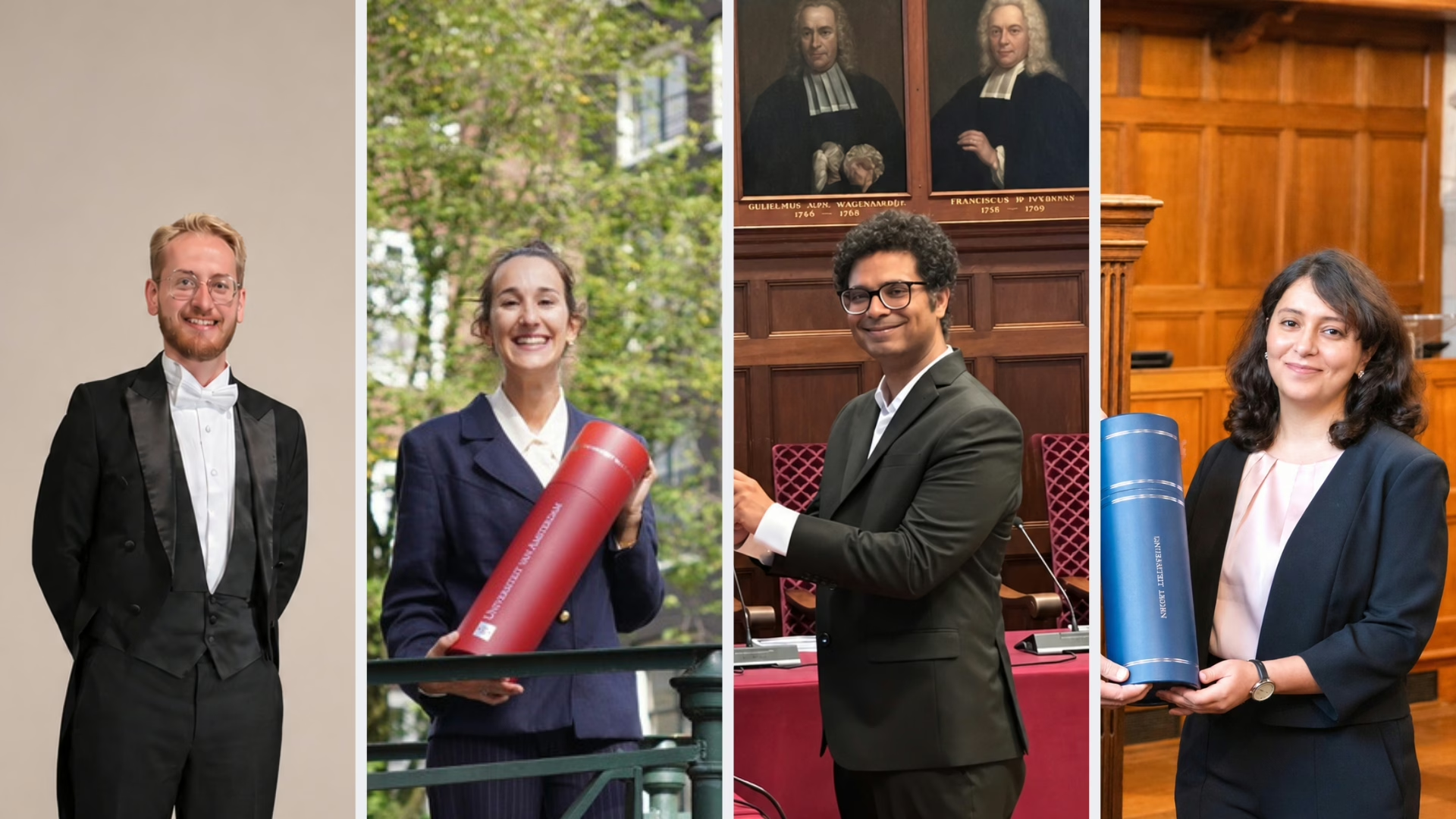
Kevin Peters (center) at PhD ceremony with his paranymphs. Photo source: Kevin Peters

The award is an initiative of the Dutch Physics Council. The award is named after Paul Ehrenfest and Tatiana Afanassjewa because of their exceptional ability to stimulate young researchers to leave the beaten path. Kevin will receive a prize certificate and € 5,000, to be spent freely. The Ehrenfest-Afanassjewa physics thesis award will be awarded during the NWO Physics conference in Veldhoven on 20-21 January 2026.

The jury is very impressed about the combination of experimental work and theory and about the conceptual innovations that Kevin Peters has brought to the research field. The jury recognizes this as exceptional, especially given that he had to build his experimental setup and develop analytical and numerical methods from scratch.

Thesis insights

Multiple new findings and insights are described in Kevin’s thesis. For example, Kevin demonstrated how a wide range of signals can be amplified by adding noise to a system. Kevin first predicted this possibility by solving a novel equation that he derived. In another line of research, Kevin demonstrated an optical sensing strategy that, paradoxically, yields more information by measuring less. In another surprising result, Kevin demonstrated how the precision of a clock can be increased free of energy cost.

Recognition of exceptional research output

Kevin has shown broad vision and came up with original research methods at the crossroads of information theory, nonlinear dynamics, and optics. Many of Kevin’s insights were influenced by his embedding in the Information in Matter department at AMOLF, which motivated him to see his optical systems through the lens of information. Kevin’s numerous results have already reshaped thinking across fields of physics and are truly exceptional. His broad and deep physics knowledge are clearly reflected in his thesis, which consists of a series of relatively short chapters conveying many of his findings.

His thesis also contains a fascinating, extensive (historical) introduction, which is appreciated by the jury. Kevin’s thesis findings have resulted in 13 peer-reviewed publications so far, including 5 in Physical Review Letters.

Learn more

To find out more about research in the Interacting Photons group of Said Rodriguez.
Share article
What's happening

Most recent news items

All news items
Joining forces to study perovskite interfaces
People and recognition

Joining forces to study perovskite interfaces

AMOLF group leaders Professor Wiebke Albrecht and Professor Bruno Ehrler have received an NWO ENW-M2 grant for their joint research project, The Dynamic Atomic Interface between Halide Perovskites and Metals. The insights gained will pave the way for sustainable, high-performance solar energy and information technology. Wiebke and Bruno will each hire a PhD student for this project. The grant amounts to €800.000.

Read news item
Wim Noorduin and Arian van Asten presenting their scientific journey
People and recognition

Wim Noorduin and Arian van Asten presenting their scientific journey

On October 8, Professor Wim Noorduin and his collaborator Professor Arian van Asten (University of Amsterdam) presented their scientific journey in a video to the audience at the ‘Avond van Wetenschap en Maatschappij’. They did so alongside the other nominees for the Huibregtsen Prize.

Read news item
Natural phenomena ‘hyperuniform disorder’ enables highly efficient, thin silicon solar cells
Research highlights

Natural phenomena ‘hyperuniform disorder’ enables highly efficient, thin silicon solar cells

Silicon solar panels are rigid and heavy, and many rooftops cannot support them. This creates a need for thin, flexible solar cells that can be integrated into building materials. However, making silicon solar cells thinner makes it harder to trap light inside the material. Researchers in the 3D Photovoltaics group found a fascinating way to overcome this challenge using a phenomenon called hyperuniform disorder. They publish their findings in the journal ACS Photonics.

The researchers were able to make highly efficient silicon solar cell materials that are 30 times thinner than conventional ones. They managed to do this by integrating a layer of nanometer sized structures on top of the material. Up close, this pattern looks random, but it is remarkably when you step back: no clumps, no gaps, and no repeating pattern. This is called hyperuniform disorder (or HUD).

Read news item
Stay informed

Get the latest research highlights, events, and news from our institute delivered to your inbox