Research highlights

How bacteria cope with randomness

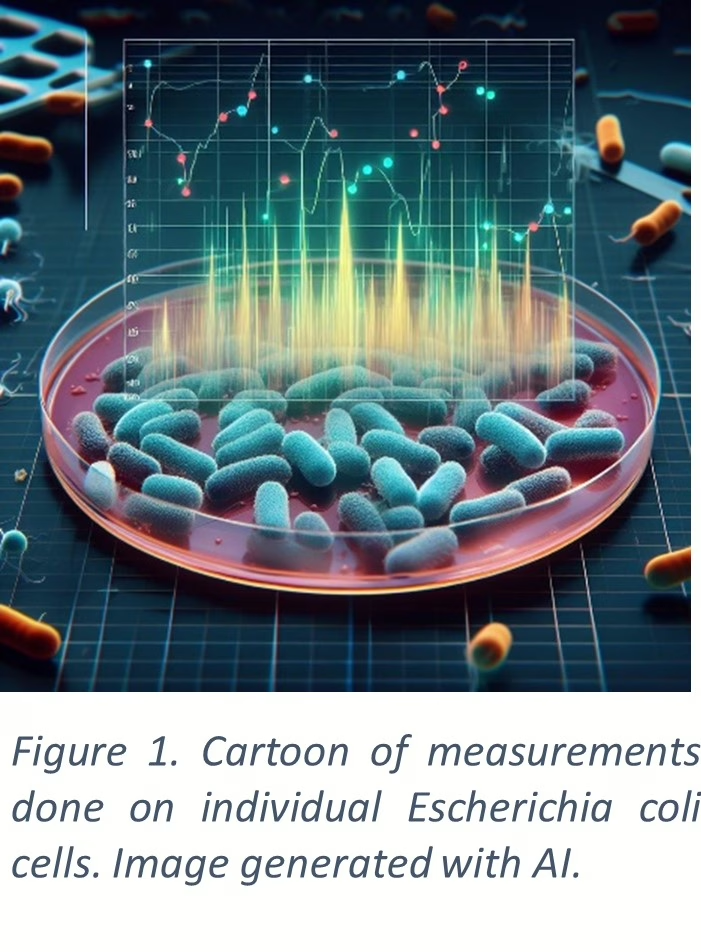
Bacterial behavior is profoundly influenced by continuous random perturbances in their regulatory pathways. Researchers from institute AMOLF and Utrecht University found a new way by which bacteria cope with these perturbances. By performing microscopy measurements on individual bacteria, and mathematical modeling, they found that a regulatory mechanism well-studied for its response to external conditions also has a previously unrecognized role in dealing with metabolic fluctuations. The study yields new insights into cellular homeostasis and regulatory interactions. The results were published in the journal Cell Reports.

Martijn Wehrens, one of the lead researchers in the group of Sander Tans at AMOLF, delves into the complexity of bacterial biochemistry: “Biochemistry is fascinating. Imagine a car in which the number of bolts, nuts, cylinders, speedometer readings, and every component you can imagine is constantly and randomly changing over time! This is what bacteria are faced with. The number of proteins and metabolites inside bacterial cells is constantly fluctuating.” Wehrens goes on to explain that the research team now has a better understanding of why this occurs and how it is meticulously controlled.

By combining experimental observations with genetic engineering and stochastic mathematical models, the work by Martijn Wehrens and his collaborator Laurens Krah from the group of Rutger Hermsen at Utrecht, shows how metabolic regulation not only performs its known role in choosing the appropriate amount of enzymes for a particular environment, but also responds to random fluctuations in internal metabolites. In the research field, it is well-known that these random fluctuations can produce real-world effects. For example, some bacteria swim much faster than others. Or, some individual bacteria reproduce faster than others under the same conditions. These fluctuations occur because fundamental molecular processes inside bacteria are partly based on chance, such that enzymatic and molecular concentrations continuously fluctuate randomly. To thrive in a particular environment, bacteria need to keep these random internal fluctuations in check. The dual function of the bacterial regulation revealed by the team of researchers allows bacteria to tame these fluctuations and keep their range of behaviors in check and more fine-tuned to their environment.
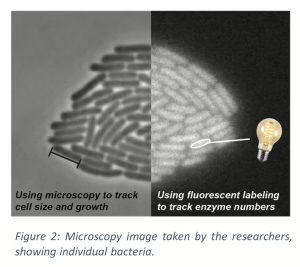
Specifically, the research team studied regulation of metabolism by the regulatory molecules cAMP and CRP as a case study. They used microscopy to track individual bacteria over time to determine the amount of metabolic enzymes, and determine growth rates of individual bacteria. Advanced mathematical modeling done by the team revealed the previously unknown dual role of the cAMP-CRP to adjust both to the environment and internal randomness. This duality might be a property of many other types of regulation in biological cells. The study therefore provides fundamental insights into why biological cells show different behaviors, and how cells curb this diversity.

Reference
M. Wehrens, L.H.J. Krah, B.D. Towbin, R. Hermsen, and S.J. Tans, The interplay between metabolic stochasticity and cAMP-CRP regulation in single E. coli cells, Cell Reports, 42(10), 113284: 1-23, October(2023).
doi.org/10.1016/j.celrep.2023.113284

Share article
What's happening

Most recent news items

All news items
Collaboration

Successful outcomes of international EBEAM program led by AMOLF

The EU Pathfinder project Electron Beams Enhancing Analytical Microscopy (EBEAM) that was recently completed has received a highly positive review of the European Innovation Council (EIC). EBEAM brought together eight European research institutions and companies, including AMOLF, that develop new concepts and instruments combining spectroscopic analysis with electron microscopy.

Read news item
Research highlights

Everything you need to know about organoids

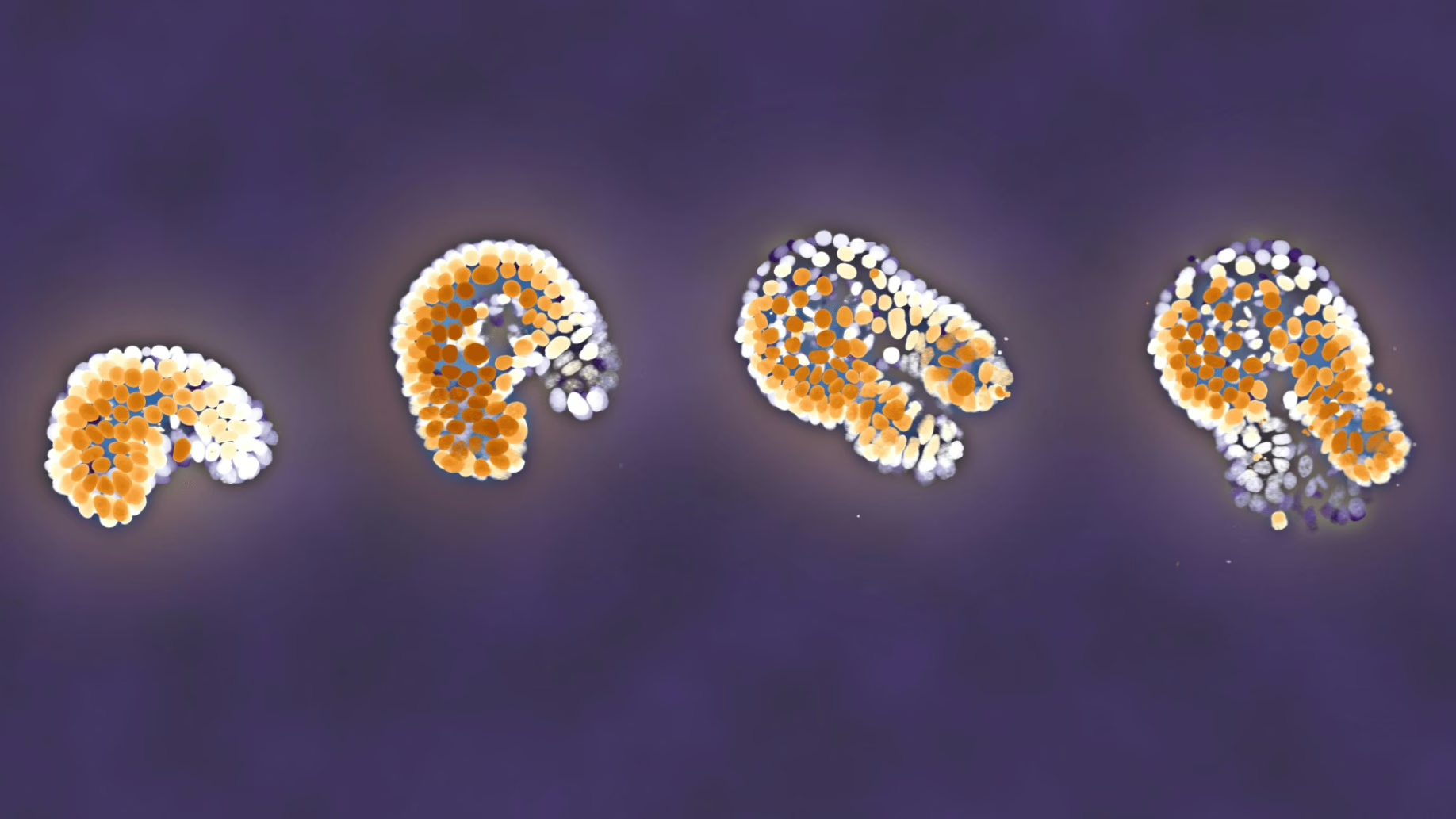
Organoids are instrumental in improving our understanding of processes that are otherwise hidden inside the body. For instance, these small 3D organs can be used to test medicines on tissue grown from a patient’s own cells. AMOLF researchers carry out unique and complex experiments to follow organoids in time. In order to enable other researchers to benefit from their experiences, they now publish their methods in the prestigious journal Nature Protocols.

Read news item
Events and outreach

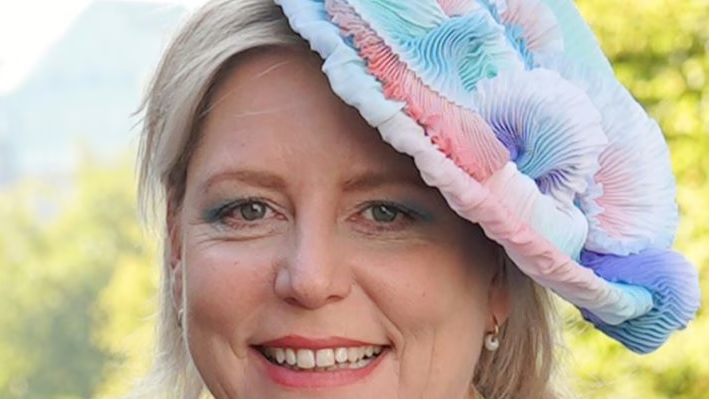
Minister Rianne Letschert wears hat and shoulder ornament inspired by Wim Noorduin’s research

This year at the opening of the parliamentary year (Prinsjesdag) Minister of Education, Culture and Science Rianne Letschert wears a spectacular hat and shoulder ornament. Both of them are inspired by the microscopic structures studied by group leader Wim Noorduin (AMOLF/UvA), which look remarkably like tiny flowers under a microscope. Artist and designer Malou Beemer translated these shapes, normally invisible to the naked eye, into wearable art.

Read news item
Nachi Stern, Group Leader Learning Machines at AMOLF
People and recognition

Nachi Stern awarded ERC Starting Grant to explore how matter learns

Why do brains learn, but rocks do not? Could a material one day adapt to its environment the way a living organism does? AMOLF group leader Dr. Nachi Stern has been awarded an ERC Starting Grant to investigate the physical laws of learning, in a project called, “Physical Learning in Dynamical Systems.”

Read news item
Stay informed

Get the latest research highlights, events, and news from our institute delivered to your inbox