
Research highlights

How an old method helps to understand new solar cells

Together with researchers from the University of Konstanz in Germany, researchers at AMOLF rejuvenated an old technique for measuring mobile ions in a promising new group of solar cell materials known as halide perovskites. The results have been published on April 24th  in the journal Materials Horizons.

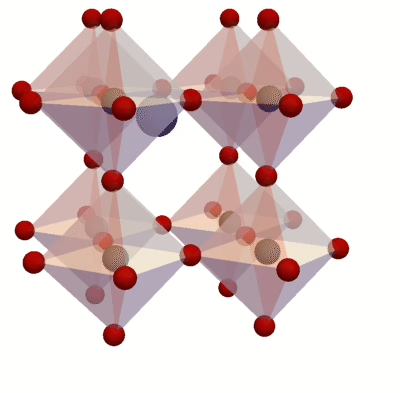
Crystal structure of the halide perovskite material. The prototype perovskite consists of the organic cation methylammonium (moving blue), surrounded by an inorganic framework of lead (black) and iodide (red).

A new class of materials based on salt crystal halide perovskites has been in the spotlight of the solar cell community in recent years. Only a few years after their discovery, solar cells made from these perovskite materials already reach efficiencies close to that of the best silicon solar cells. Unlike silicon solar cells, however, perovskite solar cells are easy to manufacture, for example by printing. They can be printed because they are made from salts, which can form an ink.

The downside is that these salts are ionic materials, which means that  the ions inside the material are able to migrate. Ion migration is an important degradation pathway impeding commercial applications. For the fabrication of stable perovskite devices, it is thus crucial to understand ion migration. So far, however, scientific measurements and theoretical predictions of ion migration vary widely, which does not help to clarify the matter.

To precisely measure the migration of ions in these perovskites, the researchers used a method originally developed more than 25 years ago, which has since received only moderate attention. This so-called transient ion drift method is based on the measurement of the capacitance change caused by the drift of mobile ions after applying an electrical pulse. By measuring the change in capacitance at different temperatures, important physical properties, such as activation energy, diffusion coefficient, and concentration of mobile ions can be measured.

By studying the prototype perovskite (methylammonium lead iodide), the research team showed that this technique is a fast and accurate method to quantify mobile ions in perovskite devices with high precision. In this perovskite material, both organic (methylammonium) and inorganic (iodide) ions are migrating, but on completely different timescales. These measurements help to clarify uncertainties in the literature over how and which ions migrate in these materials and it shows that many theoretical calculations cannot be verified experimentally. The measurements will be important to guide future investigation of ion migration and hence the degradation pathways of these promising new solar cells.

Reference

Moritz H. Futscher, Ju Min Lee, Lucie McGovern, Loreta A. Muscarella, Tianyi Wang, Muhammad Irfan Haider, Azhar Fakharuddin, Lukas Schmidt-Mende and Bruno Ehrler. Quantification of ion migration in CH3NH3PbI3 perovskite solar cells by transient capacitance measurements, Materials Horizons, 2019 DOI: 10.1039/c9mh00445a

Share article
What's happening

Most recent news items

All news items
Collaboration

Successful outcomes of international EBEAM program led by AMOLF

The EU Pathfinder project Electron Beams Enhancing Analytical Microscopy (EBEAM) that was recently completed has received a highly positive review of the European Innovation Council (EIC). EBEAM brought together eight European research institutions and companies, including AMOLF, that develop new concepts and instruments combining spectroscopic analysis with electron microscopy.

Read news item
Research highlights

Everything you need to know about organoids

Organoids are instrumental in improving our understanding of processes that are otherwise hidden inside the body. For instance, these small 3D organs can be used to test medicines on tissue grown from a patient’s own cells. AMOLF researchers carry out unique and complex experiments to follow organoids in time. In order to enable other researchers to benefit from their experiences, they now publish their methods in the prestigious journal Nature Protocols.

Read news item
Events and outreach

Minister Rianne Letschert wears hat and shoulder ornament inspired by Wim Noorduin’s research

This year at the opening of the parliamentary year (Prinsjesdag) Minister of Education, Culture and Science Rianne Letschert wears a spectacular hat and shoulder ornament. Both of them are inspired by the microscopic structures studied by group leader Wim Noorduin (AMOLF/UvA), which look remarkably like tiny flowers under a microscope. Artist and designer Malou Beemer translated these shapes, normally invisible to the naked eye, into wearable art.

Read news item
Nachi Stern, Group Leader Learning Machines at AMOLF
People and recognition

Nachi Stern awarded ERC Starting Grant to explore how matter learns

Why do brains learn, but rocks do not? Could a material one day adapt to its environment the way a living organism does? AMOLF group leader Dr. Nachi Stern has been awarded an ERC Starting Grant to investigate the physical laws of learning, in a project called, “Physical Learning in Dynamical Systems.”

Read news item
Stay informed

Get the latest research highlights, events, and news from our institute delivered to your inbox