Research highlights

Folding reconfigurable materials : Toolkit to design metamaterials with programmable shape and function

During his PhD research at Harvard University, AMOLF group leader Bas Overvelde developed a smart method for designing and investigating new metamaterials. For such materials the microstructure determines the function, rather than the molecular composition. The ideal metamaterial changes shape autonomously to achieve the desired functionality. Overvelde and his American colleagues developed a toolkit to design such metamaterials that can assume different shapes in a manner reminiscent of origami. They published their research on 19 January 2017 in Nature.

In the case of many metamaterials, the unique microstructure is what makes them ideally suitable for one specific task, for example deflecting or conducting light or sound, or damping vibrations. “Our ideal was to design metamaterials that can assume different three-dimensional structures and therefore have adaptable functionality,” says Bas Overvelde, who obtained his doctorate in 2016 under the supervision of professor Katia Bertoldi at the Harvard John A. Paulson School of Engineering and Applied Sciences.

Origami-like
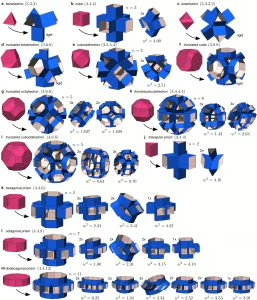
Overvelde and Bertoldi collaborated with designers to develop a strategy to systematically tackle the design of reconfigurable metamaterials. The basic shape in the design is a regular polyhedron, in which square or right-angled surfaces are always placed on the ribs so that a three-dimensional structure arises that is reminiscent of a folded origami shape. Overvelde: “The structure can fold at the edges between two surfaces. The relationship between the stiffness of the surfaces and the folding lines determines the behaviour of the eventual metamaterial and therefore how simply the material can change shape.”

Stiffness
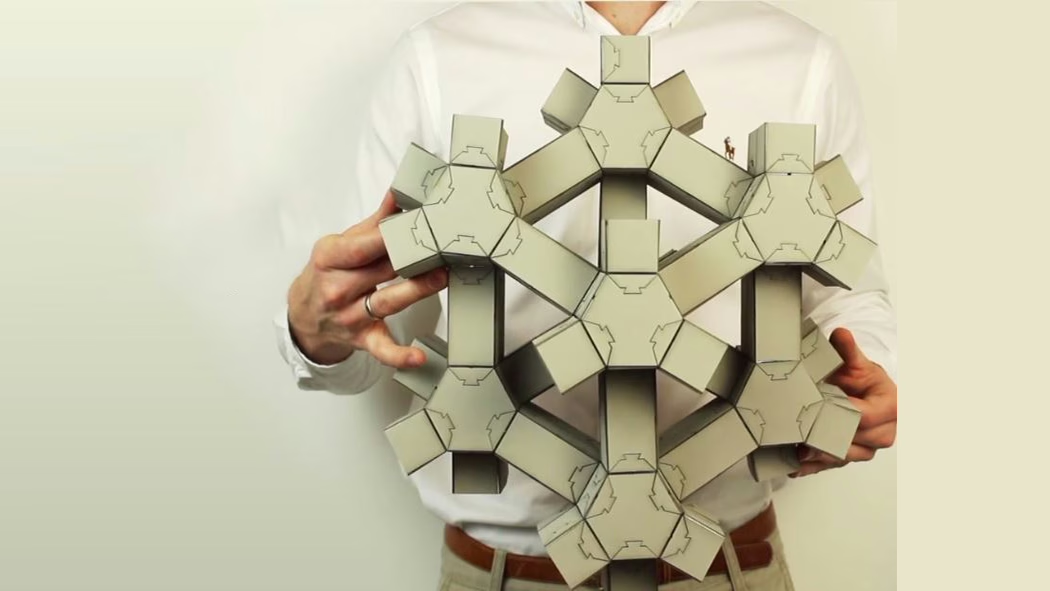
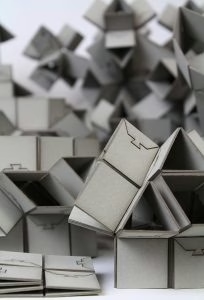
The researchers developed a model in which they used simple mathematical shapes to design a multiplicity of different structures and identify their possible configurations. For some metamaterials obtained using their design strategy, the researchers built 3D structures with surfaces of cardboard and fold lines of double-sided tape. Although these model structures were merely intended to illustrate the concept, they nevertheless clearly showed the impressive ways in which these materials can change shape.
“The strength of our model is that it is completely scalable,” says Overvelde. “It does not matter whether the final material is metres high or on the scale of nanometres. As long as the ratio between the stiffness of the surfaces and the hinges remains constant, the shape – and therefore the functionality – changes in the same manner.”
Scalability also means that these metamaterials have many possible applications: from programmable photonic materials at the nanometre scale to metres-high architectonic constructions. Overvelde: “Specialists can use our toolkit to design metamaterials for their specific discipline.”

Sensors
Following his PhD research Overvelde started the Soft Robotic Matter group at AMOLF, where he is further investigating the shape changes in metamaterials. “By using active elements and sensors the forces that cause a metamaterial to change shape do not have to be applied externally but are realised internally,” he says. “By combining knowledge from robotics and metamaterials we can design materials that respond actively and non-linearly to the environment.”

Reference
Johannes Overvelde, James Weaver, Chuck Hoberman and Katia Bertoldi, Rational design of reconfigurable prismatic architected materials, Nature 541, 347-352, 19 January 2017. DOI:10.1038/nature20824


Video credits: Leah Burrows
 

bas overvelde soft robotic matter nature
Cardboard models of metamaterials
bas overvelde2 soft robotic matter nature
The building blocks for the metamaterials that the model of Overvelde and his colleagues provides are based on regular polyhedrons. The folding lines are less stiff than the surfaces, and as a result these building blocks can assume different shapes.
Share article
What's happening

Most recent news items

All news items
Joining forces to study perovskite interfaces
People and recognition

Joining forces to study perovskite interfaces

AMOLF group leaders Professor Wiebke Albrecht and Professor Bruno Ehrler have received an NWO ENW-M2 grant for their joint research project, The Dynamic Atomic Interface between Halide Perovskites and Metals. The insights gained will pave the way for sustainable, high-performance solar energy and information technology. Wiebke and Bruno will each hire a PhD student for this project. The grant amounts to €800.000.

Read news item
Wim Noorduin and Arian van Asten presenting their scientific journey
People and recognition

Wim Noorduin and Arian van Asten presenting their scientific journey

On October 8, Professor Wim Noorduin and his collaborator Professor Arian van Asten (University of Amsterdam) presented their scientific journey in a video to the audience at the ‘Avond van Wetenschap en Maatschappij’. They did so alongside the other nominees for the Huibregtsen Prize.

Read news item
Natural phenomena ‘hyperuniform disorder’ enables highly efficient, thin silicon solar cells
Research highlights

Natural phenomena ‘hyperuniform disorder’ enables highly efficient, thin silicon solar cells

Silicon solar panels are rigid and heavy, and many rooftops cannot support them. This creates a need for thin, flexible solar cells that can be integrated into building materials. However, making silicon solar cells thinner makes it harder to trap light inside the material. Researchers in the 3D Photovoltaics group found a fascinating way to overcome this challenge using a phenomenon called hyperuniform disorder. They publish their findings in the journal ACS Photonics.

The researchers were able to make highly efficient silicon solar cell materials that are 30 times thinner than conventional ones. They managed to do this by integrating a layer of nanometer sized structures on top of the material. Up close, this pattern looks random, but it is remarkably when you step back: no clumps, no gaps, and no repeating pattern. This is called hyperuniform disorder (or HUD).

Read news item
Stay informed

Get the latest research highlights, events, and news from our institute delivered to your inbox