Research highlights

Exponential scaling of frictional forces in cells

AMOLF researchers present a theory that describes the friction between biological filaments that are crosslinked by proteins. Surprisingly, their theory predicts that the friction force scales highly non-linearly with the number of crosslinkers. The authors believe that cells use this scaling, not only to stabilize cellular structures but also to control their size. The new findings are important for our understanding of the dynamics of cellular structures such as the mitotic spindle, which pulls chromosomes apart during cell division.

Motor proteins versus frictional forces
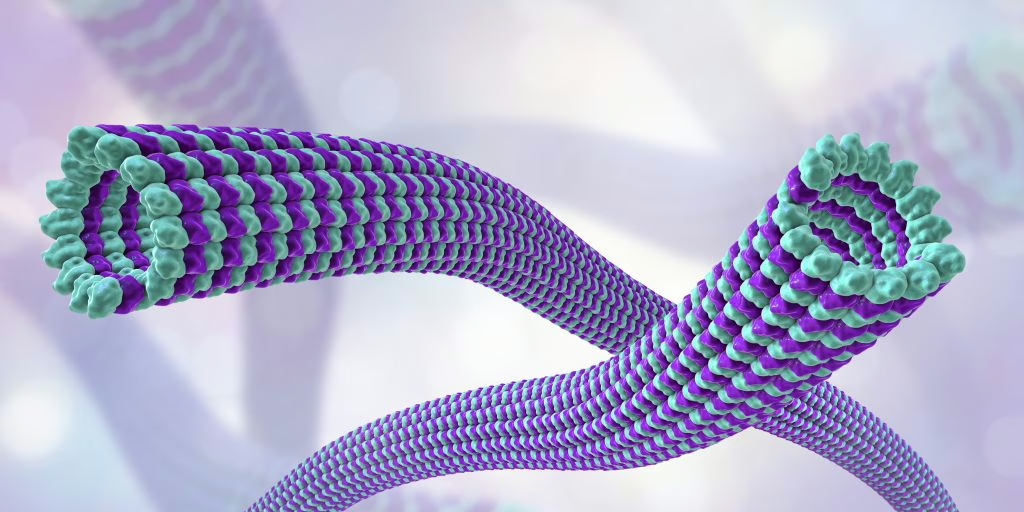
Many cellular structures consist of long filaments that are crosslinked by motor proteins and non-motor proteins (see figure). These so-called cytoskeletal structures not only give cells their mechanical stability, but also enable them to crawl over surfaces and to pull chromosome apart during cell division. Force generation is typically attributed to motor proteins, which, using chemical fuel, can move the filaments with respect to one another. However, these motor forces are opposed by frictional forces that are generated by passive, non-motor proteins. These frictional forces are a central determinant of the mechanical properties of cytoskeletal structures, and they limit the speed and efficiency with which these structures are formed. Moreover, they can even be vital for their stability, because if the motor forces are not opposed by the friction forces generated by the passive crosslinkers, the structures can even fall apart.
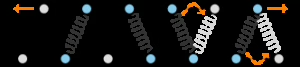
Cytoskeletal structures consist of filaments that are crosslinked by proteins. These filaments consist of a regular lattice of subunits, which yield a discrete set of binding sites for the crosslinkers.

Exponential increase
To understand the dynamics of these cytoskeletal structures and the forces they can generate, it is essential to understand how the frictional forces scale with the length of the filaments and the number of crosslinkers between them. Existing theories predict that friction increases linearly with the number of crosslinkers, which is what one would expect intuitively. However, recent experiments have vividly demonstrated that the friction forces scale non-linearly, i.e. exponentially, with the number of crosslinkers. Due to the covid-19 crisis, we all know what a dramatic difference an exponential versus a linear increase can make. Up until now, the origin of this highly unusual exponential scaling behavior of the friction between filaments was not understood.

Explanation
AMOLF group leader Ten Wolde and PhD student Wierenga have now developed a theory that explains these experimental observations. Their theory is based on the observation that biological filaments consist of a regular lattice of subunits, yielding a discrete set of binding sites for the crosslinkers. Ten Wolde and Wierenga predict that the filaments can only move if the linkers re-organize collectively. As a result of this collective reorganization, the friction forces increase very rapidly, i.e. exponentially, with the number of linkers.

The work of the authors has major implications for our understanding of the dynamics of cytoskeletal structures. In particular, the exponential scaling means that these structures essentially freeze when the crosslinker density exceeds a certain threshold; the frictional forces become so high that they prohibit any further movement. Cells may use this strong scaling to control the size and stability of cellular structures.

Reference
Harmen Wierenga and Pieter Rein ten Wolde, Diffusible crosslinkers cause superexponential friction forces, Physical Review Letters, 125, 078101, August 14 (2020).

Share article
What's happening

Most recent news items

All news items
Collaboration

Successful outcomes of international EBEAM program led by AMOLF

The EU Pathfinder project Electron Beams Enhancing Analytical Microscopy (EBEAM) that was recently completed has received a highly positive review of the European Innovation Council (EIC). EBEAM brought together eight European research institutions and companies, including AMOLF, that develop new concepts and instruments combining spectroscopic analysis with electron microscopy.

Read news item
Research highlights

Everything you need to know about organoids

Organoids are instrumental in improving our understanding of processes that are otherwise hidden inside the body. For instance, these small 3D organs can be used to test medicines on tissue grown from a patient’s own cells. AMOLF researchers carry out unique and complex experiments to follow organoids in time. In order to enable other researchers to benefit from their experiences, they now publish their methods in the prestigious journal Nature Protocols.

Read news item
Events and outreach

Minister Rianne Letschert wears hat and shoulder ornament inspired by Wim Noorduin’s research

This year at the opening of the parliamentary year (Prinsjesdag) Minister of Education, Culture and Science Rianne Letschert wears a spectacular hat and shoulder ornament. Both of them are inspired by the microscopic structures studied by group leader Wim Noorduin (AMOLF/UvA), which look remarkably like tiny flowers under a microscope. Artist and designer Malou Beemer translated these shapes, normally invisible to the naked eye, into wearable art.

Read news item
Nachi Stern, Group Leader Learning Machines at AMOLF
People and recognition

Nachi Stern awarded ERC Starting Grant to explore how matter learns

Why do brains learn, but rocks do not? Could a material one day adapt to its environment the way a living organism does? AMOLF group leader Dr. Nachi Stern has been awarded an ERC Starting Grant to investigate the physical laws of learning, in a project called, “Physical Learning in Dynamical Systems.”

Read news item
Stay informed

Get the latest research highlights, events, and news from our institute delivered to your inbox