People and recognition

Esther Alarcón Lladó appointed professor at the University of Amsterdam

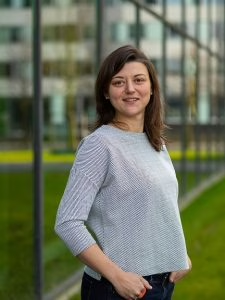
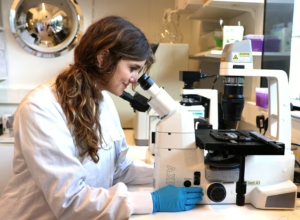
Dr. Esther Alarcón Lladó  has been appointed professor by special appointment in Nano-electrochemistry and Renewable Energy Materials at the Faculty of Science of the University of Amsterdam (UvA). The chair was established on behalf of the Foundation for the Advancement of Atomic and Molecular Physics (‘Stichting tot bevordering van de Atoom- en Molecuulfysica’) with the Van’t Hoff Institute for Molecular Sciences (HIMS) of the UvA.

Picture: Lukas Helmbrecht

In her research Esther Alarcón Lladó focuses on nanoscale phenomena at solid-liquid interfaces, particularly under the effect of electricity. She also studies new materials and new principles for energy conversion aimed at generating renewable energy. Alarcón Lladó will perform fundamental research in the fields of materials science, electrochemistry and energy conversion, keeping application in mind. This includes improving the generation of sustainable electricity using solar radiation. The research will provide the foundation for the development of new materials with higher efficiency and/or broader application possibilities than current generations of solar cells.

Adding to this, Alarcón Lladó will focus on improving the storage of ‘green electricity’ by means of electrolysis. This process utilises electricity to synthesise energy-rich chemical compounds based on water and CO2, effectively storing electrical energy in chemicals such as hydrogen, methane or alcohol. These can then be utilised as fuel or as chemical feedstock. However, current electrolysers contain scarce and expensive elements such as platinum and iridium. Fundamental research is guiding the development of new, alternative electrolyser technology for large-scale use.

Besides continuing being the head of the 3D Photovoltaics group at AMOLF, Alarcón Lladó will teach within the master track Advanced Matter and Energy Physics, a joint degree with the Vrije Universiteit Amsterdam.

About Esther Alarcón Lladó
Alarcón Lladó received her PhD from the University of Barcelona in 2009, after which she joined the Institute of Materials Research and Engineering (IMRE) in Singapore. In 2010, she went to the Lawrence Berkeley National Laboratory (USA) for two years on a Marie Curie Fellowship. In 2012, she returned to Europe at the Ecole Polytechnique Federale de Lausanne (Switzerland), where she was appointed Ambizione Energy Fellow in 2014. In 2016, she came to Amsterdam as group leader 3D Photovoltaics at AMOLF, an institute of the Dutch Research Council NWO focusing on fundamental research on new, strategically important complex molecule and material systems.
Van ’t Hoff Institute for Molecular Sciences

Share article
What's happening

Most recent news items

All news items
Natural phenomena ‘hyperuniform disorder’ enables highly efficient, thin silicon solar cells
Research highlights

Natural phenomena ‘hyperuniform disorder’ enables highly efficient, thin silicon solar cells

Silicon solar panels are rigid and heavy, and many rooftops cannot support them. This creates a need for thin, flexible solar cells that can be integrated into building materials. However, making silicon solar cells thinner makes it harder to trap light inside the material. Researchers in the 3D Photovoltaics group found a fascinating way to overcome this challenge using a phenomenon called hyperuniform disorder. They publish their findings in the journal ACS Photonics.

The researchers were able to make highly efficient silicon solar cell materials that are 30 times thinner than conventional ones. They managed to do this by integrating a layer of nanometer sized structures on top of the material. Up close, this pattern looks random, but it is remarkably when you step back: no clumps, no gaps, and no repeating pattern. This is called hyperuniform disorder (or HUD).

Read news item
Off Road grant for a better understanding of intestinal cells that communicate with the immune system
People and recognition

Off Road grant for a better understanding of intestinal cells that communicate with the immune system

AMOLF postdoc Dr. Susanna Eli received an Off Road grant from ZonMw to investigate cells known as M cells in the gut lining that connect the intestine to the immune system. Understanding how M cells develop could ultimately contribute to better treatments for intestinal and immune-related diseases. The grant amounts to 100,000 euros.

Read news item
Science for all ages at Wetenschapsdag 2026
Events and outreach

Science for all ages at Wetenschapsdag 2026

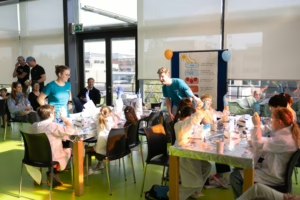
Each year during the national Weekend of Science, AMOLF opens its doors to visitors of all ages to share our enthusiasm for science. AMOLF organizes Wetenschapsdag together with four other research organizations at Amsterdam Science Park: ARCNL, Nikhef, CWI, and University of Amsterdam.

Read news item
About AMOLF

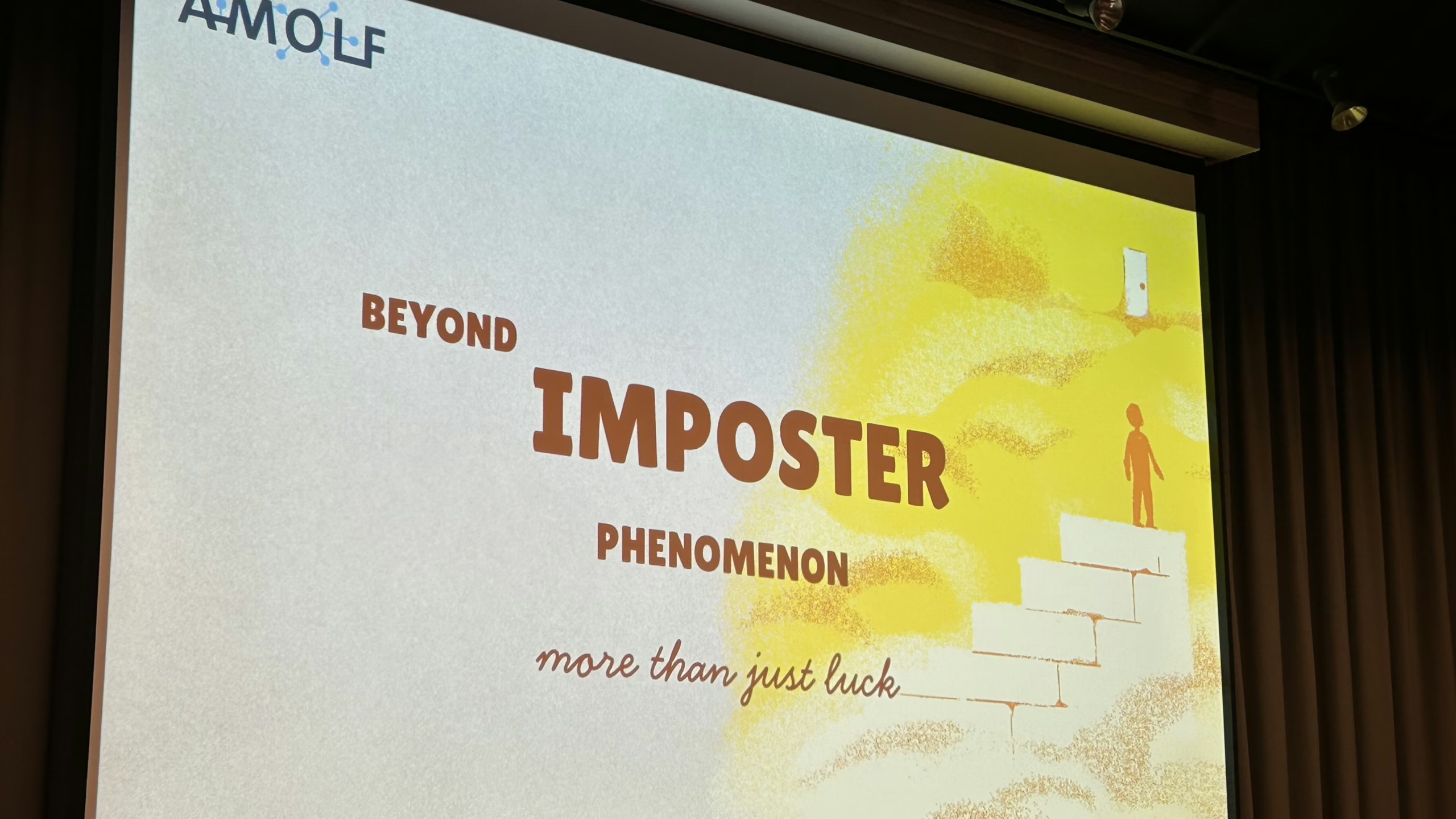
Annual AMOLF Diversity Day focuses on Impostor Phenomenon

Once a year, the AMOLF Inclusion and Diversity team organizes Diversity Day for all AMOLF employees. On October 1, this year’s event took place with the theme Beyond Impostor Phenomenon – More Than Just Luck.

Read news item
Stay informed

Get the latest research highlights, events, and news from our institute delivered to your inbox