People and recognition

ERC Synergy Grant for AMOLF-Heidelberg-ETH team

A prestigious ERC Synergy Grant worth 9.4 million euros has been awarded to the research groups of Sander Tans (AMOLF), Bernd Bukau (Heidelberg University) and Nenad Ban (ETH). The team aims to elucidate a new mechanism to explain how protein complexes are formed – the complex molecules that execute all main biological functions. Sander Tans also holds a professorship at Delft University of Technology.

Sander Tans, photo by Mark Knight

Protein complexes are essential to all cellular processes, yet their formation is also an extremely sensitive process that is prone to failure. Indeed, protein misfolding and aggregation are thought to underpin most non-infectious diseases and ageing. Rapidly accumulating findings now suggest that multiple ribosomes actively work together to orchestrate when and where different proteins come together. The research team expects that this coordinated process enables unprecedented protein production capabilities and indicates a wide spectrum of yet unknown regulatory mechanisms in cells.

To elucidate how protein complexes are produced, the team will combine a range of cutting-edge methods: RNA deep sequencing approaches to map out ribosome interactions throughout the genome, single-molecule methods that provide a direct view on how the ribosomes move along the mRNA and how proteins assemble into complexes. Finally, (tomography) Cryo-EM  to visualize the internal structures of the highly complex multi-ribosome assemblies within cells will be used.

This ambitious program aims to reveal mechanisms that impact a vast spectrum of protein complexes and to uncover unknown layers of control in protein biogenesis. These insights will be useful for diverse applications, such as the design of mRNA vaccines and therapies, and to provide new hypotheses for the causes of various medical conditions.

Share article
What's happening

Most recent news items

All news items
Natural phenomena ‘hyperuniform disorder’ enables highly efficient, thin silicon solar cells
Research highlights

Natural phenomena ‘hyperuniform disorder’ enables highly efficient, thin silicon solar cells

Silicon solar panels are rigid and heavy, and many rooftops cannot support them. This creates a need for thin, flexible solar cells that can be integrated into building materials. However, making silicon solar cells thinner makes it harder to trap light inside the material. Researchers in the 3D Photovoltaics group found a fascinating way to overcome this challenge using a phenomenon called hyperuniform disorder. They publish their findings in the journal ACS Photonics.

The researchers were able to make highly efficient silicon solar cell materials that are 30 times thinner than conventional ones. They managed to do this by integrating a layer of nanometer sized structures on top of the material. Up close, this pattern looks random, but it is remarkably when you step back: no clumps, no gaps, and no repeating pattern. This is called hyperuniform disorder (or HUD).

Read news item
Off Road grant for a better understanding of intestinal cells that communicate with the immune system
People and recognition

Off Road grant for a better understanding of intestinal cells that communicate with the immune system

AMOLF postdoc Dr. Susanna Eli received an Off Road grant from ZonMw to investigate cells known as M cells in the gut lining that connect the intestine to the immune system. Understanding how M cells develop could ultimately contribute to better treatments for intestinal and immune-related diseases. The grant amounts to 100,000 euros.

Read news item
Science for all ages at Wetenschapsdag 2026
Events and outreach

Science for all ages at Wetenschapsdag 2026

Each year during the national Weekend of Science, AMOLF opens its doors to visitors of all ages to share our enthusiasm for science. AMOLF organizes Wetenschapsdag together with four other research organizations at Amsterdam Science Park: ARCNL, Nikhef, CWI, and University of Amsterdam.

Read news item
About AMOLF

Annual AMOLF Diversity Day focuses on Impostor Phenomenon

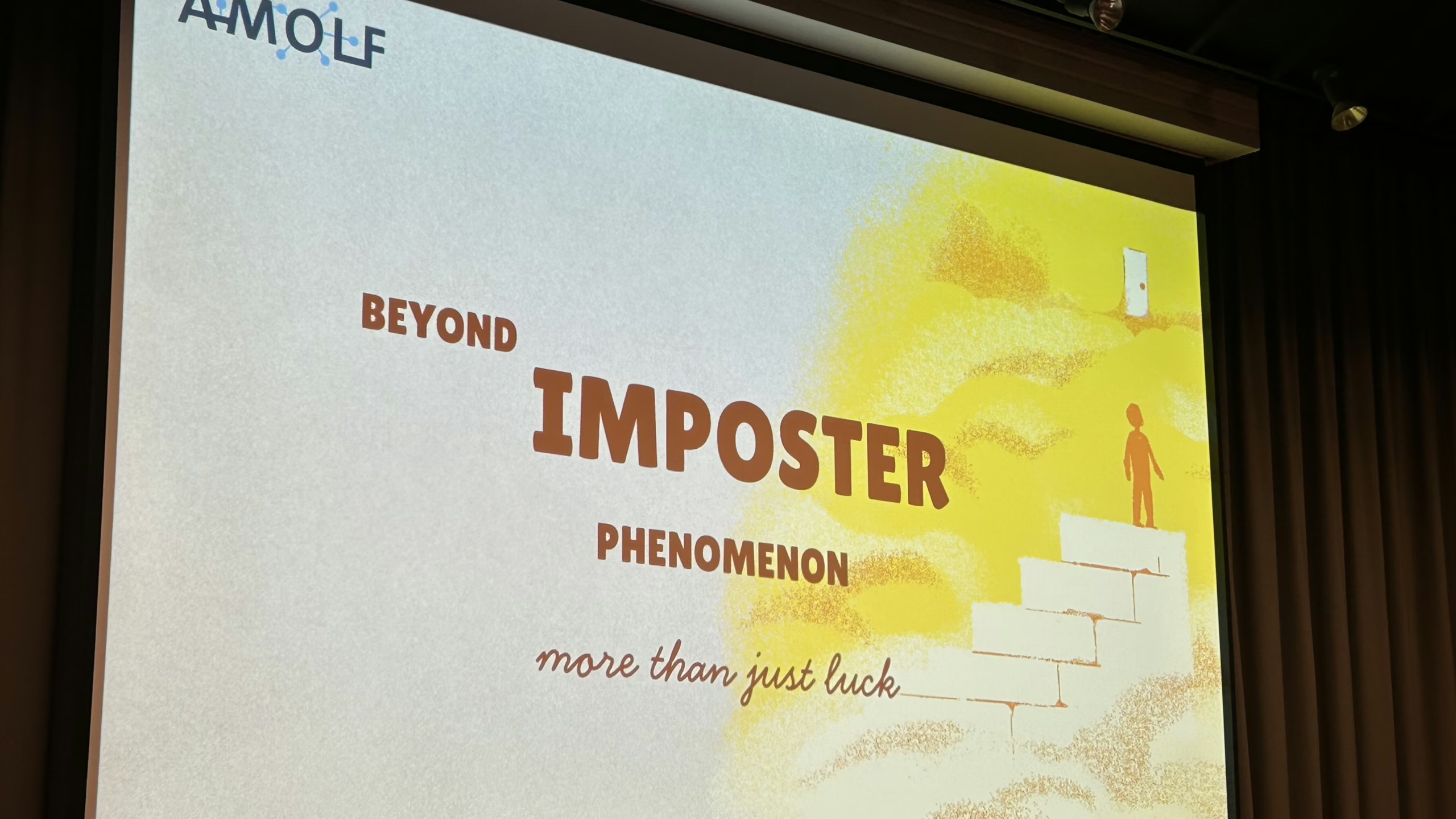
Once a year, the AMOLF Inclusion and Diversity team organizes Diversity Day for all AMOLF employees. On October 1, this year’s event took place with the theme Beyond Impostor Phenomenon – More Than Just Luck.

Read news item
Stay informed

Get the latest research highlights, events, and news from our institute delivered to your inbox