People and recognition

ERC Starting Grant for Marc Serra-Garcia

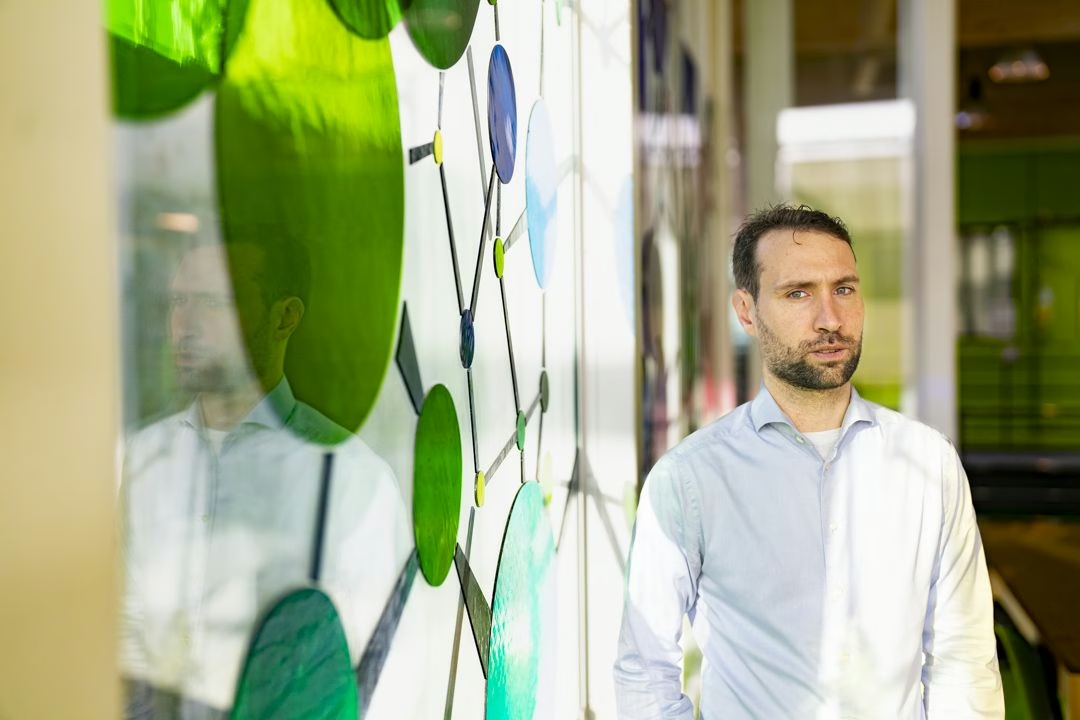
AMOLF tenure-track group leader Marc Serra-Garcia (Hypersmart Matter) has received a Starting Grant of 1.68 million euros from the European Research Council (ERC). With the project INFOPASS he will investigate information processing in passive elastic structures. The ERC uses the Starting Grants to support talented scientists in the early stages of their career in pursuing ground-breaking projects for a duration of five years.

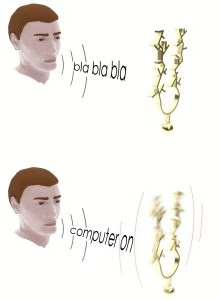
Illustration: Henk-Jan Boluijt

Continuous energy consumption
From a cell phone waiting for a call, to a fitness monitor ready to detect steps, to a smart speaker waiting for a ‘Hey Alexa’ command, our world is full of electronic gadgets ready to chip in when needed. To figure out if they are needed, those devices convert external signals (sound, acceleration, etc.) into electrical currents, and perform complex computations to determine if the key event (incoming call, voice command, etc.) has taken place. Transducing signals and analyzing the resulting constant stream of data consumes energy, which results in bulkier batteries with lower life and has a negative environmental impact. This is a problem we all are familiar with: If we leave our phone in a room for a couple of days, the battery will be dead, just from waiting for calls, commands, etc.

Zero-power event detection
With INFOPASS, Serra-Garcia aims to demonstrate zero-power event detection, focusing specifically on speech recognition. To do so, his team will leverage mechanical resonances. In the same way that a tuning fork responds to signals at one particular frequency but not others, an artificial ‘vibrating brain’ made of many microscopic tuning forks will resonate when excited by a particular word but not others. This type of ‘resonating brain’ is possible because elastic vibrations process information so efficiently that the whole word detection computation can be powered from the energy of sound itself.

Besides its applications in zero-energy information processing and the internet of things, INFOPASS also aims to shed light on the fundamental question on how a large number of ‘dumb’ masses and springs, when connected together, give rise to intelligent responses such as understanding speech.

Read Dutch language interview with Serra-Garcia

Read ERC press release
Share article
What's happening

Most recent news items

All news items
Joining forces to study perovskite interfaces
People and recognition

Joining forces to study perovskite interfaces

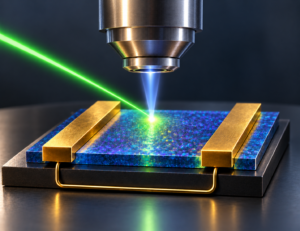
AMOLF group leaders Professor Wiebke Albrecht and Professor Bruno Ehrler have received an NWO ENW-M2 grant for their joint research project, The Dynamic Atomic Interface between Halide Perovskites and Metals. The insights gained will pave the way for sustainable, high-performance solar energy and information technology. Wiebke and Bruno will each hire a PhD student for this project. The grant amounts to €800.000.

Read news item
Wim Noorduin and Arian van Asten presenting their scientific journey
People and recognition

Wim Noorduin and Arian van Asten presenting their scientific journey

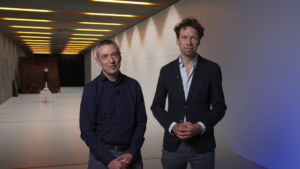
On October 8, Professor Wim Noorduin and his collaborator Professor Arian van Asten (University of Amsterdam) presented their scientific journey in a video to the audience at the ‘Avond van Wetenschap en Maatschappij’. They did so alongside the other nominees for the Huibregtsen Prize.

Read news item
Natural phenomena ‘hyperuniform disorder’ enables highly efficient, thin silicon solar cells
Research highlights

Natural phenomena ‘hyperuniform disorder’ enables highly efficient, thin silicon solar cells

Silicon solar panels are rigid and heavy, and many rooftops cannot support them. This creates a need for thin, flexible solar cells that can be integrated into building materials. However, making silicon solar cells thinner makes it harder to trap light inside the material. Researchers in the 3D Photovoltaics group found a fascinating way to overcome this challenge using a phenomenon called hyperuniform disorder. They publish their findings in the journal ACS Photonics.

The researchers were able to make highly efficient silicon solar cell materials that are 30 times thinner than conventional ones. They managed to do this by integrating a layer of nanometer sized structures on top of the material. Up close, this pattern looks random, but it is remarkably when you step back: no clumps, no gaps, and no repeating pattern. This is called hyperuniform disorder (or HUD).

Read news item
Stay informed

Get the latest research highlights, events, and news from our institute delivered to your inbox