People and recognition

ERC Starting Grant for AMOLF group leader Jeroen van Zon

AMOLF group leader Jeroen van Zon has received a prestigious ERC Starting Grant.

Jeroen van Zon will use his grant to start a research program on the role of stochastic processes in embryonic development. In a growing embryo each cell has to assume exactly the right cell fate in order to result in a healthy adult organism. Surprisingly, in many important cases cells assume their fate in a stochastic manner, picking one fate randomly from a repertoire of multiple possible fates. It has been hypothesized that these stochastic cell fate decisions are driven by small stochastic fluctuations on the molecular level, also called ‘molecular noise’, that are amplified by signaling networks inside the cell. Van Zon’s group will use a quantitative biophysics approach to study stochastic cell fate decisions in the small nematode worm Caenorhabiditis elegans. Using this simple multicellular organism, the researchers will analyze how stochastic cell fate decisions arise from molecular noise and how embryos can use such a fundamentally stochastic process to still generate extremely reliable outcomes.

This is the third ERC Starting Grant assigned to AMOLF this year.
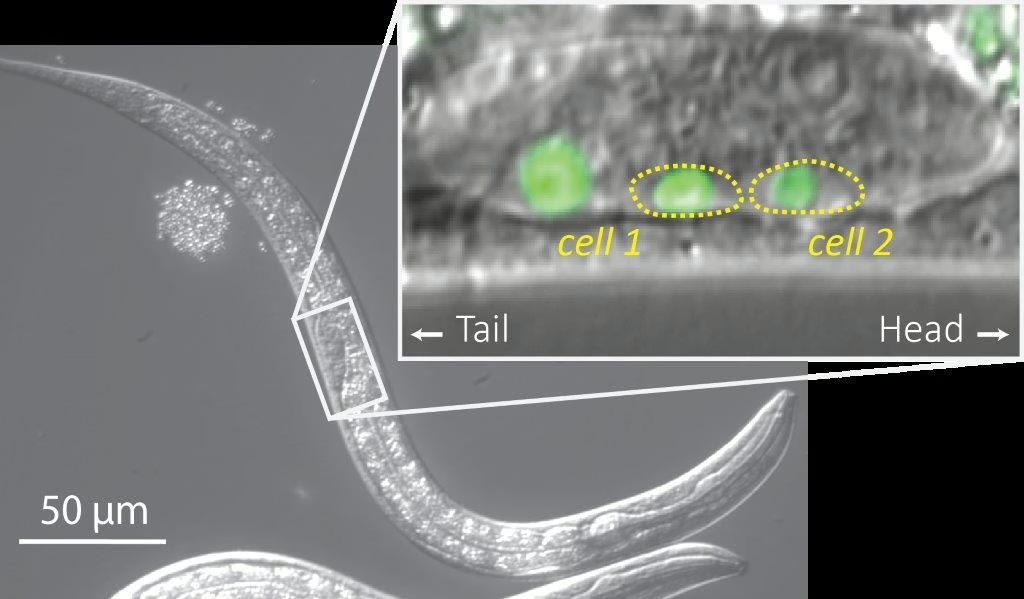
A 15 hour old C. elegans worm. The two cells outlined in yellow are in the process of making a stochastic cell fate decision. Using a fluorescent protein (shown in green) the activity of the signaling network is measured. Ultimately, the signaling activity will be restricted stochastically to one of the two cells. This in turn will lead to a different cell fate for each cell.
Share article
What's happening

Most recent news items

All news items
Joining forces to study perovskite interfaces
People and recognition

Joining forces to study perovskite interfaces

AMOLF group leaders Professor Wiebke Albrecht and Professor Bruno Ehrler have received an NWO ENW-M2 grant for their joint research project, The Dynamic Atomic Interface between Halide Perovskites and Metals. The insights gained will pave the way for sustainable, high-performance solar energy and information technology. Wiebke and Bruno will each hire a PhD student for this project. The grant amounts to €800.000.

Read news item
Wim Noorduin and Arian van Asten presenting their scientific journey
People and recognition

Wim Noorduin and Arian van Asten presenting their scientific journey

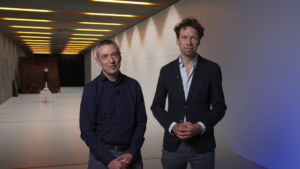
On October 8, Professor Wim Noorduin and his collaborator Professor Arian van Asten (University of Amsterdam) presented their scientific journey in a video to the audience at the ‘Avond van Wetenschap en Maatschappij’. They did so alongside the other nominees for the Huibregtsen Prize.

Read news item
Natural phenomena ‘hyperuniform disorder’ enables highly efficient, thin silicon solar cells
Research highlights

Natural phenomena ‘hyperuniform disorder’ enables highly efficient, thin silicon solar cells

Silicon solar panels are rigid and heavy, and many rooftops cannot support them. This creates a need for thin, flexible solar cells that can be integrated into building materials. However, making silicon solar cells thinner makes it harder to trap light inside the material. Researchers in the 3D Photovoltaics group found a fascinating way to overcome this challenge using a phenomenon called hyperuniform disorder. They publish their findings in the journal ACS Photonics.

The researchers were able to make highly efficient silicon solar cell materials that are 30 times thinner than conventional ones. They managed to do this by integrating a layer of nanometer sized structures on top of the material. Up close, this pattern looks random, but it is remarkably when you step back: no clumps, no gaps, and no repeating pattern. This is called hyperuniform disorder (or HUD).

Read news item
Stay informed

Get the latest research highlights, events, and news from our institute delivered to your inbox