Research highlights

Demonstration of a flat lens for ultraviolet light

AMOLF researchers have created a new optical lens that is flat, rather than curved like a traditional glass lens. The lens operates by the mechanism of negative refraction, that was first predicted by Veselago in 1968 and focuses ultraviolet light to a diffraction-limited spot. It can find applications in ultracompact optical storage devices and ultrasmall microscopy instruments.

Ever since its first prediction by Veselago in 1968, the concept of a flat lens that focuses light by negative refraction has intrigued optical scientists. Such a flat lens has no optical axis, allowing parallel imaging on a large scale, and has a focal distance smaller than an optical wavelength, enabling many new applications in imaging. However, negative refraction does not exist in naturally occurring materials. Hyperbolic metamaterials have been developed that exhibit negative refraction, but are unsuited for the fabrication of a practical flat lens, as their anisotropy leads to strong aberrations, and hence strongly blurred images.

In a new article, published online on June 8th in Optica, the researchers present a new design for a flat lens, inspired by the hyperbolic metamaterial design, in which the dispersion of light was engineered in such a way that the lens emulates the response of an isotropic negative refractive index equal to n=-1, avoiding aberrations. The researchers fabricate the flat lens that operates in the UV at lambda=364 nm using a silver/titanium-dioxide single-periodic thin film multilayer structure. Using confocal microscopy they observe a clear focus positioned only 350 nm away from the flat lens surface, in very good agreement with analytical calculations and numerical simulations. Group leader Albert Polman: “It surprised us that such a simple anisotropic layered structure can have so many isotropic characteristics. Using an extremely simple design we can send light in the opposite direction, clearing the way to multiple innovating applications.”
flat lense ultraviolet light photonic materials albert polman

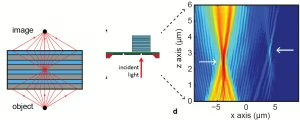
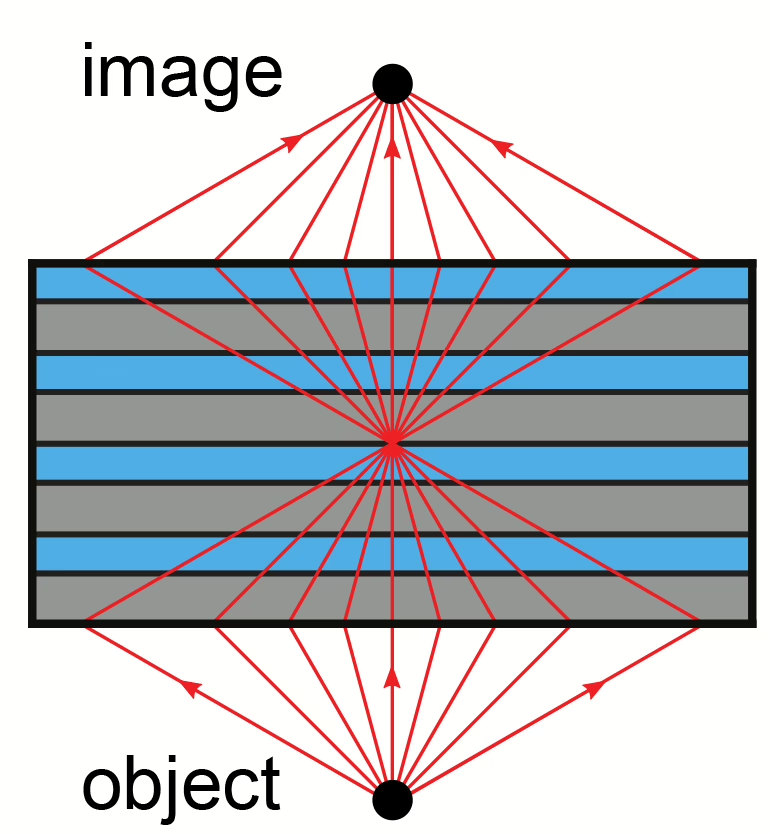
Figure (left) When light enters a structure made of very thin alternating layers of silver and titanium dioxide (blue and gray stripes), negative refraction takes place, allowing the structure to focus light coming from multiple angles and thus act as a lens. Figure (right) Measurement of the light focus above the lens. Light (wavelength 364 nm) is incident from the bottom and forms an image on top of the multilayer, as measured using a confocal microscope.

Reference
Planar metal/dielectric single-periodic multilayer UV flat lens, R. Maas, J. van de Groep, en A. Polman, Optica,3, 6, pp. 592-596 (2016) | DOI: 10.1364/OPTICA.3.000592

 

Share article
What's happening

Most recent news items

All news items
Collaboration

Successful outcomes of international EBEAM program led by AMOLF

The EU Pathfinder project Electron Beams Enhancing Analytical Microscopy (EBEAM) that was recently completed has received a highly positive review of the European Innovation Council (EIC). EBEAM brought together eight European research institutions and companies, including AMOLF, that develop new concepts and instruments combining spectroscopic analysis with electron microscopy.

Read news item
Research highlights

Everything you need to know about organoids

Organoids are instrumental in improving our understanding of processes that are otherwise hidden inside the body. For instance, these small 3D organs can be used to test medicines on tissue grown from a patient’s own cells. AMOLF researchers carry out unique and complex experiments to follow organoids in time. In order to enable other researchers to benefit from their experiences, they now publish their methods in the prestigious journal Nature Protocols.

Read news item
Events and outreach

Minister Rianne Letschert wears hat and shoulder ornament inspired by Wim Noorduin’s research

This year at the opening of the parliamentary year (Prinsjesdag) Minister of Education, Culture and Science Rianne Letschert wears a spectacular hat and shoulder ornament. Both of them are inspired by the microscopic structures studied by group leader Wim Noorduin (AMOLF/UvA), which look remarkably like tiny flowers under a microscope. Artist and designer Malou Beemer translated these shapes, normally invisible to the naked eye, into wearable art.

Read news item
Nachi Stern, Group Leader Learning Machines at AMOLF
People and recognition

Nachi Stern awarded ERC Starting Grant to explore how matter learns

Why do brains learn, but rocks do not? Could a material one day adapt to its environment the way a living organism does? AMOLF group leader Dr. Nachi Stern has been awarded an ERC Starting Grant to investigate the physical laws of learning, in a project called, “Physical Learning in Dynamical Systems.”

Read news item
Stay informed

Get the latest research highlights, events, and news from our institute delivered to your inbox