Research highlights

Computational power of cells

How can molecular systems or cells be used to perform complex computational tasks? And what is the lowest amount of energy needed to execute such operations? Group leader Pieter Rein ten Wolde from AMOLF recently published two articles together with his colleague Thomas Ouldridge of the Imperial College London, in which they provide first clues on how to construct a biochemical system that is able to copy and transfer information in an energy efficient way.

Cells, like bacteria or cells in our bodies, are continuously processing information from their environment. To do so, they make use of biomolecules like proteins and DNA, which engage in chemical reactions. Are these reactions also able to perform computational tasks, comparable to computers? And if so, how efficient can these cellular computers ultimately be? Pieter Rein ten Wolde, group leader of the Biochemical Networks group at AMOLF, together with his colleague Thomas Ouldridge of the Imperial College London, investigated the theoretical framework for such cellular computers.

Copy states
In a first article, published on April 7, 2017, in Physical Review X, they show how a relatively simple molecular process that takes place inside living cells, can copy the state of a protein into another protein. In their theoretical analysis, the researchers focussed on a system that cells commonly employ to transmit external signals from the surface of the cell to their nucleus. Receptor proteins at the surface of the cell bind signalling molecules, for example food molecules. Only when a receptor molecule is bound to such a signalling molecule, a phosphate group is added to a downstream messenger protein that carries the signal into the nucleus. The state of the messenger protein thus reflects the state of the receptor protein, and has become a kind of copy.
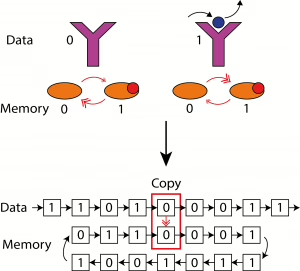
Living cells measure chemical concentrations of signalling molecules via receptor proteins on their surface that bind the signalling molecules. The signal is transmitted into the cell by copying the binding state of the receptor (the data bit; 0: no ligand bound; 1: ligand bound) into the phosphorylation state of a downstream messenger protein (the memory bit; 0: unphosphorylated; 1: phosphorylated). Ouldridge and Ten Wolde have shown that this cellular copy operation can be rigorously mapped onto a computational copy operation, as occurring in our electronic computers.

Design recommendations
The article in Physical Review X shows that this kind of biochemical computational copying is fast and needs little energy. Furthermore, based on theoretical analysis of this system, the article provides a blueprint for building synthetic, energy efficient, copying systems inspired by nature.

Complex copies
In the second article, published on April 11, 2017, in Physical Review Letters, the researchers take the idea one step further. In this article, they consider the production of polymer copies. Such a copy process happens not only during DNA replication, needed for cell division, but also during protein synthesis. In the latter process, information present in one type of polymer – the DNA – is copied into that of another – the protein, much like copying text from one piece of paper onto another.

The better the copy, the higher the costs
From their analysis, the researchers conclude that such a complex copying process is only possible in systems which are continuously fed with new energy. This new insight could explain why until now no one has succeeded in making synthetic systems that persistently produce accurate copies, which is one of the requirements for artificial ‘life’. Finally, Ten Wolde and Ouldridge prove through theoretic modelling that the more accurate copies have to be, the more resources and energy their production requires.

References
Thomas E. Ouldridge,1 Christopher C. Govern, and Pieter Rein ten Wolde, The thermodynamics of computational copying in biochemical systems, Physical Review X 7 (2017)

Thomas E. Ouldridge and Pieter Rein ten Wolde, Fundamental Costs in the Production and Destruction of Persistent Polymer Copies, Physical Review Letters 118, (2017)

Share article
What's happening

Most recent news items

All news items
Collaboration

Successful outcomes of international EBEAM program led by AMOLF

The EU Pathfinder project Electron Beams Enhancing Analytical Microscopy (EBEAM) that was recently completed has received a highly positive review of the European Innovation Council (EIC). EBEAM brought together eight European research institutions and companies, including AMOLF, that develop new concepts and instruments combining spectroscopic analysis with electron microscopy.

Read news item
Research highlights

Everything you need to know about organoids

Organoids are instrumental in improving our understanding of processes that are otherwise hidden inside the body. For instance, these small 3D organs can be used to test medicines on tissue grown from a patient’s own cells. AMOLF researchers carry out unique and complex experiments to follow organoids in time. In order to enable other researchers to benefit from their experiences, they now publish their methods in the prestigious journal Nature Protocols.

Read news item
Events and outreach

Minister Rianne Letschert wears hat and shoulder ornament inspired by Wim Noorduin’s research

This year at the opening of the parliamentary year (Prinsjesdag) Minister of Education, Culture and Science Rianne Letschert wears a spectacular hat and shoulder ornament. Both of them are inspired by the microscopic structures studied by group leader Wim Noorduin (AMOLF/UvA), which look remarkably like tiny flowers under a microscope. Artist and designer Malou Beemer translated these shapes, normally invisible to the naked eye, into wearable art.

Read news item
Nachi Stern, Group Leader Learning Machines at AMOLF
People and recognition

Nachi Stern awarded ERC Starting Grant to explore how matter learns

Why do brains learn, but rocks do not? Could a material one day adapt to its environment the way a living organism does? AMOLF group leader Dr. Nachi Stern has been awarded an ERC Starting Grant to investigate the physical laws of learning, in a project called, “Physical Learning in Dynamical Systems.”

Read news item
Stay informed

Get the latest research highlights, events, and news from our institute delivered to your inbox