Living cells are chemical factories that are in constant use. Cells take up sugars such as glucose, break these down into smaller molecules and use the smaller molecules to construct DNA, proteins, cell membranes and energy molecules that drive the factory. This step-by-step process, called metabolism, enables cells to perform various functions but also to grow and multiply and therefore to create an entire body.
Up until now, scientists have assumed that the cell factory always operated in a regular manner because there are plentiful supplies of sugar and other nutrients and cells consist of so many molecules that the random movements of molecules are negligible. “That was a nice idea, because even if metabolism would be regular and constant it is extremely difficult to understand how the countless reactions influence each other”, says research leader professor Sander Tans. However, his team has discovered that the metabolic activity of cells fluctuates in an unpredictable manner and that makes the functioning of the cell factory even more complex.
Relay race
The researchers came to the conclusion thanks to two smart choices. First they zoomed in on a single reaction in the cell factory at a time, for example a sugar breakdown step. By binding fluorescent proteins to enzymes that facilitate this reaction they could record both the quantity of enzymes and the rate of the reaction. In addition the physicists developed a new, automated microscopic technique to follow the growth rate of individual E. coli cells during their growth and reproduction process.
The researchers discovered that random fluctuations in the enzyme production subsequently resulted in a change in the growth rate of E. coli cells. A change in the quantity of enzymes therefore led to a change in the rate of the breakdown reaction and those fluctuations were transmitted step-by-step to all subsequent reactions, just like a baton in a relay race, so that eventually the cell’s growth became disrupted.
According to Tans, this is the first time that researchers have studied the dynamics and stability of metabolism. The discovery elicits a range of interesting questions. Tans: “Biological growth seems to be far more chaotic than was previously thought. In this light it is similar to economic growth, in which unpredictable fluctuations are commonplace. Do cells actively work to limit the chaos to a certain extent? And if so, how? Why has evolution not managed to completely suppress this chaos, so that all cells can always grow quickly? And finally, do variations in the metabolism play a role in diseases where irregular growth is a characteristic, such as cancer?”
This research was co-financed by the Netherlands Organisation for Scientific Research (NWO).
Reference
Daniel J. Kiviet, Philippe Nghe, Noreen Walker, Sarah Boulineau, Vanda Sunderlikova and Sander J. Tans, Stochasticity of metabolism and growth at the single-cell level Nature (2014) | DOI: 10.1038/nature13582

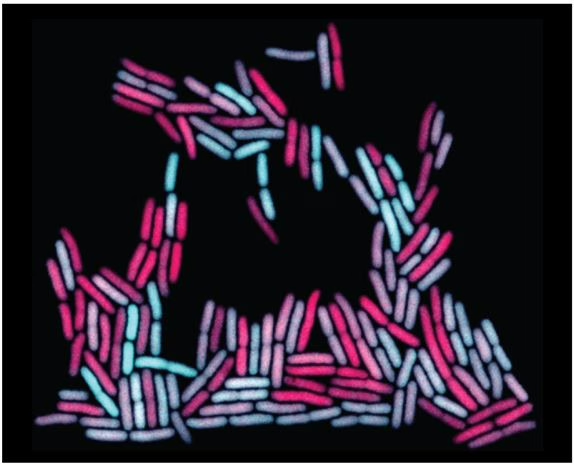
This study has shown that metabolism and growth are inherently destabilised by molecular fluctuations, which is illustrated here. Molecular fluctuations are visualised as variations in color, and growth as variations in cell size (left image). Using genetics and image analysis it was possible to ‘sort’ cells based on their metabolic activity (right image). Random fluctuations in the synthesis of single enzymes were shown to destabilise the entire metabolic machinery of cells and hence their growth. Image credits: Daan Kiviet & Sander Tans.