Research highlights

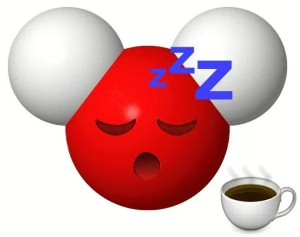
Caffeine makes water fall asleep

Contrary to the well-known stimulating effect on humans, caffeine slows down the movement of water molecules. Researchers from the NWO Institute AMOLF in Amsterdam and the ESPCI in Paris report this in a recent publication in the Journal of Physics Communications.

Illustration: Caffeine makes a water molecule (H2O) fall asleep. Credits: I. Cerjak (AMOLF)

A cup of coffee is known for its boosting effect. That is because it contains caffeine: the most commonly used stimulant in the world. It enjoys enormous popularity in beverages like coffee, tea, soft drinks, and energy drinks. Caffeine stimulates the central nervous system and boosts human performance by speeding up reaction times and by increasing alertness.

Caffeine and Energy Drinks
The human body consists for about 60% of water. These water molecules move very fast and continuously create new mutual bonds. Would they show the same behavior in the presence of caffeine? The Dutch researchers asked themselves this question and performed experiments in the laboratory to find out. They used modern laser techniques to study the movement of water molecules and discovered that the presence of caffeine slows down the movement of water molecules by a factor 5. They observed that one caffeine molecule slows down 10 surrounding water molecules. Hence, in a cup of coffee, one in a thousand water molecules is slowed down.

The researchers also studied the effect of taurine, another frequently-used constituent of energy drinks. They discovered that taurine also puts the brake on water molecules; a single molecule of taurine slows down 4 water molecules. Energy drinks often contain both caffeine and taurine. Their combined effect causes 1 in 2000 water molecules to be slowed down.
However, do not worry in case you have just poured yourself a cup of coffee; to notice the effect of slow water, you need to drink so many cups of coffee that it becomes unrealistic. The consumption of one cup of coffee slows down only one in a million water molecules in the human body.

Reference
Wilbert J. Smit, Eliane P. van Dam, Roberto Cota, and Huib J. Bakker, Caffeine and taurine slow down water molecules, Journal of Physics Communications 3, 2019. DOI: 10.1088/2399-6528/ab07e4

Share article
What's happening

Most recent news items

All news items
Joining forces to study perovskite interfaces
People and recognition

Joining forces to study perovskite interfaces

AMOLF group leaders Professor Wiebke Albrecht and Professor Bruno Ehrler have received an NWO ENW-M2 grant for their joint research project, The Dynamic Atomic Interface between Halide Perovskites and Metals. The insights gained will pave the way for sustainable, high-performance solar energy and information technology. Wiebke and Bruno will each hire a PhD student for this project. The grant amounts to €800.000.

Read news item
Wim Noorduin and Arian van Asten presenting their scientific journey
People and recognition

Wim Noorduin and Arian van Asten presenting their scientific journey

On October 8, Professor Wim Noorduin and his collaborator Professor Arian van Asten (University of Amsterdam) presented their scientific journey in a video to the audience at the ‘Avond van Wetenschap en Maatschappij’. They did so alongside the other nominees for the Huibregtsen Prize.

Read news item
Natural phenomena ‘hyperuniform disorder’ enables highly efficient, thin silicon solar cells
Research highlights

Natural phenomena ‘hyperuniform disorder’ enables highly efficient, thin silicon solar cells

Silicon solar panels are rigid and heavy, and many rooftops cannot support them. This creates a need for thin, flexible solar cells that can be integrated into building materials. However, making silicon solar cells thinner makes it harder to trap light inside the material. Researchers in the 3D Photovoltaics group found a fascinating way to overcome this challenge using a phenomenon called hyperuniform disorder. They publish their findings in the journal ACS Photonics.

The researchers were able to make highly efficient silicon solar cell materials that are 30 times thinner than conventional ones. They managed to do this by integrating a layer of nanometer sized structures on top of the material. Up close, this pattern looks random, but it is remarkably when you step back: no clumps, no gaps, and no repeating pattern. This is called hyperuniform disorder (or HUD).

Read news item
Stay informed

Get the latest research highlights, events, and news from our institute delivered to your inbox