Research highlights

Building with flexible blocks

On an apparently normal cube a pattern of hollows and bulges appears when the cube is compressed. Physicists from FOM Institute AMOLF and Leiden University together with colleagues from Tel Aviv University have developed a method to design such three-dimensional structures and to construct these using simple building blocks. This paves the way for the use of ‘machine materials’ in, for example, prostheses and wearable technology. The researchers published their findings on 28 July in an article in Nature.

Normally, atoms and molecules determine the properties of the materials they form. However that is different for ‘metamaterials’ designed by humans. “In the case of metamaterials, the spatial structure determines the material’s behavior,” explains AMOLF group leader professor Martin van Hecke. “For example, a pattern of holes in a sheet of material gives rise to a mechanical response that is completely different than in the same material without holes. We also wanted to investigate this phenomenon for a three-dimensional pattern of holes.”

3D puzzle
Van Hecke and his colleagues designed a cube-shaped, flexible building block with a hole in it. If pressure is applied to such a block then some of the sides cave in, whereas others bulge out. By stacking several of these building blocks researchers could make three-dimensional structures. Van Hecke: “The orientation of the blocks in the metamaterial is important. Under pressure, all of the hollow and bulging sides must fit exactly together. Most of the stacks are ‘frustrated’: somewhere within two hollows or bulges meet. However a large number of fitting solutions for this three-dimensional puzzle were found.”

Patterns
Van Hecke’s colleagues at Tel Aviv University calculated the number of possible, non-frustrated stacks for different cubes of building blocks. “For one cube of 14x14x14 building blocks that is a number with no less than 65 figures,” says Van Hecke. “For each possible stack the deformation within the cube results in a specific pattern on the sides of the cube. By smartly combining the building blocks we can program the material such that every desired pattern appears on the sides of a compressed cube. Surprisingly such a cube can also be used to analyse patterns. If we press it against a pattern of hollows and bulges then we measure a force that is dependent on the pattern.”

Machine materials
Although Van Hecke’s research is fundamental in nature there are applications on the horizon. “This type of programmable ‘machine materials’ could be ideal for prostheses or wearable technology in which a close fit with the body is important,” says Van Hecke. “If we can make the building blocks more complex or produce these from other materials then the possibilities really are endless.”

Reference
Corentin Coulais, Eial Teomy, Koen de Reus, Yair Shokef and Martin van Hecke
Combinatorial Design of Textured Mechanical Metamaterials
Nature 535, 529-532 (2016), DOI:10.1038/nature18960
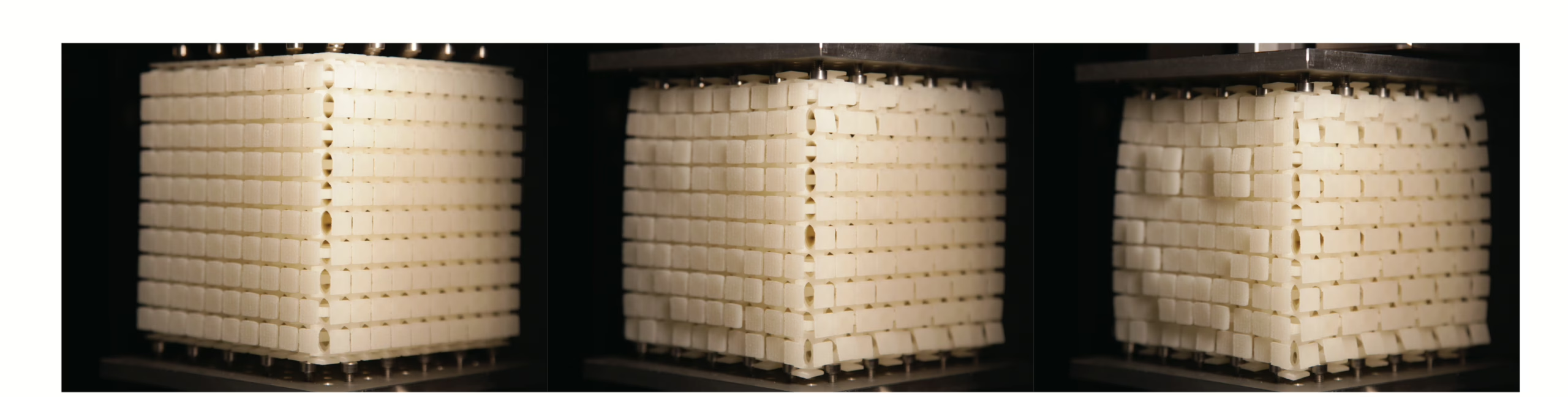
Photo: To demonstrate that any pattern can be produced on a cube’s surface, the researchers developed a cube of 10x10x10 blocks on which a smiley appears when the cube is compressed. credits photo: Corentin Coulais


credits video: Fast Facts

Share article
What's happening

Most recent news items

All news items
Collaboration

Successful outcomes of international EBEAM program led by AMOLF

The EU Pathfinder project Electron Beams Enhancing Analytical Microscopy (EBEAM) that was recently completed has received a highly positive review of the European Innovation Council (EIC). EBEAM brought together eight European research institutions and companies, including AMOLF, that develop new concepts and instruments combining spectroscopic analysis with electron microscopy.

Read news item
Research highlights

Everything you need to know about organoids

Organoids are instrumental in improving our understanding of processes that are otherwise hidden inside the body. For instance, these small 3D organs can be used to test medicines on tissue grown from a patient’s own cells. AMOLF researchers carry out unique and complex experiments to follow organoids in time. In order to enable other researchers to benefit from their experiences, they now publish their methods in the prestigious journal Nature Protocols.

Read news item
Events and outreach

Minister Rianne Letschert wears hat and shoulder ornament inspired by Wim Noorduin’s research

This year at the opening of the parliamentary year (Prinsjesdag) Minister of Education, Culture and Science Rianne Letschert wears a spectacular hat and shoulder ornament. Both of them are inspired by the microscopic structures studied by group leader Wim Noorduin (AMOLF/UvA), which look remarkably like tiny flowers under a microscope. Artist and designer Malou Beemer translated these shapes, normally invisible to the naked eye, into wearable art.

Read news item
Nachi Stern, Group Leader Learning Machines at AMOLF
People and recognition

Nachi Stern awarded ERC Starting Grant to explore how matter learns

Why do brains learn, but rocks do not? Could a material one day adapt to its environment the way a living organism does? AMOLF group leader Dr. Nachi Stern has been awarded an ERC Starting Grant to investigate the physical laws of learning, in a project called, “Physical Learning in Dynamical Systems.”

Read news item
Stay informed

Get the latest research highlights, events, and news from our institute delivered to your inbox